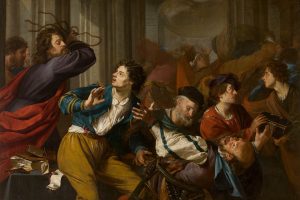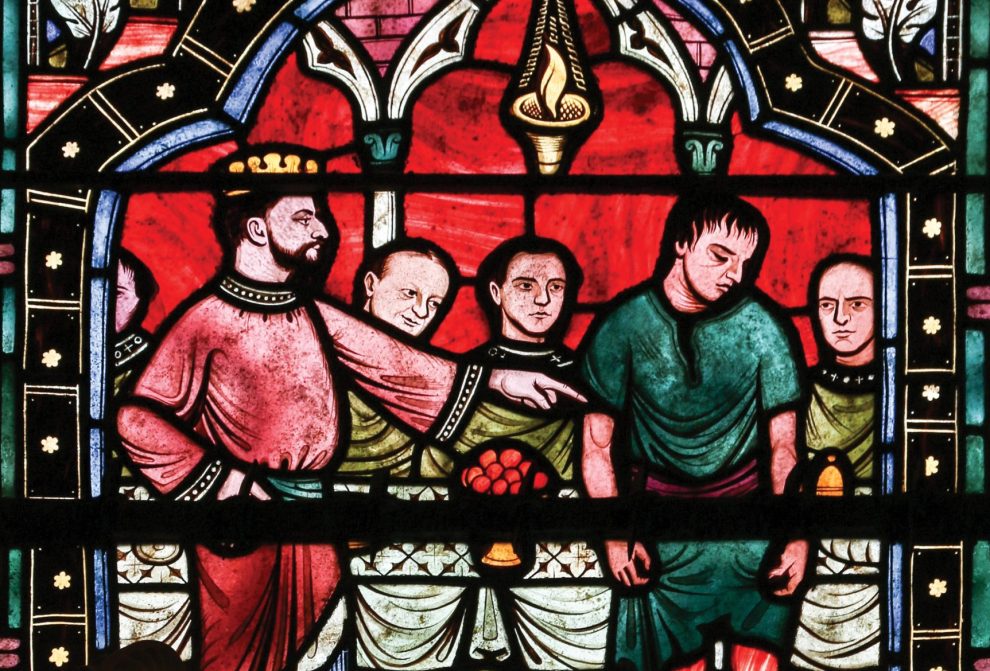
Then the king said to the attendants, “Bind him hand and foot, and throw him into the outer darkness, where there will be weeping and gnashing of teeth.”
(Matthew 22:13)
My favorite thing about weddings is the community. People who’ve known the couple since childhood sit beside friends they recently met. Family members who rarely agree share a meal and, for one evening at least, celebrate something beyond themselves. The best weddings aren’t about the expensive venue or the good food, but the people. It feels a little bit like the kingdom of God—loved ones from every corner of life all together.
I think this is part of what makes the parable of the wedding feast in Matthew’s gospel so jarring. A king gives a wedding banquet for his son, but there are no loved ones to be found, and the couple themselves barely feature in the story. We don’t know why the family isn’t there. What we know is that instead of love, community, and family, the parable talks about murder, destruction, and exile.
Some of the first guests the king’s servants invite to fill empty seats refuse to come; others seize and kill the servants. The king responds by sending troops to destroy those invitees and burn their city. Then he sends more servants into the streets to invite whoever they find. The wedding hall is filled with guests, “both good and bad” (Matt. 22:10).
When the king enters the room, he notices a man who isn’t dressed appropriately. He asks the man why he’s not wearing a wedding robe. When the man doesn’t answer, the king tells his attendants, “Bind him hand and foot, and throw him into the outer darkness, where there will be weeping and gnashing of teeth. For many are called, but few are chosen” (22:13–14).
In the typical interpretation of this parable, the story is used to argue that we are all called to God’s table, but those who come unprepared or with hearts unready to be transformed will not be permitted to join the feast. But feminist, womanist, and liberationist scholars have long encouraged us to pay attention to the way our interpretations reflect cultural assumptions about power, authority, and belonging. In this case, those assumptions about who has power connect God with the king. But that makes God a despot who kills people who displease him or accidentally commit a crime as minor as not dressing up for a wedding they didn’t know they were invited to until it was already happening.
This interpretation doesn’t match the Jesus I’ve met elsewhere in the Gospel of Matthew. How could the Jesus who blesses the poor, tells us to love our enemies, and commands us to clothe the naked suddenly ask us to imagine God as a monarch who murders people and casts someone into darkness for not being properly dressed? After all, this is the gospel where we read about King Herod’s murder of infants in his frenzied search for baby Jesus, and where Jesus says it is easier for a camel to go through the eye of a needle than for a rich man to go to heaven, and that those who inherit the kingdom are those who feed the hungry and clothe the naked. The gospel writer doesn’t exactly seem pro-king.
What if the king isn’t God, but just a human king abusing his power? In her book, “While the Bridegroom is with them” (Bloomsbury), scripture scholar Marianne Blickenstaff writes: “If the ‘king’ is read as any human tyrant, then the Kingdom of Heaven itself is not violent but exists in a violent place in the here and now, before it is fulfilled.”
Imagine, in that case, being the underdressed wedding guest. You are pulled from the street and brought into the palace of a king who has just completed a vengeful streak of murder and destruction. It probably felt dangerous to decline. The table is full, the wine is poured, everything is beautiful—it is tempting to partake. How often do you get to wear your finest clothes and attend a royal feast? And yet, something feels wrong.
The king’s invitation might seem generous, but it is a twisted version of hospitality. The king has opened the doors of his palace, but he has not opened his heart to the people. They are guests only insofar as they participate in his celebration, affirm his power, and follow his rules.
In her book Just Hospitality (Westminster John Knox), theologian Letty Russell describes hospitality as the “practice of God’s welcome embodied in our actions as we reach across difference to participate with God in bringing justice and healing to our world in crisis.” True hospitality is not simply allowing someone into our space. It changes the relationship between host and guest. It is a mutual exchange where the boundaries between center and margin—between royalty and subjects, perhaps—begin to blur.
The king’s banquet does the opposite. He invites outsiders in, but he does not relinquish power. He decides who comes, what they wear, and how they participate. The guests are not welcomed but are part of his show. Maybe the man doesn’t wear the wrong clothes because he’s unaware of the dress code or unprepared to be in the king’s presence, but because he refuses to accept state violence.
Matthew’s gospel is full of people who quietly resist state power. The magi go home by another way and don’t tell Herod where to find Jesus. Jesus enters Jerusalem on a donkey, not on a war horse. When Satan offers worldly power, Jesus outright refuses it. What if this man’s garments are another example of this same resistance?
“The Matthean parables elsewhere depict the Kingdom of Heaven as something small but with great potential to take over, like a mustard seed and leaven in bread,” Blickenstaff writes. “Just so, the seemingly powerless and insignificant garmentless guest and the apparently defeated city are things that have started inauspiciously but which will eventually take over. . . . the parable’s conclusion that ‘many are called, but few are chosen’ no longer means that those who stay at the banquet are the ones chosen; rather, it is those who resist the king who are the chosen of the Kingdom of Heaven.”
In this reading of the parable, the takeaway isn’t about arriving at God’s banquet adequately prepared and dressed. It’s about whether we have mistaken empire for God’s table.
The world is constantly inviting us to participate in the king’s wedding feast: To accept systems that depend on someone else’s suffering, to consume more without considering the effects of our consumption, to confuse physical wealth or comfort with God’s blessing. The man willing to be thrown into the outer darkness rather than participate in empire’s sham is a reminder that following Christ sometimes means rejecting what society tells us to do. Our allegiance is to God’s reign, not to the king’s.
As Russell says, when the distinctions between margin and center begin to blur, we can see signs of God’s new creation breaking in. That is what a true wedding feast would look like—a table where all are welcomed and where equal and reciprocal relationships can form—not a celebration of power. Until that feast is fully revealed, we are called to practice the hospitality of God, not to put on a costume in order to participate in empire’s pageant.
This article also appears in the October 2026 issue of U.S. Catholic (Vol. 91, No. 10, pages 46-48). Click here to subscribe to the magazine.
Image: Flickr.com/ Fr. Lawrence Lew, O.P.