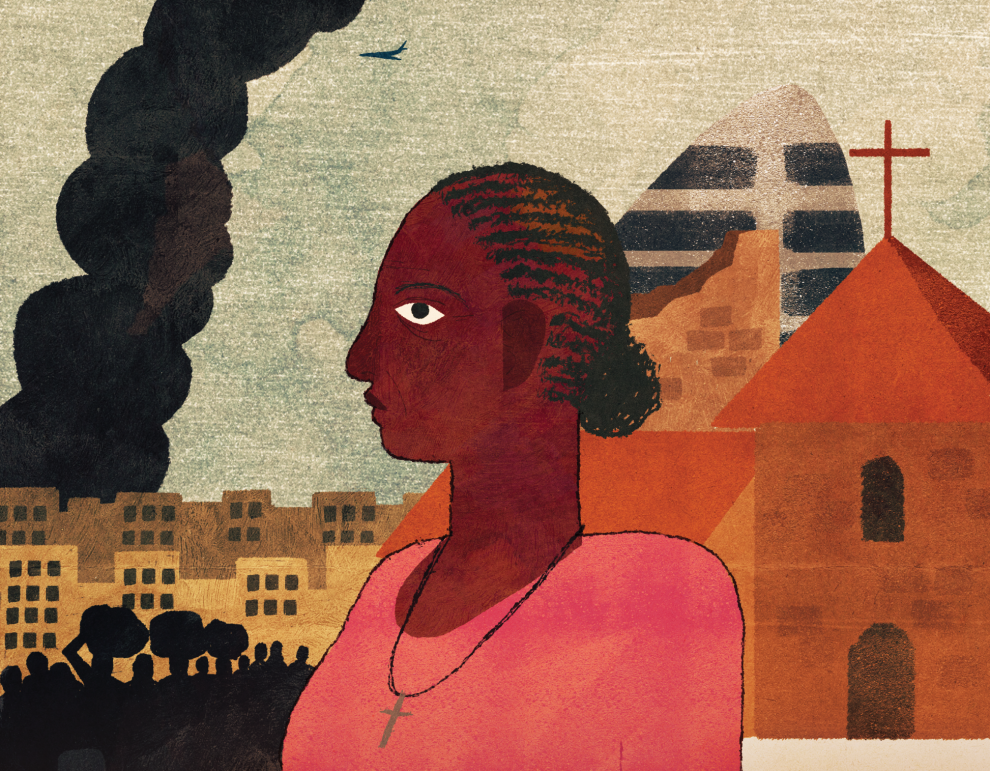
On April 15, 2023, Suzan Kuku was having breakfast at home in Omdurman, Khartoum, when news broke of a war between the paramilitary Rapid Support Forces (RSF) and the Sudanese Armed Forces (SAF), Sudan’s official national military. She thought it was a typical battle between two groups. After finishing her breakfast, she went to help her neighbor with her wedding preparations.
“We lived in Khartoum through the revolution,” she says, so they were familiar with how these groups usually deal with conflict among themselves. This time, the RSF took control of the city. Within four days, drones flew past her bedroom window. Grenades exploded in her neighborhood. The two groups used a weapon she had not seen before. “It was a very unique gun,” Kuku says. “Every time they used it, the sound made my door and our house structure shake.”
As days passed, she became numb and unable to cry. “I was just shivering and started having panic attacks,” she says. “I could not control my body anymore.” Kuku never imagined that war would come to Khartoum, but now she felt she was living in a war zone.
Kuku is Catholic. Before the war, she was a student at the University of Khartoum, studying geography and population studies. She was the first Christian on the population studies faculty. “After me, there came three more students” who were Christian, she says. Her family had moved to Khartoum from El Obeid a few months before the 2019 revolution. When the war broke out, she had returned home to help with Easter preparations at her parish, Immaculate Conception of the Virgin Mary.
When her family decided to leave their home, her mother warned her not to disclose her identity. “The first thing was to ensure no one knew we were Christians,” Kuku says. “If they knew, they had many reasons to attack you.” She remembers covering her hair and wearing a burqa that her neighbor gave her. “We need to be invisible,” she says. “This is not something we need to fight. It’s not the time to say this is our right. We had to secure ourselves.”
They passed through five checkpoints on the road out of Khartoum. At each point, they prayed to cross without being asked about their identities. “They could shoot you,” she says. She had heard about one of her friends being kidnapped from her family and of parents killed in front of their children. Luckily, they had left with a Muslim friend, who spoke to the soldiers. At some of the checkpoints, the soldiers looked them up and down but then decided to wave them through.
Kuku’s story is not unique. Sudan’s 1.3 million Catholics, less than 3 percent of the country’s total population, have been displaced and largely forgotten in international coverage of what the United Nations now calls the world’s largest humanitarian crisis. Despite this, Kuku and other Sudanese Catholics refuse to give up hope and continue advocating for peace from the different countries where they have sought asylum.
The origins of the conflict
The current Sudan war started in 2023, but its origins lie in the time when Sudan and South Sudan were one country, the Republic of the Sudan.
After the SAF and RSF overthrew the civilian government in October 2021, rivalry between the two groups escalated, and on April 15, 2023, the conflict became a full-on war.
The war started as an internal power struggle, but it has increasingly become a proxy conflict from which external factions profit. According to the International Rescue Committee, gold is exported while war ammunition is imported, creating little incentive for either side to stop the war. As a result, civilians have faced bombings, attacks, sexual violence, hunger, and disease outbreaks since the violence started, and more than 10 million people have been internally displaced. More than 4 million families have fled in search of protection and assistance in neighboring countries such as Egypt, South Sudan, and Chad.
Joseph Aloo, the country representative for the Catholic Agency for Overseas Development (CAFOD) Sudan, says that the total number of displaced people inside and outside Sudan now exceeds 33 million. “These 33 million people don’t have proper shelter, clothing, regular meals, or clean water,” he says. “The situation is terrible.”
Catholics, a minority population
Before 2023, Sudan’s Catholic community was about 1.3 million, approximately 2.9 percent of 45.6 million people. The faithful were served by 125 priests, six bishops, and 385 catechists, who together oversaw 47 parishes and 363 smaller pastoral centers. The Archdiocese of Khartoum had 79 priests and 123 religious sisters and brothers serving 17 parishes across the northeastern half of the country. The Diocese of El Obeid, Kuku’s home diocese, covered the rest, including Darfur and Kordofan.
The Catholic community in Sudan dates back to the 19th century, when Pope Gregory XVI established the Apostolic Vicariate of Central Africa on April 3, 1846. St. Daniel Comboni shaped the Catholic identity in Sudan and became Sudan’s first bishop. He spent the rest of his life building what he called self-sufficient African Christian communities, rooted in his vision, “Save Africa with Africa.” With new converts, he established farms at Malbes near El Obeid and at Dilling. He founded the Comboni Missionaries and the Comboni Missionary Sisters, congregations that continue his work to this day. When he died in Khartoum in 1881, his last recorded words were: “I am dying, but my work will not die.”
During the past 37-plus months of war, most of the missionaries and local priests have left for South Sudan. “These ones came by land, and they were helped along the border to fly to Juba,” says Father John Gbemboyo, social communications coordinator of the Sudan and South Sudan Conference of Catholic Bishops (SSSCCB). “Some were integrated into dioceses in Juba. Others are waiting, hoping to return.”
The war directly damaged church infrastructure. Aloo reports that drone attacks have struck Catholic properties. “The diocese building in El Obeid had some strikes; part of it was destroyed,” he says. “In Khartoum, the church headquarters, the secretariat, was also attacked.” He says that Khartoum is now calmer, the SAF has taken over the city, and the archbishop has returned to his office. “The church is recovering from the previous attack,” he says.
Gbemboyo says that some priests have paid the ultimate price. Father Luka Jomo was killed while serving a parish in El Fasher, the capital of North Darfur, Western Sudan. The war blocked him there. He is believed to be the first priest to have died in the crossfire.
Despite this, some priests remained. “In Khartoum, the Catholic community is very strong,” says Sister Hannan Kuku, a representative of Caritas Sudan. “Four priests in some parishes remained with the residents for about 2.5 years. They practice all the parish activities and pray.”
She describes a Salesian priest and three Salesian sisters who stayed until bombs fell on their houses. They gathered around a statue of Mary and continued to pray and attend Mass.
In areas where there are no priests and transport is limited due to insecurity, a different kind of gathering takes place. Catholics visit one house after another. “They remain within themselves, praying like Legio Maria,” says Sister Kuku “They continue with their faith, praying the rosary together. Even with the little they have, they still contribute to the house, which doesn’t [have anything].”
Communal survival efforts
Despite the war, life continues. Weddings, Easter, and Christmas are celebrated. Mass is still offered where priests are present. In the Diocese of El Obeid, Bishop Yunan Trille Tomber remains.
“They go on with their activities,” Sister Kuku says. “Masses, prayers, and visiting homes still continue.”
Christians of different denominations gather when needed. “When it comes to Christmas, if they want to have a party, they go together and stay together. During this time, people become stronger in faith,” she says.
Beyond parish life, Catholic humanitarian agencies have stepped in to fill gaps. CAFOD Sudan, working through local partners, including Caritas Sudan, runs nutrition programs for children under 5 with acute malnutrition. Aloo says they reestablished a stabilization center in a government hospital on the border between the states of White Nile and Khartoum. “It has been able to admit quite a number of children with severe acute malnutrition and medical complications who are undergoing treatment,” he says.
Caritas Sudan has shifted its humanitarian approach. Instead of distributing food, which is expensive and logistically challenging, they use cash transfers via a mobile money service called Bankak. Sister Kuku says that with $100, someone can buy food, soap, medicine, and clean water for at least two to three weeks.
The assistance is distributed without regard to religion. Caritas works through community leaders who identify the neediest households. “We don’t say this is Muslim and this is Christian. The community leaders know the most urgent cases,” Sister Kuku says.
Paul Emes of Catholic Relief Services (CRS) Sudan notes that CRS collaborates with the Caritas network and dioceses, parishes, priests, and religious sisters to build their capacity to provide assistance. They also support peace-building initiatives and emergency response rooms that help local populations survive economic collapse and insecurity.
When asked what Sudanese people need the most, Sister Kuku gives a clear answer: “Food, shelter, water. Those are the first things. Life-saving.” Medicine is also an urgent need. People weakened by hunger who receive food and water frequently develop diarrhea within a day. Without medicine, the relief cycle becomes a crisis.
Children carry a unique burden in the war. Many have witnessed killings and shootings. “You cannot take a child through counseling like adults,” Sister Kuku says. “Those 2- or 3-year-olds cannot express themselves. When they see the police with guns, they get afraid and run.” She says that toys, instruments, and footballs help them to process their trauma without formal counseling. Beyond material things, adults need rosaries and local instruments such as drums, guitars, and keyboards to get back some sense of normalcy in their lives.
Emes says that children urgently need vaccination, education, and psychosocial support to cope with trauma and prevent long-term harm. “Protection from violence, exploitation, and displacement remains critical, particularly for women and children,” he says. He also highlights the need for cash assistance and livelihood support to restore dignity and resilience.
Church unity amid division
When Sudan and South Sudan separated in 2011, the SSSCCB remained a single body, bearing the weight of the two nations. “Due to the nature of our setting, we have been one country,” Gbemboyo says. “In order to preserve the unity of the bishops and also between the countries, they decided to keep the conference as one.”
Once a year, the bishops from both countries meet for a general assembly. They issue joint pastoral letters addressing the challenges facing the two countries. On June 30, 2023, the bishops released a joint pastoral letter titled, “There is Posterity for the Man of Peace.” The letter was signed by the Catholic bishops of South Sudan, since the Sudanese bishops could not safely gather, but it was written in solidarity with their Sudanese counterparts.
The letter describes the conflict as a power struggle between the RSF and SAF. It mentions the wishes of Sudanese citizens for a democratic civilian government and for the merging of the two separate forces under civilian control.
The bishops condemn the daily human rights abuses—killing, looting, rape, destruction of hospitals, and denial of food, water, and electricity to civilians. They commit to welcoming displaced priests and religious men and women who have fled to Juba and to continuing humanitarian work through Caritas South Sudan.
The role of the media
Reporting on Sudan’s war has been severely constrained. Aloo says that the government strictly controls what information can be released. “Even if you want to do any research or data collection or assessment, there are a lot of bureaucracies,” he says. “You need to secure approvals from the government. They control what kind of data you collect, what data collection tools you use, and even the report you generate. They want to see it.”
He cites cases where nongovernmental organizations reporting on human rights violations, including gender-based violence, were deregistered or expelled. “The government would not want the situation on human rights violations to be reported,” Aloo says. In hotspot regions such as Darfur, where atrocities continue, authorities try to minimize negative reports to maintain their reputation during peace talks. “Any negative reports on human rights would go against them and turn the global community against them,” he says.
In addition, Gbemboyo says Sudan’s suffering has been buried beneath more visible conflicts. “Their suffering has been overshadowed by the Ukrainian war, and now the Iran war is coming in,” he says. “Practically, there is nobody coming forward to put stress or pressure on people who are responsible in these countries for peace.”
He identifies a deeper problem in how African conflicts are reported, creating a perception of a war-torn continent. Africans are naturally communal, he says, living by the spirit of Ubuntu, a concept drawn from South African Bantu languages that means, “I am because you are.” He describes how the media reports on the brutality of war and suffering instead of a community that holds together in spite of the war.
He recommends a solution rooted in journalism. “In our journalistic work, if you look at what they call mis-journalism, journalists are supposed to give a voice to all,” he says. “Many times, you hear of stories of one or two people who catch the headlines, but the woman or man giving a solution in the village is not given a voice.”
Sister Kuku and Emes agree that the Catholic media, both in Africa and the West, could do more to amplify underreported testimonies of human dignity and mobilize faith communities through parish fundraising and prayer campaigns.
Aloo emphasizes that the church has a large role to play in building social cohesion at the grassroots and national levels, working with local leaders and with Islamic faith leaders since Sudan is a majority Islamic country.
Enduring hope
Suzan Kuku now lives in Kampala, Uganda. After leaving Khartoum, she spent 11 days in a city called Kosti in South Sudan, then traveled by bus to meet her father, who had already settled there. Her older brother stayed behind to protect the family home, but after four months of fighting nearby and their uncle being targeted, he fled to South Sudan.
She completed her university degree online and graduated in 2025, with plans to continue her research in population studies. Through her research thesis, she met Magam, a Muslim woman who also fled Sudan. Magam worked as an epidemiologist at the Federal Ministry of Health in Sudan before the war. After a harrowing journey through several checkpoints across Sudan and the border town of Jodha, she arrived in Uganda and now runs the Refugee Livelihood Space to help other refugees.
The two young women became friends despite the war being rooted in the imposition of Sharia law. They pray in different ways but share the same hope. “After the war, you just need a place to pray,” Suzan Kuku says. “You don’t choose if it’s Catholic, Anglican, or Protestant. Just a place to connect with God.”
Back home, her church in Omdurman, Khartoum, has been severely damaged by the ongoing war. Now she prays in a borrowed room or a church she finds as she goes about her activities. Her parents are Catholic. Together, whenever they get a chance, they go to a Catholic church to pray.
She is cautiously optimistic that the war will end. Deep down, she hopes those responsible will sit down and negotiate while keeping in mind the human lives at stake. “They deserve to live in peace,” she says. “I deserve to go back to my relatives and build my country.”
For now, she doesn’t know when she will go home, but she prays every day, while she and others continue to rebuild their lives as best they can.
This article also appears in the August 2026 issue of U.S. Catholic (Vol. 91, No. 8, pages 10-15). Click here to subscribe to the magazine.
Art by Shiroug Idris