Not every love story is a romance.
Some love stories—the ones rooted in reality and humanity—are also stories of the cultural fissures in a particular historic moment. They may also show us the ways lovers can sometimes clumsily harm each other, while they barely understand themselves.
By reducing Wuthering Heights to a mere romance, Emerald Fennell’s recent film cheats us out of wrestling with the actual issues Emily Brontë put on the page in 1847. These issues—generational trauma, class and race divides, entrenched gender expectations, and abuse from people who love us—are still acutely relevant today.
Other films have successfully told these kinds of complex stories (Marriage Story, 2019; A Star is Born, 1937, 1954, 1976, and 2018; Silver Linings Playbook, 2012), delivering emotional impact and winning critical acclaim. At least seven other versions of Wuthering Heights exist, all of which were more faithful to Brontë’s story. Given all that, Fennell’s choice to oversimplify one of the most electric, intense, and raw tales ever written is puzzling and unsatisfying. His film turns it into just another romance movie.
If ever two characters loved each other despite personality disorders and social boundaries, it’s Heathcliff and Cathy. These people are knotted up in dysfunctions we would readily name today: narcissism, dismissive avoidance, codependency. Their story is disturbing, haunting, and beloved because of the flat-out fierceness these two characters have for each other, the consuming obsession and cruel behavior they share, and the exquisite violence of their passion for each other.
Fennell’s version diminishes a tale of tortured personalities shaped by hardship, class divides, and probably racism. (Brontë describes Heathcliff as being dark and swarthy, and he’s called a “Gipsy”; that explains a great deal about why his friendship and eventual romance with Cathy were so offensive to their society.)
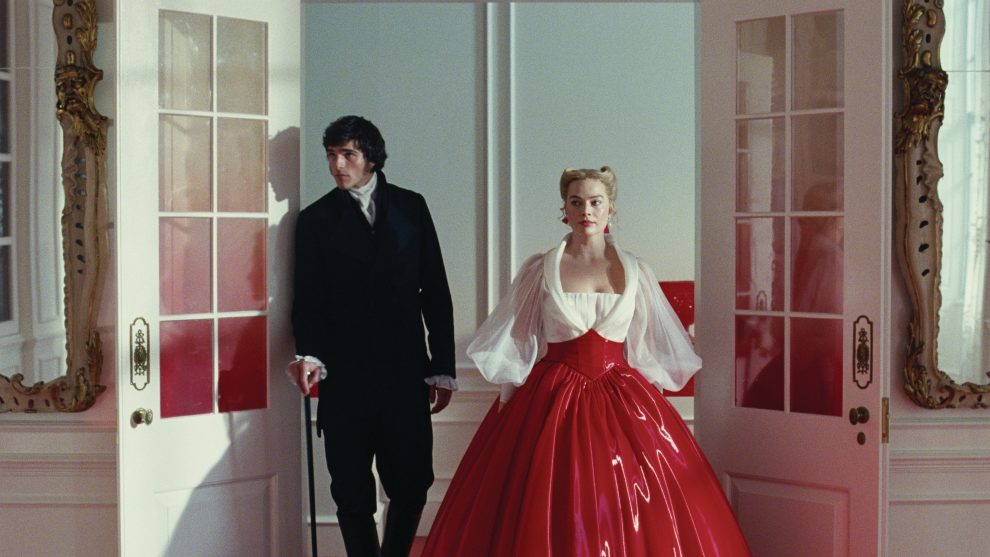
In Fennell’s film, the tall, handsome (and white) Jacob Elordi portrays Heathcliff—which seems especially odd; Shazad Latif, a British-Pakistani actor, is cast as Edgar Linton. Margot Robbie, however, is convincingly willful as Cathy, as merciless and difficult to warm to on screen as the character is in the novel.
Where Brontë critiqued the artificial cultural and social barriers people invent and insert between one another—sources of much human pain and suffering—the film neatly lops that out of the conversation.
Heathcliff’s brutish rage at the injustice of the poverty he’s been dealt is simply missing here—though that’s part of what fueled him to leave Cathy, go out into the world, make himself into a wealthy gentleman, and return to destroy the prosperous men around him. With this element removed, the narrative loses much of its power. We don’t get to see Heathcliff at his wildest, exacting revenge on the class system that dismissed him and kept him from wedding Cathy. Load-bearing plot elements and essential characters are carved out of the narrative, turning the grand, searing story into a dime-a-dozen romance.
There’s none of the book’s redemption here. No scene of Cathy and Heathcliff’s ghosts, wandering the moors together. No tale of Cathy’s daughter finding a more peaceful love with Hareton, who is expunged from the film entirely. No Heathcliff agonizing in guilt after Cathy dies.
Set design is extraordinary in places (the fireplace mantel of carved hands!), and costumes—though thuddingly symbolic (we get it, she always wears red, she bleeds to death)—are stunning. The scene of Cathy crossing the moors in her voluminous wedding dress and veil lifted by the wind is a spectacle.
Cathy seizes what power is available to her—the power of a woman to attract and use men. Far more vicious in the book, here she manipulates the attention of a rich man, denying herself the man she really loves. She breaks her own heart because of who she wants to be in life. At the same time, she exerts as much agency as her society grants her.
Brontë’s story expresses a feminism of sorts, however twisted. But it’s a feminism Fennell leaves unexplored. Cathy has her own justifiable rage at her limited options in life, but the film leaves that perspective in the background.
Cathy’s sort of feminism was surely central for Brontë, who created female characters pushing back against the Victorian ideals of feminine behavior that bound the author herself. (She initially published the book under a male pseudonym to bypass 19th-century prejudice against female authors.)
She and her sisters Charlotte and Anne created imaginary worlds for their own entertainment, driven by their isolated lives on the bleak and remote moors. Emily wrote the book for herself, and published it only after Charlotte urged her to do so—because they needed the money. One of the most powerful love stories ever, written by a woman for the pleasure of scribbling it down, just for herself.
This should be a story about damaged people loving each other savagely and without pause, finding what’s lovable and deserving in each other, despite their many flaws and obstacles. The film should have been an exploration of human passion and what binds us to one another, even in unhealthy ways. Instead, it’s much less.
A movie isn’t instantly bad if it doesn’t follow the book. But in a world of insipid romances, why add another?
This article also appears in the June 2026 issue of U.S. Catholic (Vol. 91, No. 6, pages 34-35). Click here to subscribe to the magazine.
Image: Photo Courtesy Warner Bros. Pictures