How do you teach someone who doesn’t want to learn? You might look for new ways to engage people who, at best, are indifferent to your message and at worst, are hostile toward it. This is increasingly the case with climate change, an issue about which Pope Leo XIV has echoed Pope Francis’ lament in Laudate Deum (On the Climate Crisis), “that ‘some have chosen to deride’ the increasingly evident signs of climate change, to ‘ridicule those who speak of global warming’ and even to blame the poor for the very thing that affects them the most.” Against this challenging backdrop, documentarians use various methods to draw reluctant audiences to this pressing topic.
Filmmakers such as longtime producer, director, and naturalist Sir David Attenborough, whose documentaries include The Blue Planet (2001), Planet Earth (2006), and Ocean with David Attenborough (2025), opt to showcase the wonders of nature. The breathtaking footage and fact-based presentations raise awareness about humanity’s negative impact upon the environment in a serious but measured tone. However, some filmmakers have sought more emphatic messaging. In the powerful documentary The Here Now Project (2026), directors Greg Jacobs and Jon Siskel offer a film rooted in human experiences of climate change that is equally compelling for what it doesn’t do as for what it does.
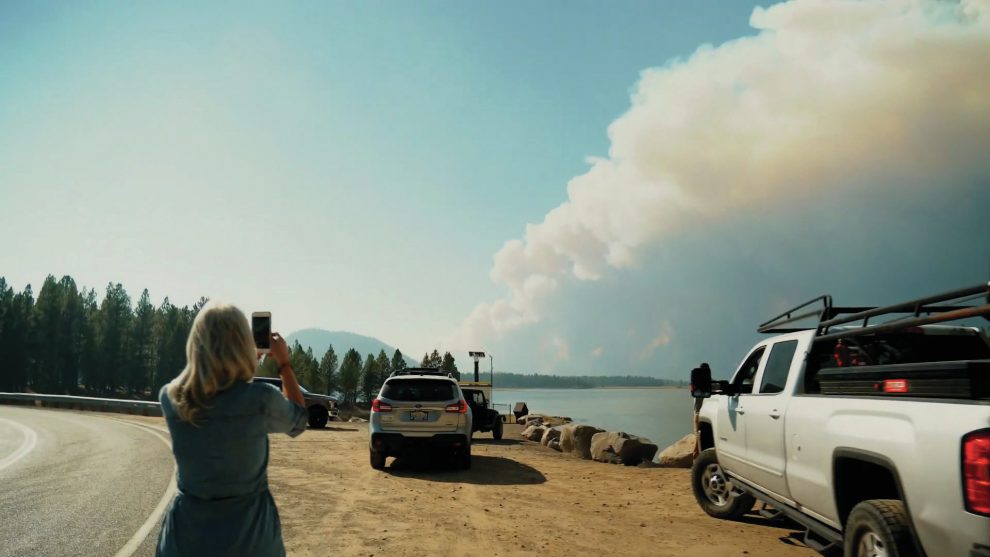
Setting aside documentary conventions, Jacobs and Siskel use no expert narrator or beautiful cinematography to persuade audiences. Instead, they rely on found footage recorded mostly on cell phones by people experiencing extreme weather events around the world during 2021 and then shared on social media. In this way, the filmmakers offer a “don’t take our word for it; see for yourselves” approach.
These people, recording in the midst of unprecedented floods, fires, or windstorms, claim no unified political or ideological perspective. All are simply trying to process and endure frightening and often tragic circumstances: A middle-class man in Texas is bewildered as an ice storm knocks out the power grid for days; a woman in British Columbia endures record-breaking heat and races to save her mother from a raging forest fire; a woman in a small town in Germany laments not evacuating as she retreats to the second story of her home to escape the rising waters of a flooded river.
The footage is recorded in real time, and the fear, anger, and confusion is palpable. Some scenes are heart wrenching, like when a frightened child sits in the passenger seat of his father’s truck as they attempt to escape the first recorded cyclone in Indonesia. As the child weeps, begging to go faster, the father—already doing the best he can—encourages his son to pray. The boy lowers his head: “Dear Jesus, keep me safe from the flood. Dear Jesus, keep us safe. Amen.”
At times, The Here Now Project seems less like a documentary and more like a horror film. Watching passengers in a subway in China stand waist-high in water as the doors fail to hold back the rising tide stirs legitimate terror. The film supplements these powerful images with live weather reports from the time of the events and occasional text. In the case of the subway flooding in China, we learn that 12 people died. While these curatorial elements remind viewers that we are watching a film and choices were made about what to show us, they also add important context as the film navigates the globe.
In fact, it’s the scope of the film that is one of its most affecting contributions to the climate change conversation. From Kenya to California, we see people overwhelmed by unprecedented weather events. This isn’t a future dilemma but a current reality.
Moreover, while the church has long emphasized that it is the poor who are most affected by climate impacts, The Here Now Project shows the growing danger to affluent populations, too. Dismissiveness and denial in the face of such events and experiences would seem increasingly difficult to maintain. But must people experience catastrophic weather events to grasp the severity of the climate crisis?
In a useful filmic device, Jacobs and Siskel include clips during the credits of some of the people who lived through the events shown in the film reflecting on their experiences. Perhaps most telling is the man from Texas who endured the ice storm. He says: “For us it was like a cold camping trip. It wasn’t that big a deal. We were fine. We had provisions. We had food. We had stuff to keep us warm. But what we didn’t know until afterwards was people died. People died. I mean children, the elderly; it was not good, and we didn’t know. We didn’t know until afterwards. I’m thinking a lot about that.”
Changing hearts to think about things that affect the well-being of all, especially the most vulnerable, is no mean feat. If The Here Now Project can stir such change, it is to be applauded. And if it can move changed hearts to changed actions, even better. Pope Leo XIV raises the stakes still higher, saying at a Vatican conference on climate justice last October: “God will ask us if we have cultivated and cared for the world that he created, for the benefit of all and for future generations, and if we have taken care of our brothers and sisters. What will be our answer?”
This article also appears in the April 2026 issue of U.S. Catholic (Vol. 91, No. 4, pages 34-35). Click here to subscribe to the magazine.
Image: Luke Zbella. September 14, 2021. Smoke from the Dixie Fire near Portola, California.