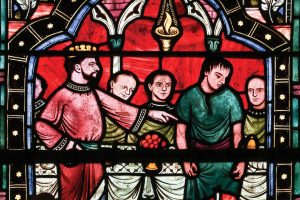
Artificial intelligence has been a literary trope since antiquity. Early instances of robots in stories include myths about self-operating tools or statues coming to life—usually due to divine intervention.
The Catholic Church’s moral engagement with technology also predates modern sci-fi. The church teaches that technology must serve the human person and the common good. This conviction shapes recent Catholic teaching on AI. The Vatican’s 2025 doctrinal note Antiqua et Nova (On the Relationship Between Artificial Intelligence and Human Intelligence) recognizes AI as a remarkable fruit of human creativity yet emphasizes that it lacks moral conscience and genuine freedom. Human beings remain the moral agents responsible for AI’s design and use.
Antiqua et Nova acknowledges the great possibilities AI brings in education, communication, health care, and science. But it warns about the risks accompanying these developments, including the concentration of technological power in the hands of a few, the manipulation of information, social inequality, and the threat of fully autonomous weapons. The church insists that AI must never replace human responsibility, become an instrument of domination, or reduce the dignity of the person to efficiency or gain.
These teachings connect to Pope Francis’ criticique of the “technocratic paradigm” that treats technology as the ultimate standard of progress and views creation through the lens of control, detaching technology from ethics and relationships. Against this, Francis proposes an “integral ecology,” which insists that human dignity, economic justice, cultural identity, and care for creation are inseparably linked.
Building on Francis’ critiques, Leo describes AI as part of a new Industrial Revolution. Just as the 19th-century Industrial Revolution transformed work, economics, law, and social structures, AI now stands poised to reshape nearly every sphere of human life. Leo urges us to treat AI not just as a technical instrument but as a civilizational turning point that demands moral courage and cultural discernment.
In medicine, AI can support healing yet exacerbate depersonalization; in business and finance, it may increase productivity yet deepen inequality; in education, human formation may become mechanized; in geopolitics, AI may contribute to greater security or lead to terrifying autonomous weapons. Meanwhile, the law struggles to keep pace. The church’s engagement with these issues goes beyond mere caution or celebration and insists on ethical formation and moral responsibility.
The goal can’t be simply to build “smarter” machines. We must ensure that AI operates within norms that protect justice and human flourishing, remembering that human progress depends not on the magnitude of our machines but on our fidelity to human dignity and the common good.
This article also appears in the March 2026 issue of U.S. Catholic (Vol. 91, No. 3, page 49). Click here to subscribe to the magazine.
Image: Unsplash/Gertruda Valaseviciute