“As a Black woman who has been a member of the Catholic Church all of her life, it never occurred to me while growing up that being both Black and Catholic was an anomaly,” writes sociologist Tia Noelle Pratt in the introduction to her new book, Black and Catholic: Racism, Identity, and Religion (Notre Dame Press). Despite having deep Catholic roots reaching back centuries, Pratt found herself frequently having to explain the existence of Black Catholics to people for whom Catholicism was either overtly or covertly coded as white.
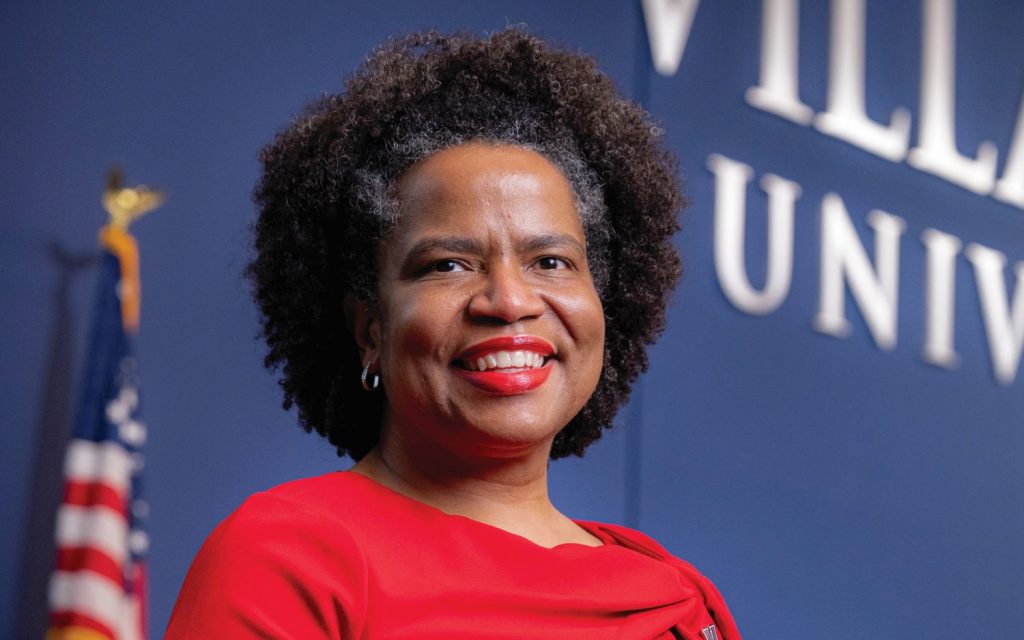
In 2015, at a symposium hosted by the Institute for Advanced Catholic Studies at UCLA, Pratt finally decided it was time to write a book on the topic, so that when anyone questioned her, she could say: “I wrote you all a book. Here it is.”
It took a long time for Pratt to get Black and Catholic out in the world, however, in part because the work she had to do interviewing people and hearing their experiences dredged up a lot of pain. Often, she said, the Black Catholics she conversed with had never been asked before about what it was like to be Black in this church, in this nation.
Black and Catholic tells these untold stories, as it looks at the history of Black Catholics in the United States, the legacy of systemic racism in urban Catholic life, the vitality of Black Catholic liturgy, and the many contributions Black Catholics have made to the life of the church, not as outsiders, but as essential parts of the body of Christ.
Who were the first Black Catholics to arrive in the United States?
In his seminal work The History of Black Catholics in the United States, Father Cyprian Davis writes about a Black man from Spain named Esteban. He was part of a group of Spanish explorers that arrived in what is now the United States in the 16th century. So, we know Black Catholics were in the United States at least that far back.
In terms of communities of Black Catholics, New Orleans and Baltimore are the dual-pronged ancestral homes of Black Catholics in the United States. And their presence predates the United States as a political entity. Black Catholics were here before the United States even existed. When we think about the history of the Louisiana Territory and the Maryland colony—why and how they were founded—it makes sense that there were Black Catholics there. And Black Catholic presence just extended from those places.
You stress in your book that Black Catholics have always been a part of the church. What are some of the contributions Black Catholics made and continue to make to the U.S. Catholic Church?
One of my favorite lines in the book is that there were Catholics of African descent when St. Patrick was casting snakes out of Ireland. One of their important contributions to the church is that of faithfulness, of devotion. An early iteration of a title I considered was “Faithful and Devoted,” because that was what the people I interviewed highlighted.
When it comes to Black Catholics in this country, we need to think about how the church in the United States was formed. My former colleague at Villanova, Shannen Dee Williams, has written about how the largest corporate slaveholder in the Americas was the Catholic Church. But that’s not the only way we can and should think about Black Catholics.
In modern times, when we think about Black Catholics’ contributions to the church, a lot of it has to do with cities. Our predominantly Black parishes—though we’ve lost so many—in cities like Baltimore, Chicago, Philadelphia, and New York really held up the church in urban areas. But as life has evolved, Black parishes are not the only places where we find Black Catholics. That calls for a shift in pastoral planning and in how dioceses conduct outreach to their Black Catholic constituents.
Some Black Catholics were brought into the church via slavery. How did that shape Black Catholic faith expressions and faith life?
Because I am a sociologist by training, I love to think about organizations. Think about what it meant to come into a faith tradition through a cruel institution—an institution designed for maximum cruelty—yet finding there a faith that would sustain folks through that cruelty and beyond. We have so many Black Catholics who can trace their family heritage for multiple generations through that time and into the present day. So this is a faith tradition that is very strong.
Many Black Catholics were initially barred from religious orders or the priesthood. They experienced a lot of pain and cruelty, and sometimes their efforts did not come to fruition. Consider Venerable Augustus Tolton and what he had to go through. His local priest wrote to every seminary that existed in the United States at the time. None would take him. That’s why Father Tolton did his seminary training in Rome.
When he returned to the United States after his ordination, he endured so much hardship just to live out his vocation. I think that was a part of the fact that he died so young. He was only in his early 40s, and he was coming back from having led a retreat. It was a hot summer day, and he got off the train and collapsed from heatstroke and died a couple days later.
Think about the train car he would have had to ride in. He would not have been allowed to ride in the comfortable train cars; even traveling on a train was so much harder for him than it was for other people.
That’s just one example. There are many other examples in Shannen Dee Williams’ book, Subversive Habits (Duke University Press).
In your book, you write about the idea of a “cosmopolitan canopy”—a space where diverse people can come together. Why is this so important for people who are experiencing racism?
Sociologist Elijah Anderson coined the term cosmopolitan canopy to refer to diverse islands of civility amid a virtual sea of racial segregation. A cosmopolitan canopy is a place of respite from the things that come at folks at once—a respite from the “death from a thousand pinpricks.” I use this idea to talk about the church and Black Catholics. The church purports to be a cosmopolitan canopy, a place where there is respite from racism, but Black Catholics don’t experience it that way.
Segregated seating and segregated communion lines are not things from the distant past. There are people who are alive and well today, still doing important work in the church, who were made to stand to the side while other children received their first holy communion, and it was only after those other children sat down that Black Catholic children could receive the Lord in the Eucharist. No, we can’t dismiss things just because they’re far in the past—but this isn’t far in the past. This is still quite recent. The church has not been the cosmopolitan canopy it purports to be.
Anderson also coined the term white space to refer to spaces where whiteness is exalted and Black folks are typically not found; spaces where they are implicitly or explicitly not welcome. I call the church an ultra-white space, because it purports to be a cosmopolitan canopy but is not. Because it is not, and intentionally is not, that makes it an ultra-white space.
How does this affect the education and faith formation of Black Catholic children in Catholic schools?
It can affect formation of faith in a multitude of ways. Who are the saints our children learn about? Do they learn about Black saints of the universal church? Do they learn about the six African Americans who are on the path to sainthood?
There’s even a seventh African American candidate for sainthood now, Father Martin de Porres Ward, who was originally from Massachusetts. Ward, as I understand it, moved to Brazil shortly after his ordination and spent the rest of his life there. That’s where he is buried. He was American, so he counts as seven, even though his life of holiness, for which he is a candidate for sainthood, did not happen in the United States.
When we look at the Catholic high-school religion curriculum, does it mention slavery? How? Many curricula only mention slavery within the context of the Book of Exodus. Limiting the conversation to that space does everybody a disservice, because we’re not talking about how the church in the United States has come to be.
And we should also talk about how, despite all of that, the United States claims 3 million Black Catholics. Look at this perseverance. Look at this commitment to the teachings of the church and our belief that we can be connected to the Lord through the Eucharist. These are things that our ancestors have passed on to us, and we shouldn’t take them for granted.
How is that perseverance in faith made manifest in the stories of Black Catholic parishes?
We have seen, particularly in cities, the consolidation and reorganization of parishes and the closing of churches. This has resulted in many people losing their church home. Whenever a church is closed, it is difficult. When the big events of your life, literally from birth to death, happen in a building, it is a big deal when that building isn’t there anymore.
There are people in the cities that I’ve mentioned—Philadelphia, Baltimore, New York, Chicago, St. Louis—who have gone through this multiple times, and it doesn’t get easier. What came out, as I was conducting interviews for the book, is that sometimes these decisions are made without talking to and hearing from the people most affected. That is something that can easily be corrected if those in diocesan leadership want to do so.
Irish parishes, Polish parishes, Italian parishes, Lithuanian parishes—these are not the only places where this is happening. Yet these ethnic parishes get more attention than the losses experienced by Black Catholics.
In Undoing the Knot (Beacon Press), Maureen O’Connell writes about the Irish immigrant populations that shifted from being on the margins, from being considered the “other” in both society and the church, toward embracing whiteness. As she makes clear in the book, that was a choice. They could have made a choice of solidarity with Black Catholics, especially since the immigrant generation she talks about was accustomed to solidarity, to fighting systemic injustice in the societies they came from. This wouldn’t have been a new issue. But the choice was made to embrace whiteness. That was a shift Black Catholics were not able to make.
What makes the Black Catholic approach to liturgy so unique, and what can the rest of the church learn from this?
It’s important to keep in mind that Black Catholics are not a monolith. When it comes to Black Catholic expression, there are different liturgical themes and different ways to incorporate Blackness. One way Black Catholics have contributed is to show how ethnic expression, racial solidarity, and liturgy can come together and how Black Catholic expression is no less Catholic than Irish, Italian, or Polish expressions. There’s this idea that if it’s Black, it’s not Catholic. Yet Black Catholics have existed for all these years in contradiction to that assertion.
What Black Catholics bring to liturgy is not just one thing. And Black Catholics bringing their experiences to the church is not being done by folks who are outsiders. This is done by folks who are just as Catholic as everybody else who’s Catholic.
In my book, I describe three different types of Black Catholic liturgy: what I call traditionalist, spirited, and gospel liturgy. They are different. In some churches, you can find all three of them, especially in churches fortunate enough to have multiple Masses on a weekend. What we see in all of them is that there is room for contemplative, prayerful expression of the faith—and music and homilies that contribute to that—and also expressive musical celebration. The understanding that there’s not just one way to do things is a significant contribution Black Catholics make, because, again, we can sometimes see a range of expressiveness at one church in a single weekend.
How does this diversity of Black Catholic expression spill over into Black Catholic theology?
We have so many talented and influential Black Catholic theologians who have paved the way for the work I have been doing. I think about M. Shawn Copeland or Father Bryan Massingale, just to name two of the many scholars who have done important work.
One of the many things we can learn from their work, particularly in theology, is how all these issues intersect with one another. Liturgy and social issues—whether racism, politics, or voting rights—none of these things exist in a vacuum. They all intersect with one another. That is important, and it’s something we often see in Black parishes, especially in recent years, that we don’t see quite as frequently in other parishes.
Certain characteristics of Jesus are especially important for African American Catholics. I don’t want to invoke the terms low Christology and high Christology, although those are terms that have been used in the past. But think about the connection to Jesus’ humanity, his earthly suffering; Black Catholics have likewise experienced suffering, both in terms of practicing our faith and in other aspects of daily life. Black Catholics can connect to Jesus as someone who experienced monumental suffering but triumphed over that suffering by rising from the dead. We connect to Jesus in a sacred and intimate way in the Eucharist and look to him as a guiding light in how we can live our lives. We see that, through his model, there are ways to pursue what we’re doing in life despite suffering.
What might the U.S. Catholic Church look like if we worked toward not being an ultra-white space and more collectively acknowledged Black Catholics as essential members of the church?
The short answer is we’d have a Catholic Church that was much more catholic—a big-C Catholic Church that was much more small-c catholic. That’s something that we should all be working toward in our own ways. We would have a church that is not dismissive of experiences that are different than the ones that we are used to.
We would have a church that understands that multiple voices have to be present at the table. It is important, when we’re sitting around the table of decision-making, to think about who is not here and to make a concerted effort to bring them to the table. If we could have a church that looks like that, so much would be so much easier.
What would it mean for us to start elevating those seven Black Catholics who are candidates for sainthood?
It would mean a lot. First of all, we’d remember that lives of holiness take place everywhere. This includes the saints that we already have, like St. Josephine Bakhita and the Ugandan martyrs. And it would contribute to being a big-C Catholic Church that is small-c catholic. These holy men and women provide examples for all of us. Our litany of the saints is no less Catholic if we include St. Josephine Bakhita in it. That is one of the things that we as a church need to fully embrace that has not happened yet.
And I say yet purposely, because I have not given up hope that it will happen. It is starting to happen, as we talk more about these African Americans who have deep ties to the United States, whether they were born and raised and lived much of their lives in the United States like Augustus Tolton or Henriette DeLille, or whether, like Father Ward, they were born in the United States but spent their lives and ministry elsewhere. These are holy men and women that are examples for all of us.
This article also appears in the February 2026 issue of U.S. Catholic (Vol. 91, No. 2, pages 16-20). Click here to subscribe to the magazine.
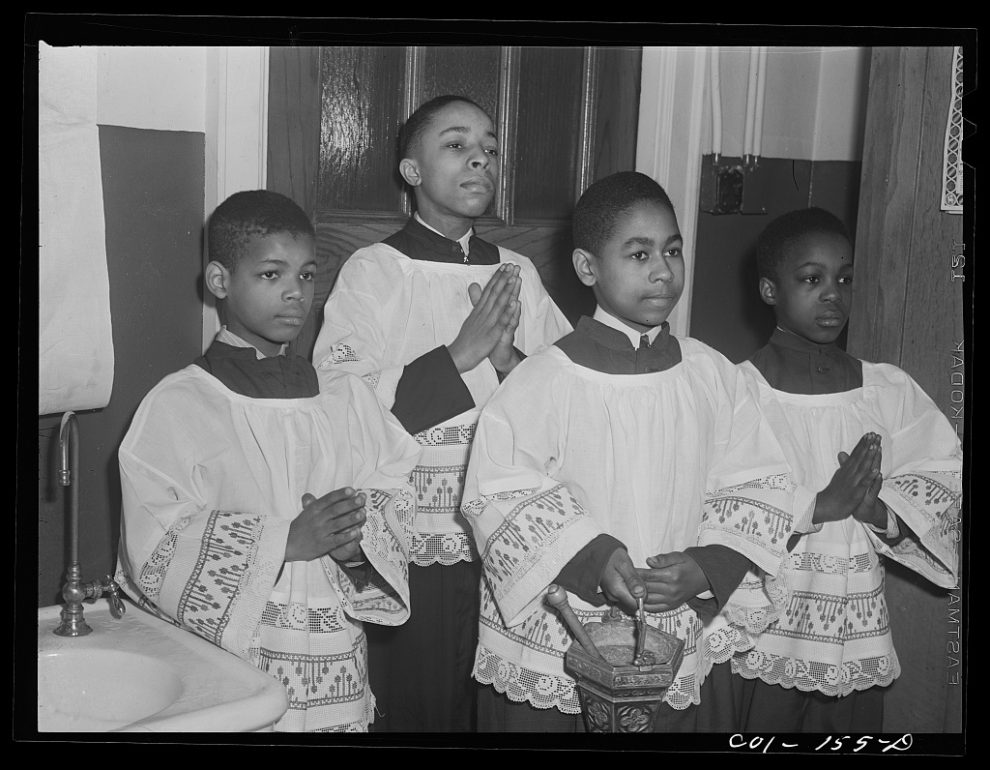
Image: Altar boys at Saint Elizabeth’s Catholic church (Picryl.com)