In the western suburbs of Chicago, on an industrial corridor with metal fencing, transportation trucks, and no-trespassing signs, stands Broadview Processing Center. This is where the U.S. Department of Homeland Security (DHS) and Immigration and Customs Enforcement (ICE) bring detainees. A recent article from CBS reports that as of November 16, 2025, nearly half the ICE detainees in custody lack any criminal charges or convictions in the United States. Using the federal government’s own statistics, CBS found that the number of immigration detainees without criminal records has increased by over 2,000 percent since the start of the second Trump administration. At Broadview, these immigrants are often held for days in dismal conditions with no contact with their families or anyone on the outside.
This fall, the Trump administration sent hundreds of ICE agents to Chicago in what he called “Operation Midway Blitz.” Thirteen days after agents arrived, they had arrested 550 people.
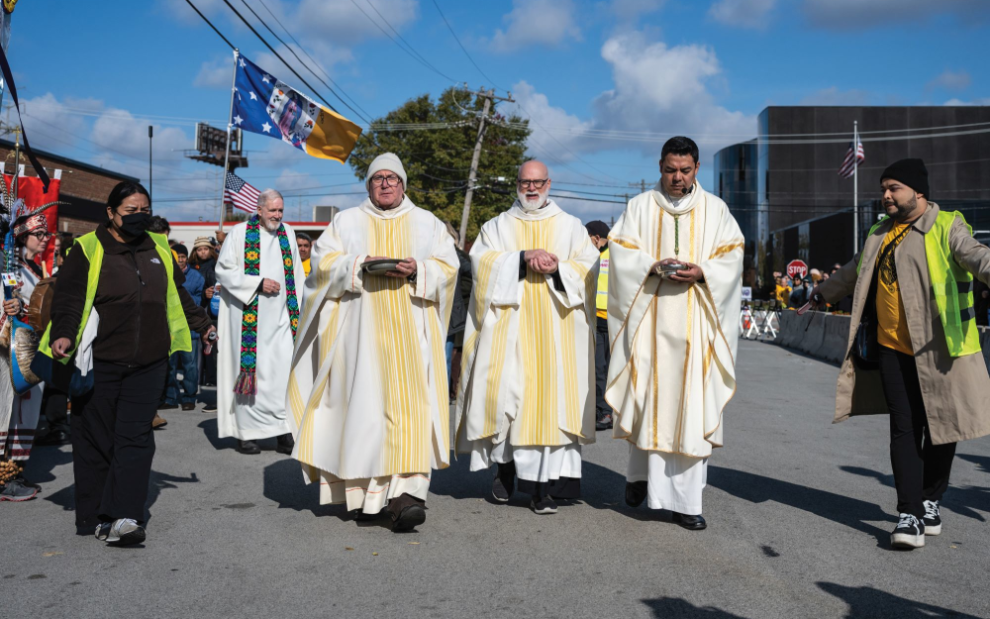
In response, thousands of Catholics came together to celebrate liturgies outside Broadview’s walls, to worship publicly in a place of state-inflicted suffering and violence. On October 11, under a blue sky, 1,000 protesters gathered at St. Eulalia Church in Melrose Park for a eucharistic procession to Broadview that spanned more than a mile. Attendees were given bright yellow T-shirts bearing words from Mary’s Magnificat in Spanish and English and an image of Mary raising her fist: “God has cast down the mighty from their thrones, and has lifted up the lowly.”
Then, on November 1, an All Saints’ Day/Día de los Muertos Mass was held outside of Broadview, with Bishop José María García-Maldonado as the main celebrant. This People’s Mass was celebrated in Spanish and English in a parking lot across from Broadview, with the altar set up under a canopy tent. More than 2,000 people attended.
The goal of these liturgies was to distribute communion and provide spiritual care to people inside the facility. Although the delegations were denied entry, they prayed and sang loud enough that they hoped the people inside the facility could hear them. Organized by the Coalition for Spiritual and Public Leadership (CSPL), the eucharistic procession and the People’s Mass were examples of liturgy as “public work on behalf of people, in service of people,” says Anne McGowan, who teaches about liturgy, worship, and sacraments at Catholic Theological Union. She recalls the original Greek meaning of the word liturgy: “work of the people.”
That understanding of liturgy—that “it’s God’s people gathered to begin realizing their mission to share in Christ’s work of redeeming the world,” McGowan says—is what she saw happening at the People’s Mass when she attended with her family, beginning with the proclamation of scripture, preaching, and intercessions. McGowan says these gave “us suggestions of what our mission in the world might be through what we are praying for.” The liturgy culminated in celebrating the Eucharist to “strengthen us to go out and do something.”
Public work
Celebrating the liturgy in such a public way, at a place of state violence, is a way that the body of Christ “reaches out to the people who feel they have been forgotten by God,” says Scalabrini Father Leandro Fossá, who serves at Our Lady of Mount Carmel Parish in Melrose Park. “Publicly celebrating means that the church wants to be with those who are on the margins,” he says.
Joanna Arellano-Gonzalez, the director of training and formation at CSPL and one of its cofounders, agrees. “It’s one thing to talk about being against the empire, and then it’s another thing to actually do it,” she says. “That’s the cost of being a disciple of Jesus if we really mean it. It also means that we’re doing this together.”
Arellano-Gonzalez grew up in Little Village in Chicago, known as the “Mexico of the Midwest,” and attended St. Agnes of Bohemia, a Catholic community deeply involved in justice and service.
Started in 2017, CSPL merges community organizing and liberation theology. Its members include parishes, religious congregations, schools, and more. When dreaming up what CSPL might look like, Arellano-Gonzalez, along with Gabriel Lara and Michael Okińczyc-Cruz, wondered: “What would it be like if there was an organizing training where we could talk about the discernment of spirits, Ignatian contemplation, and being mystics in the same tongue as campaign strategy?”
That marriage of deep contemplative spirituality and active concern for justice came alive in the public liturgies this fall. In early 2025, folks at CSPL were seeing signs of “how bad it was going to be” with ICE, Arellano-Gonzalez says. “Seeing what happened in Los Angeles and Washington, D.C., we had to take this seriously.”
On September 5, CSPL members held a conference call to discuss the news that 250 ICE agents would be housed at the Great Lakes Naval Base north of Chicago. The idea for a People’s Mass was born from that call. The first People’s Mass was held at the naval base on September 13.
On September 12, ICE officers shot and killed Silverio Villegas González after they detained him during a traffic stop. Fossá reached out to CSPL to see if they could help organize a liturgy to honor his life. “Silverio was killed by ICE in Franklin Park, and the community wanted to do a novenario [a funeral prayer ritual] and a Mass, because some of his family members attend our parish,” Fossá says.
As they heard about the conditions at Broadview and the violent actions against people protesting at the facility, CSPL members continued to discern actions to take. “We need to go where the most pain is happening,” Arellano-Gonzalez says. “And that decision didn’t come lightly, because we knew that there were possibilities of tear gas, rubber bullets, pepper spray, and being hit with batons.”
CSPL planned the eucharistic procession and All Saints’ Day Mass with careful consideration. They had participants pledge nonviolence, made sure safety marshals and medical supplies were present, and worked with local authorities.
Irma Hernandez, an organizer with CSPL, says the eucharistic procession and People’s Mass “felt like it was this triumph over evil, saying that God is with us. Where the Eucharist is, demons go away; they can’t harm us.”
Hernandez and her husband came to the United States from Atoyac, Jalisco in Mexico, and they moved to Chicago in 2003. In Mexico, she worked at a belt factory; she was pregnant with her second daughter when they came to Chicago.
She got involved in social justice ministry at St. Charles Borromeo, and later worked at P.A.S.O. (Proyecto de Acción de los Suburbios del Oeste, Action Project of the Western Suburbs) in Melrose Park. She learned about CSPL through Fossá, who invited her to be part of a social justice team at Our Lady of Mount Carmel. Hernandez recently received an award from the Archdiocese of Chicago for her organizing work in the community.
“I kept feeling the Holy Spirit saying: I need you,” she says. “Thinking about this new administration, I wasn’t feeling secure that everything was going to be OK. But I like the way that CSPL organizes, because they start with God.”
The raids, González’s killing, and ICE’s violent tactics have deeply affected Hernandez. “I felt really alone and was asking God to give me and the community strength, to feel God’s presence by our side,” she says. “Our people are feeling really defeated, but we can’t let fear and sadness overcome us because that’s how they paralyze us. I was asking God to do the opposite, to make us brave, to help us fight for our people. That’s when we started organizing everything.”
During the October 11 eucharistic procession, Arellano-Gonzalez went ahead of the crowd to set up. She remembers “looking out at the corner on Beach Street and seeing this sea of people in yellow T-shirts and images of María and the Eucharist coming forth. I just wanted to cry. It felt like the most peaceful and beautiful army.” The choir sang “Pan de Vida,” and two men lifted up La Virgen Migrante, a 200-pound image of Mary.
Felician Sister Jeremy Marie Midura was part of the delegation that asked the state troopers to let them in. “They had to call ICE and wait for a call back,” she says. “When the call came back, he looked as disappointed as we did. I think the hardest part is we knew of people who had been taken that week. There were people who gave us names of individuals, and I had the names of some women in my heart who I was supposed to look for if I was able to go in and give Eucharist.”
Mercy Sisters Pat Murphy, who died on July 21, and JoAnn Persch, who died on November 14, had been praying outside and ministering to those at Broadview since 2007. They helped get the Religious Ministry Act passed in 2008, which forced ICE to allow them into Broadview to provide spiritual care. Every Friday after that, they went to Broadview and ministered between 4 and 6 a.m., the only time they were allowed in.
But this year, Midura says, “all the laws changed with the presence of these ICE officials, and all the folks that they had already established relationships with were gone, and all of that just disappeared and you’re starting from step one all over again.”
Persch was part of the delegation that asked to be let in to distribute communion at the All Saints’ Day Mass. When she came back and told everyone they said no, “there was this moment of silence that was three minutes long,” Arellano-Gonzalez says. “I remember seeing her face, and it was really painful. For her to see how cruel it’s gotten, I’m sure it was heartbreaking. During her wake, they said she died because of a tear in her heart. She was heartbroken about everything that was happening.”
The dehumanization and cruelty, Arellano-Gonzalez says, is “unlike anything I’ve ever seen before. The evil fruit of hatred, polarization, oppression—you know it’s the evil one at work.”
Hernandez did a lot of outreach, calling and texting people about the Mass. “It was well organized and it touched many hearts,” she says. At Broadview, she saw a “sea of people praying. I trust that our efforts are favorable to God. Just like God led people out of Egypt, God will lead us free from this oppression,” she says.
In his homily, García-Maldonado shared that he’s an immigrant and that, because of the color of his skin and the language he speaks, he too could be one of the people held inside the detention facility. After they were denied entry, they offered a prayer of spiritual communion for the folks inside the facility.
Dominican Sister of Sinsinawa Christin Tomy was a member of the delegation attempting to distribute communion inside Broadview at both the eucharistic procession and People’s Mass. Tomy is a campus minister at Dominican University, which is a CSPL member. “For me, it was such a powerful eucharistic experience,” Tomy says. “As we shared the body of Christ, we were witnessing to the brokenness of that body through these really inhumane immigration practices.”
Along with García-Maldonado, more than 25 other priests concelebrated the Mass on November 1. Father Paul Keller, the provincial of the Claretian Missionaries, was one of them. The Claretians are a corporate member of CSPL and have a long history of accompanying migrants. “It’s why the Claretian Missionaries came to the United States initially in 1902,” Keller says. “We were following migrants, underserved or forgotten, or even tormented and persecuted Spanish-speaking populations.”
During communion, Keller, Persch, Tomy, and others tried to distribute the Eucharist to the people inside the facility. “I think there’s kind of a spiritual battle happening,” Keller says. “In order to respond to a spiritual crisis, you should use powerfully spiritual means. As Catholics, we don’t have any spiritual means that are stronger than the Eucharist.”
While some people may say this is a politicization of the Mass, Keller disagrees. “We are going to the core of what the Mass is, which is bringing the body of Christ to the body of Christ.”
After the Mass was over, Keller says he approached the state troopers and asked, “With all the people gone, can one person go in quietly?”
“They’re not going to respond to that,” the trooper replied.
“This isn’t just symbolic,” Keller says. “There’s a very concrete specific goal, which is we want to provide pastoral care and worship and the Eucharist in the Broadview detention facility.”
After the Mass, two Catholic lawyers reached out to CSPL and said they would represent them in a legal case against ICE and DHS on the basis of religious freedom. CSPL is waiting for the judge to announce a court date.
CSPL planned ahead and followed all protocols that DHS said were required for entering. “We made sure that we publicly followed all the steps that they outlined for us to be let in,” Arellano-Gonzalez says. “But it’s a cat-and-mouse game. They just want to exhaust you.”
Liturgy and social justice
The connection of liturgy and social justice isn’t new, McGowan says. In the mid-second century, Justin Martyr recorded one of the earliest descriptions of Christian Eucharist, where he says, McGowan explains, that “eucharistic elements are sent through deacons to those who are not present. He’s saying, we take up a collection and then things are distributed to the sick, to those in need, to the imprisoned, to strangers, to those journeying among us. There’s that sense of going out.”
Like any liturgy, culture and context are important, and “there was a lot situating why we were there,” McGowan says. “Liturgy can do a lot of things at once: celebration, lament, and protest.”
The All Saints’ Day liturgy celebrated God’s promise of a world where prisoners are freed, McGowan says. “We lament that we can clearly see that what is around us is not that.” The protest element is an invitation for others who “might be curious bystanders of these gatherings: What is this all about? Why does this matter?”
Liturgical theologians often reference the phrase lex orandi, lex credendi, lex vivendi, meaning “the law or ways of praying shape the law or ways of believing,” McGowan says, and ultimately, “how do we live our beliefs?”
For Tomy, “it was very important that our presence there was liturgical.” Nonviolent resistance aims to make visible “evil that is occurring. I think there’s a way that celebrating the liturgy was able to do that—to make really apparent the way that people were literally being denied participation in the Eucharist,” Tomy says.
Dance, liturgy, and resistance
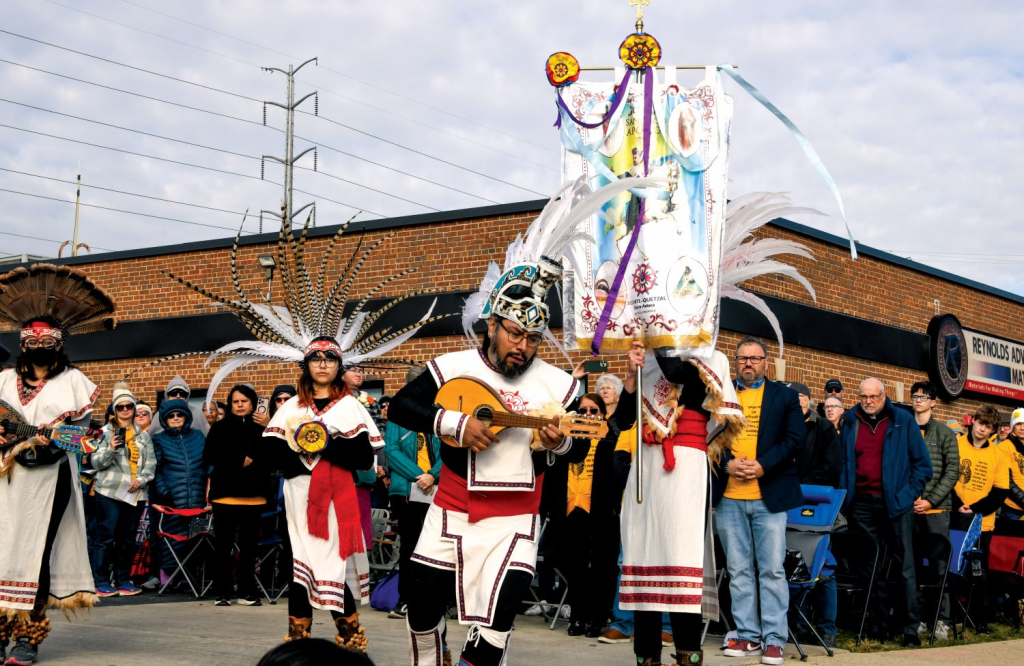
At the opening of the People’s Mass on November 1, Aztec dancers—concheros—wore regalia and played instruments and danced outside Broadview. The group, Xóchitl-Quetzal Aztec Dance: Mesa Santiago Apostol (Apostle St. James), dances out of a deep tradition of faith and social justice.
Henry Cervantes, founder and director of Xóchitl-Quetzal Aztec Dance and an ordained dance chief, says his job is to “carry out the tradition as it was instilled to me, from a place of love and faith.”
Cervantes has been dancing for 20 years. In the early 2000s, he saw dancers holding a demonstration where ICE raids were happening in Little Village, the dance group’s home base. “I remember them praying and singing songs about Jesus and Mary,” he says. “At that moment I fell in love with the dance.”
This Aztec dance tradition dates back to 1531, after the conquest of Mexico. “That’s the place of reference for many of us dancers,” Cervantes says. “The mass conversion that happened in Mesoamerica. Our ancestors accepted the faith traditions that came but still held on to who they were.”
The concheros play mandolin and guitar, which is a way to “preserve the drum beats that were forbidden during the early colonization of the Americas,” Cervantes says. “What’s happening today has been happening for 500 years. That they could just pick you up on the street because you’re brown, because you speak Spanish, and because you happened to be born somewhere else.”
The patron saint of Xóchitl-Quetzal Aztec Dance is St. James, who is known as the “carrier of the four winds, because he carried the word of Jesus to the edges of the Earth,” Cervantes says. Dancers carried their banner of St. James as they opened the People’s Mass for the Day of the Dead. A dancer blew a conch shell.
“It was a solemn dance for us,” Cervantes says. “It wasn’t a dance of celebration. It was a dance of struggle. The dance I did was Señor de la Misericordia, which means Lord of Mercy. We know the reports of the many people who died this year alone under ICE custody—that’s who I was thinking about.”
There are 40 dancers in the group, but not everyone could make it to the Mass because of the risk of deportation. “We’re grateful that the Mass happened, because I think there’s always a need for that tradition of understanding Catholic social teachings and the activist spirit,” Cervantes says.
“Hope is an active virtue”
CSPL created toolkits for other parishes and dioceses to hold their own public liturgies. “None of this happened overnight, but that doesn’t mean that other folks can’t do it,” Arellano-Gonzalez says. “Start with a small planning team. Meet with your deaneries and your vicariates and start base building.” CSPL has another action planned for Ash Wednesday, February 18.
Arellano-Gonzalez is grateful that the Broadview liturgies reached the ears of Pope Leo, who called for “deep reflection” over the treatment of migrants after hearing they were denied access to communion.
“I want the church to lean into its moral authority and be OK with going against empire,” Arellano-Gonzalez says. “Now with the threats of [renewed ICE activity in Chicago] in March, we need to build together.”
Many folks are “facing greater threats to our capacity to keep hope alive than perhaps we have before,” Tomy says. “Hope is an active virtue, and sometimes just being a part of the struggle does nurture that flame of hope for us.”
Participating in liturgy as the work of the people, “grounded and rooted in Christ’s work, can help us not be afraid,” says McGowan. “It’s not our success or failure. It’s not our work. But we get to help participate.”
When Hernandez gets up at dawn, she lights a candle and prays “for anyone whose family member is in detention, that they don’t fall into depression and that God’s light gives them strength, and that in this moment, it deepens our solidarity and our prayer for one another.”
Though she hasn’t left her house much lately because of the risks, she says, “We are still going to church. I don’t want it to paralyze me, where fear stops us from receiving communion because it’s also what sustains me and gives me strength and joy.”
Hernandez hopes people inside detention facilities know they are not alone. “We are praying for you,” she says. “God is on the side of the oppressed. How can we stay silent? The church always has to raise its voice.”
This article also appears in the February 2026 issue of U.S. Catholic (Vol. 91, No. 2, pages 10-15). Click here to subscribe to the magazine.
This article is also available to read in Spanish.
Header Image: flickr/Paul Goyette