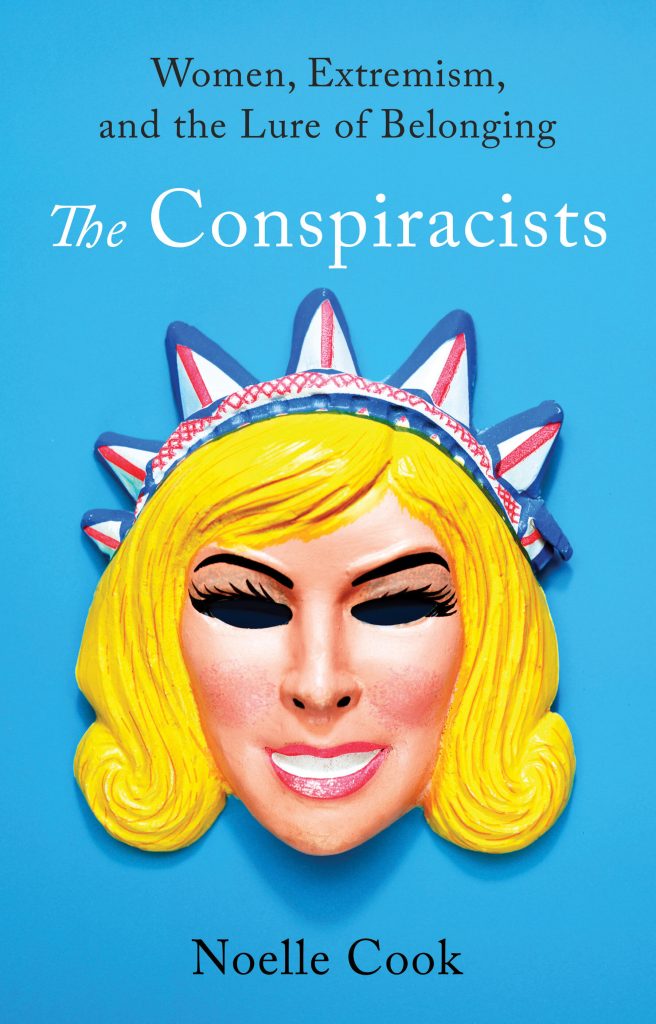
The Conspiracists
By Noelle Cook (Broadleaf Books, 2026)
We all remember the day. A violent mob charging through the halls of the U.S. Capitol building. An older man sitting with his feet up on Nancy Pelosi’s desk. Another man, younger, with a painted face and elaborate horned headdress: the QAnon Shaman, he called himself. For at least half of us in the United States, the events of January 6, 2021 were mind-boggling; it truly seemed like our compatriots had broken with reality.
After five years of research—which has included befriending and bonding with two female insurrectionists—anthropologist Noelle Cook has discovered that many people drawn to the mix of conspiracy theories, far-right politics, and New Age beliefs that Cook calls conspirituality are of a demographic the author herself belongs to: middle-aged white women. Through her intimate portraits of Yvonne St. Cyr and Tammy Butry, Cook offers us the opportunity to understand why women are susceptible to conspiracism. She urges us toward a solution that can seem incredibly difficult: empathy and compassion across epistemic, religious, and political divides.
Cook, who pursued graduate studies in anthropology in middle age after raising her children, never expected to befriend January 6 rioters. She started studying protests academically and attended the Stop The Steal rally armed with a notebook and a camera, hoping to start a thesis project. The shock of that day led her to begin studying the movements behind it with a high level of academic distance. But eventually, she concluded that looking at online groups and social media posts was not enough. She needed to meet and get to know people.
While an ethnographic study focused on just two people has obvious limitations, its strength lies in its humanity. We are offered a vivid portrait of two women who both endured multiple traumas, searched in vain for something to believe in, faced isolation during the pandemic, and eventually got drawn into conspirituality online, often leaving family members, church communities, and friends behind. We see the complexity behind their beliefs: One of these women has a transgender daughter and Black grandchildren, making her opinions much more nuanced than people outside their circles might expect.
Cook poignantly brings herself into the story, showing how she found common ground with these two women by confiding in them about her own divorce and financial precarity. “As older women, we all feel largely invisible,” she writes, mentioning that many middle-aged women drawn to conspiracism feel that the Democratic Party, with its focus on reproductive issues, has little to say about the difficulties that older women face. Deeply rooted patriarchal systems that ignore older women’s struggles fuel their attraction to any community that offers hope and belonging.
In the final chapter, Cook presents solutions that are research-based but not easy. She warns that while fact-checking may help prevent people from embracing conspiracy theories in the first place, it does nothing to change the minds of believers. Shaming, ridiculing, and isolating do not help either. Instead, Cook cites research that empathy is the key ingredient: “Treating conspiracists with kindness, patience, and understanding appears to be a precondition for a successful exit. . . .They need a compassionate friend.”
This article also appears in the November 2026 issue of U.S. Catholic (Vol. 91, No. 11, page 46). Click here to subscribe to the magazine.