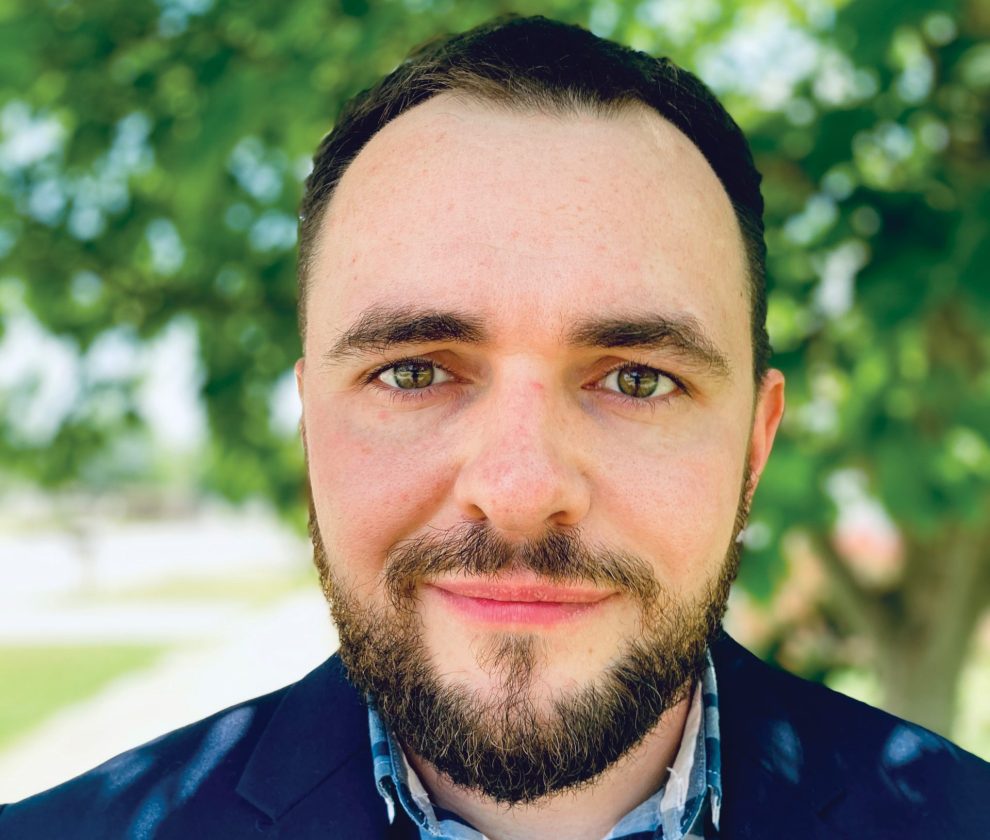
When Paul Fahey published his first paper on spiritual abuse—the misuse of spiritual or religious authority to control or harm another person—he had no idea how well it would be received.
“I found I had stepped into a gap I didn’t even know existed,” Fahey, a licensed mental health counselor, says.
Shortly after the paper, titled “The Place Where You Stand is Holy Ground,” went live, messages started coming in from people writing to him about their own harmful experiences in the Catholic Church.
The variety of accounts surprised him; they represented every corner of the church, from parishes to convents to Catholic families.
He published the paper, he says, because he wished he had something like it during his time as a director of religious education.
Fahey’s Catholic faith has always been strong. Now 36, as a teen he had a deep experience at a Steubenville Youth Conference that made him decide to go into ministry in the church. He studied theology at Augustine College in his home state of Michigan and then started working as a director of religious education at a parish. He also married his wife, Kristina, who is an artist. Fahey loved his work at the parish, but by 2020, he realized that it didn’t provide the kind of stability or salary he needed for his family that then comprised four children, now five.
“I started looking for an off ramp,” he says.
He found it in the professional counseling program at his alma mater.
When publicity for the program popped across his Facebook page, he first suggested it to a colleague at that parish. “ ‘You’d be good at that,’ I told her. Her response was, ‘So would you,’ ” he says.
That was the first time he thought about making the move to mental health counseling. After some discernment, he applied for the program and received a scholarship. It seemed like God was calling him to go.
While he was a student, a long-standing, difficult situation between the pastor at the parish where he worked and the lay staff came to a head, resulting in all the lay staff at the parish—including himself—“walking away,” Fahey says.
Then, during the last months of his counseling studies, Fahey had to write an in-depth research paper on a topic of his choice, and he decided to write about spiritual abuse as a way to process those last difficult years in his parish work. “I decided if I had to do this, I wanted to do something for myself,” he says.
Like most Catholics, and despite some two decades of the clergy sexual abuse and cover-up scandal, spiritual abuse was something he was only vaguely aware of until it touched him personally.
“I wish it didn’t take me having to experience what I experienced myself for my defenses to drop, to hear the stories of survivors of all kinds of abuse in the church. But that’s what it took and so I was able to hear people’s stories in a different way and take them seriously in a different way, especially the systemic problems,” he says. “It isn’t just about a bad priest. It’s about a system that allows it to happen and continues to allow that to happen.”
He defines spiritual abuse as using spiritual means as a tactic of coercion. The dynamic of spiritual abuse follows that of other forms of abuse but “it has the added component of the spiritual authority that the abuser has,” Fahey says.
In the worst cases, it can be a form of grooming for other forms of abuse, such as sexual abuse. But, Fahey believes, most spiritual abuse happens out of good intentions, whether through carelessness, overzealousness, or a Catholic culture that has normalized the use of fear and shame.
“An abuser’s self-protective mechanisms—whether bullying or lying or other behaviors—are often couched in spiritual language. They invoke spiritual authority or even God to coerce people to do what the leader wants them to do,” he says.
It’s also alarmingly common. He cites the work of researcher Lisa Oakley in the United Kingdom, who found in a survey that 75 percent of respondents reported experiencing coercion in their Christian churches.
“And these are only the responses from the people still in the church. Imagine those who have already disconnected,” Fahey says. He cites an example that he and likely many Catholics have been subjected to: a priest saying in a homily that voting for a certain political candidate or ballot proposal regarding abortion is a mortal sin.
“What I would like to have heard is, ‘This may be a serious matter: Please take this into consideration in your conscience,’ ” he says, noting that recent church teaching has been very clear on the sacredness and freedom of the individual conscience and the responsibility of those in offices of spiritual authority to exercise their role with care and respect.
Fahey emphasizes that weaponizing spirituality means that the harm done, besides that caused by bullying or manipulation, is also spiritual.
“The harm is also the spiritual harm of deforming God’s character for the abused, damaging the victim’s capability to discern and get direction from God in prayer,” he says.
While he knows deep cultural change is needed in the church from the top down, he focuses on where he can make an important positive impact—the education of laypeople. Part of the pervasive problem of spiritual abuse in the church is what he calls “epistemic injustice,” meaning victims do not even have the language to describe or understand spiritual abuse or abuse of conscience.
Fahey is changing that through his writing and his workshops on spiritual abuse. “It makes a difference at the margins,” he says of the importance of educating people on the topic.
Fahey’s work is clearly relevant for many Catholics. His Substack and weekly podcast, Catholic Third Space, have 27,000 subscribers. He leads four-week-long workshops on spiritual abuse, which over 150 people have already attended. A friend helped Fahey create a recorded version for self-study, which is also now available.
Fahey considers this part of his professional work so important that he keeps his Substack and podcasts available for free, though he has many paid subscribers. He offers steep discounts on his workshops as well, with many people even attending for free.
His work has not gone unrecognized by the church. In 2025, he was asked by the Trappists to give a presentation on spiritual abuse via teleconference to the meeting of the order’s general chapter—an important international gathering of superiors.
Awareness of the reality of spiritual abuse in the church is rising, but there is still a long way to go to achieve the deep cultural change needed, Fahey says. He notes that his original monograph remains a top hit on an internet search for Catholicism and spiritual abuse.
“It’s not because it’s the best resource out there,” he says, “but because it is one of the only resources out there.”
This article also appears in the October 2026 issue of U.S. Catholic (Vol. 91, No. 10, pages 42-43). Click here to subscribe to the magazine.
Image: Courtesy of Paul Fahey