My son Quentin died by suicide on April 26, 2020. Every Catholic parish has people like me who bear the sorrow of suicide loss, as well as those whose loved ones have attempted suicide. They also have people who wrestle with suicidal ideation and others who have survived their own suicide attempts.
The most recent data indicates suicide is the tenth leading cause of death in the United States. The assumption that suicide only strikes people who are outside the church or no longer practice their faith only isolates those who have experienced this heartrending loss.
As the body of Christ, the church is called to bear witness and accompany all who suffer. Pope Leo displayed this gentle-spirited approach as he listened to a young woman in Barcelona share her account of attempting suicide. “The Son of God took all the anguish, loneliness and suffering of humanity upon himself, in his own flesh,” the pope reassured her.
Suicide prevention and ministry to those who have been affected by it are important responsibilities for Catholics and the church as a whole. In my experience, Catholics care deeply, yet suicide is often misunderstood. This confusion can unintentionally contribute to stigma, silence, and uncertainty about how to respond. Parishes can become better equipped to address suicide by taking some practical and compassionate steps.
Correcting misconceptions
Many Catholics and others misunderstand the church’s teaching on suicide. Historically, Catholic doctrine treated suicide as a mortal sin, and those who died by suicide were generally denied Catholic funerals and burial in consecrated ground.
Although the teaching has since changed, I regularly meet Catholics and non-Catholics who still think suicide automatically excludes someone from Catholic funeral rites, burial, and heaven itself. I co-facilitate my parish’s ministry to survivors of suicide loss and have encountered several survivors plagued by fear that their deceased loved ones are eternally condemned. They are consistently relieved to learn what the Catechism of the Catholic Church actually says.
Suicide ends a life, which explains why the church considers it a serious matter. However, the catechism states that mental illness, severe emotional distress, and significant adversities diminish responsibility. It reminds us that the church prays for those who have died by suicide and invites us to trust in God for their salvation.
I hold these truths close during every Mass. When the priest mentions all who have died in God’s mercy, I place my hand over my heart. This is my quiet way of sending love to my son and praying in solidarity with everyone who shares a similar loss.
Actions parishes can take
Using accurate language is essential when ministering to people touched by suicide. Most of us are accustomed to saying someone “committed suicide.” This common phrase implies an immoral or possibly criminal act. But suicide is a description of someone’s cause of death, not an accusation. After all, no one “commits cancer” or “commits kidney failure.” A better practice is to factually state that someone “died by suicide.”
Praying for the living and the dead is a spiritual work of mercy, which is why every parish can add prayers for those who have died by suicide to their petitions. We might pray: For the souls of all who have died by suicide, may they obtain eternal rest in God’s loving embrace. For the families who grieve them, that they are comforted by Christ’s peace. For everyone who struggles with thoughts of suicide or the pain of a past attempt, may they find hope and healing through our support.
A parish or diocese could devote an entire month to praying for suicide prevention and the consolation of mourning families, as Pope Leo did in November 2025. Suicide Prevention Month occurs every September, and the Saturday before Thanksgiving is Survivors of Suicide Loss Day. These occasions offer opportunities, but they are not the only times to confront the heartbreak of suicide with the compassion of Christ.
Pastors and deacons can discuss suicide in their homilies. Preaching educates the community, empowers parishioners to talk about suicide openly, and provides solace to those who mourn. This happened in my parish. In August 2024, one of our deacons preached on the prophet Elijah, who prayed to die. His frank and kindhearted message helped launch our first support group for those bereaved by suicide loss.
Frequently, the only time suicide is spoken of in a homily is in reference to physician-assisted suicide. This crucial life issue concerns human dignity, the elderly, disabled, people with mental illnesses, and more. But a homily focused primarily on legal and political questions can overlook the grief and struggles that many parishioners carry with them to Mass.
The Eucharist is the church’s way of encountering Christ, so dioceses and parishes around the country have started hosting Masses of Remembrance and Healing. Videos are available online, functioning as models for communities to use. In my own diocese of Colorado Springs, we are preparing for our first Mass of Remembrance this fall.
Offering a Mass intention is another simple yet meaningful act any Catholic can perform. A few weeks after my son’s death, I received Mass intention cards from people who knew how he had died. Their thoughtful gestures connected him and my grief to the church’s liturgy.
Catholic communities can connect with organizations such as the Association of Catholic Mental Health Ministers to help organize liturgies and further serve people affected by suicide. This organization has worship aids, intercessory prayers, homilies, articles, prayer cards, and webinars specific to suicide.
My support group uses the eight-session video series When a Loved One Died by Suicide. In this series, Catholic survivors, including clergy, share stories about their deceased loved ones as well as their own journeys through grief. Each video contains prayers and explanations of Catholic teaching. These short films are available on Formed, the online platform to which many parishes already subscribe.
Suicide prevention
Preventing suicide is the main goal, so parishes should not overlook partnering with local and national agencies such as the American Foundation for Suicide Prevention. These groups have developed accurate information, educational tools, and best practices concerning the prevention, causes, and aftermath of suicide.
Suicide affects LGBTQ+ youth more frequently than their straight peers, but parishes sometimes hesitate to minister to them or their families. I have even heard Catholic speakers callously suggest that a person’s sexuality is the root cause of suicidal impulses. However, organizations like The Trevor Project correct misinformation and provide resources that focus on saving the lives of LGBTQ+ young people.
No single factor causes suicide. Prevention means we have to stop tiptoeing around suicide and mental health as if they were somehow shameful. This involves encountering real human persons and respecting their authentic experiences. Perhaps the worst thing anyone could do is to judge someone for their mental illness, suicidal feelings, or grief related to how their loved ones have died.
Redeeming the stigma
For the ancient Romans, crucifixion inflicted humiliation, not just physical pain. Christ, though, redeemed the disgrace of the cross, and today, the crucifix is God’s preeminent sign of love and solidarity with us. While suicide is still often stigmatized, I believe the church can redeem that stigma—as Jesus did with the cross—by welcoming anyone this tragic way of dying has touched.
We begin the redemption process by listening and being present to survivors of suicide loss. We work to understand the interrelated cluster of psychological, physical, social, and spiritual factors that can drive a person to suicide.
The Archdiocese of Chicago has worked to redeem the stigma. In July 2026, they dedicated the “At Peace” memorial in Queen of Heaven Cemetery as a place for survivors to remember their loved ones. Such memorials might not be feasible for every diocese and parish, but each one can still find ways to support those who are grieving and help prevent these tragic deaths.
The gospels describe an occasion when a disabled man’s friends broke open the roof of a crowded house so they could bring him to Jesus. I am drawn to this image and believe we can “break open the roofs” of the church. People who are beleaguered by suicide loss, attempts, or ideation need to encounter the healing grace of Christ.
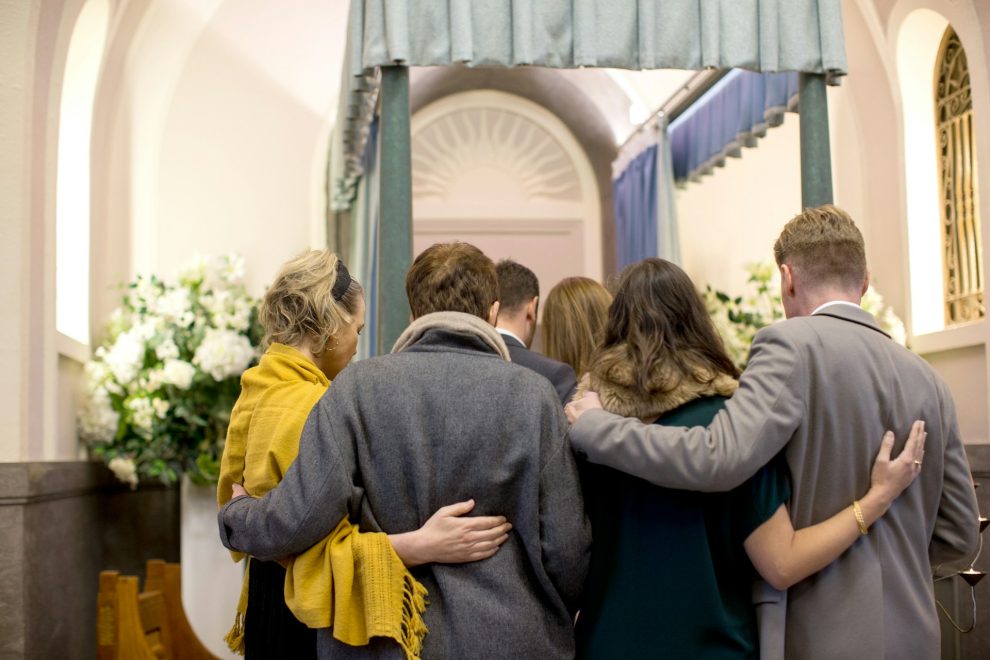
Image: Unsplash/The Good Funeral Guide