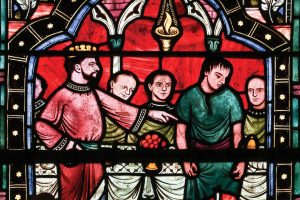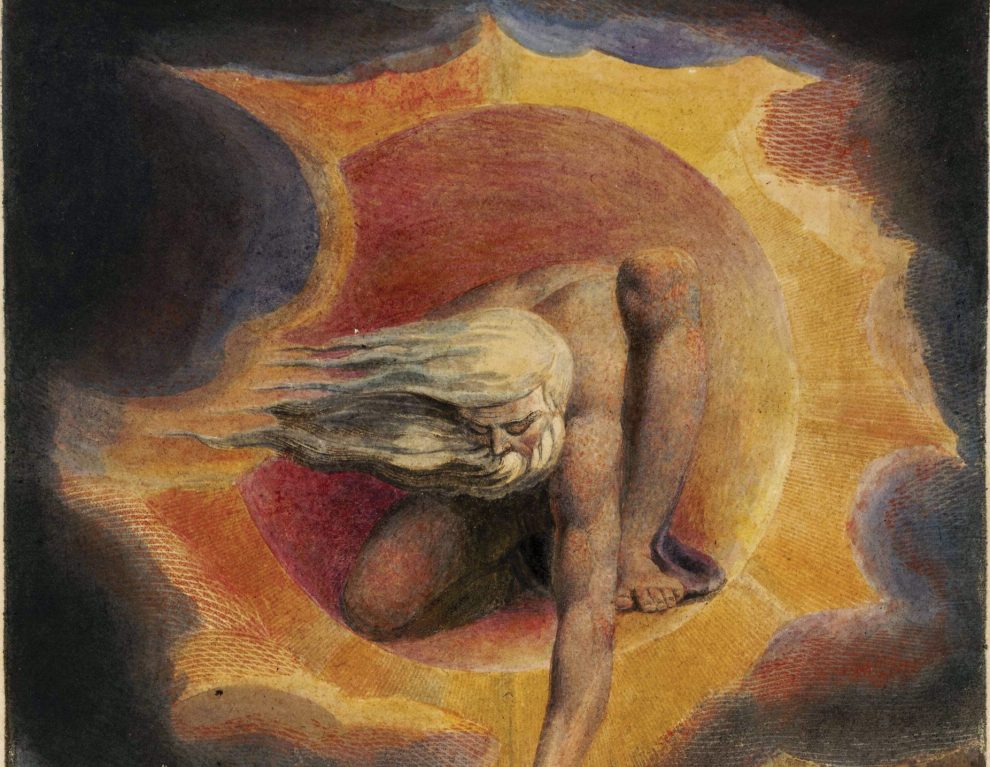
As I watched, thrones were set in place, and an Ancient One took his throne; his clothing was white as snow, and the hair of his head like pure wool; his throne was fiery flames, and its wheels were burning fire.
(Daniel 7:9)
You know those crystal-clear childhood memories—the ones where you remember every detail and can still see exactly what everything looked like? One of mine is walking into the living room when I was around 10 years old and asking my dad what God looks like. I still remember exactly where he was sitting and exactly where I was standing.
It would have been simple enough in that moment for my dad to say, “No one knows!” or “We can’t see God.” Instead, he picked up a Bible and read to me from Daniel 7:
An Ancient One took his throne; his clothing was white as snow, and the hair of his head like pure wool; his throne was fiery flames, and its wheels were burning fire. A stream of fire issued and flowed out from his presence. A thousand thousands served him, and ten thousand times ten thousand stood attending him. (7:9–10)
I can only imagine the look on my face as I listened. God sounded amazing.
The question of what God looks like is a natural one to ask, and the Bible has plenty of answers for us. This is the power of a living Word—living and breathing with dynamic stories and colorful images that spark our imaginations and help us better understand who God really is. If we had only the abstract perspectives of theology and philosophy, we could easily flounder in the invisibility and formlessness of God. Although abstraction has its place (even Jesus said, “God is spirit”), let’s face it—it’s hard to relate to an invisible God.
The graphic descriptions of God in scripture may not be physically literal, but they help us grasp on to something very real about God. As a child listening to Daniel 7, I saw light and glory. I imagined something ancient but bursting with life. I encountered someone worthy of awe and worship.
The Bible wastes no time in giving us glimpses of God. The first chapters of Genesis describe the Creator as forming human beings from dust and “breathing into [their] nostrils” the breath of life (2:7). While this isn’t an explicit description of God’s appearance, the narrative is enough to create a picture in our minds—God is forming dust and clay; God is breathing. In the same account, God walks in the garden “at the time of the evening breeze” (3:8). It is one thing for a disembodied voice to say that creation is very good (1:31); it is quite another for the divine to walk among the Earth’s vegetation, smelling the freshness of the dirt and enjoying the coolness of dusk.
Other stories in Genesis and Exodus speak of God as having a tangible presence among us. When three men visit Abraham, the text says that “the Lord appeared to Abraham” (Gen. 18:1–2). When Abraham negotiates with God to save the people of Sodom, the frank, intimate conversation sounds like it could be taking place between any two people (18:22–33). When Jacob wrestles until daybreak with a man who finally strikes Jacob’s hip socket in a winning blow and then blesses Jacob at his request, Jacob is certain he has seen God “face to face” (32:23–30). When Moses and the elders ascend a mountain to worship, “they [see] the God of Israel,” under whose feet is a beautiful path of sapphire (Exod. 24:10). Moses is described as speaking with God “face to face,” and his own face shines afterward as proof (Exod. 33:11; 34:30). Later, when Moses asks to see God’s glory (Hebrew kavod), God tells him he cannot see God’s face but only God’s back (33:18–23).
While we need not interpret these stories and images in an overly literal way as God having woolly white hair or physical feet to walk in a garden or stand on sapphire, we’re wise to guard against dismissing them completely. The sensations evoked in me as my father read Daniel 7 were real: God is beautiful and glorious. The stories of Eden are fantastic but true: God is the source of every breath we take. A wrestling match with God is not so far-fetched: God is exceedingly close to us in our most distressing times.
What does God look like according to these ancient texts? God looks like proximity and intimacy. God looks like breath and conversation. God looks like wrestling and negotiating. God looks like companionship and relationship. God looks like glory.
Our belief in the incarnation builds on this biblical understanding of God as remarkably close to us—close enough to breathe intimately within us, walk with us, and talk with us. Incarnation is a new reality in the gospels, but it isn’t an entirely new concept. Jesus is God “face to face.” Jesus is God breathing, walking, and talking—doing all the things God did in the garden and among the matriarchs and patriarchs of Israel. The image of God in the face of Jesus of Nazareth may be new, but the intimacy of God’s presence among us is not. What does God look like according to the gospels? Like a baby crying in an animal trough. Like a boy at home in a temple. Like a relentless miracle worker. Like a man dying.
The gospel accounts of Jesus’ transfiguration (a word that means “to change in outward appearance”) draw our attention once again to God’s face among us. These stories echo the glory of God described in texts such as Daniel 7. In fact, on the Feast of the Transfiguration, the lectionary pairs these readings together so we can easily hear the parallels: the Ancient One of Daniel 7 has bright white clothing, vividly white hair, and a stream of fire emanating from his throne. In Matthew 17, the face of the transfigured Jesus shines like the sun, and his clothes become dazzling white (17:2). Brightness, luminosity, and the heat and light of glory radiate from both the Ancient One and the incarnate Son of God.
The divine kavod is not reserved to a heavenly throne. It is with us. This is why Peter says to the shining Jesus, “Lord, it is good for us to be here” (17:4). Not somewhere abstract or beyond, but here. Peter’s desire to build three tents recalls ancient Israel’s construction of the desert tabernacle, where God was said to dwell among the people (Exod. 25:8).
Like the psalmist, we yearn to see God’s face: “ ‘Come,’ my heart says, ‘seek his face!’ Your face, Lord, do I seek” (Ps. 27:8–9). When we express this yearning, we aren’t asking for a description of Jesus’ features or an eyewitness account of the Ancient One. What we really want is to know that God is beautiful, that God is glorious, that God is present. And this is the story our living Word tells. The breath of God still breathes in us, the feet of God still walk with us, the voice of God still speaks to us, the face of God still shines on us.
This article also appears in the August 2026 issue of U.S. Catholic (Vol. 91, No. 8, pages 46-48). Click here to subscribe to the magazine.
Image: William Blake, The Ancient of Days, 1794, etching/watercolor, 9⅛ x 6⅞ inch, British Museum, London