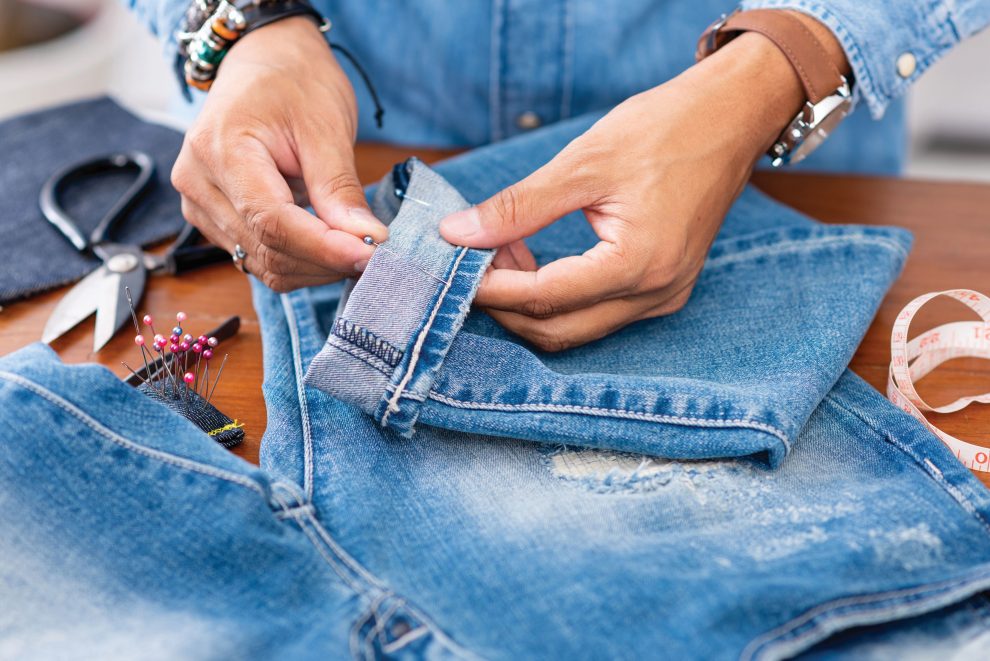
In my bedroom, I have a bag filled to the brim with socks that have seen better days. Some have pilled fabric, while others are speckled with rips and holes in the heels. At first, I felt paralyzed about what to do with them. Part of me wanted to throw them away—but something stopped me. So I set them aside (and slowly added more to the pile) in the hopes that I will someday muster up the courage to repair them.
Such an aspiration—the courage to mend a rip—would make my ancestors laugh. I come from a line of seamstresses and tailors, professionals and hobbyists, who handled sartorial adjustments and mends with ease. For too long, I’ve been unlike them, lacking their skills, daunted by the task of mending a garment with my own hands.
Fast fashion, the most abundant kind of clothing online and in stores, is so cheap—and so poorly made—it’s easier to replace than to repair it. And with a significant percentage of Gen Z reporting a lack of sewing skills, it’s understandable that many of us would rather throw out a frayed shirt than take the time to acquire the skills and tools to repair it. This is connected with the culture’s broader throwaway attitude toward objects (and people). Why mend when you can just replace?
Yet faith offers a different vision, one where God views creation and creatures alike as worthy of repair. With a desire to embody that vision, I have made a conscious effort to pursue mending as a kind of prayerful practice. As I’ve done so, I’ve seen a subtle change in myself—and I have been encouraged by what sartorial repair can reveal about social repair.
I’ve always had a fixation on clothes, but in recent years, I have become preoccupied with attending to their “needs.” A series of unfortunate events brought me here; for example, I remember that spilling hair oil on a beloved linen dress taught me about surfactants and how dish soap can lift oil stains. Over time, I slowly developed an internal dictionary of fabrics, their laundry requirements, and “cures” for wrinkles, stains, and discolorations.
Again, this revelation is laughable to older generations who regularly tended to garments, housewares, and appliances themselves. People from my generation and younger, however, have a keen awareness that we’ve become distanced from these skills, as well as the products and processes that give our lives form. The decline of home economics classes in schools contributes to this culture shift, but so does capitalism. Corporations cut corners in manufacturing processes to reduce costs, perpetuate trend cycles and planned obsolescence, and charge high repair costs to encourage buying new things. We’ve become used to faulty and finite goods, and we lack the time, space, and social empowerment to restore them. But it doesn’t have to be this way.
I have been privileged throughout my life to have my mother—an adept seamstress—mend my clothes, from hemming my prom dress and class uniform to replacing buttons and zippers on my work clothes. Although I’m grateful for her careful repairs, I can no longer tolerate my ignorance. I’m at a skills impasse, familiar to many in my age group. It’s here, at this gap in my knowledge, where God who mends all met me.
In Genesis, we encounter God as Creator, fashioning the sky and sea, human beings, and everything in between. In the Christian scriptures, we see God through Christ, who sets out on a path of healing work on Earth, revealing the ultimate repair God holds for humankind. Throughout the gospels, we see Jesus mending the physical, emotional, and spiritual wounds of the people around him.
Jesus also attends to scorned and reviled individuals who were discarded by their communities. He resists the social convention to reject, for example, the prostitute or the tax collector. Instead, we learn through Jesus’ ministry that we are called to choose repair over disposal, to mend the world’s wounds and wounded.
It is this understanding of Christ as mender-repairer that gave my sartorial repair practices spiritual meaning. Through this image of Christ, I began to see repair as a way to embody Jesus, to draw near to the forgotten and discarded, to honor their value.
This image also invites us to approach mending as a way to express gratitude for created goods, which find their roots in God’s creation. Without the flax plant, I would have no linen dresses to steward. Without sheep, I would have no woolen sweaters to keep me warm or remind me of family in Ireland. God has given us gifts through creation, which human creators have spun and woven into new gifts that end up in our closets and cupboards.
In our capitalist era, where we can order an item and never encounter the people who made, packaged, and delivered it (or see the land where it originated), it’s easy to forget gratitude. Yet every act of repair can present the opportunity to give thanks and express gratitude.
For me, the struggle to darn socks provided that opportunity for gratitude. In the initial stages of learning, I barely grasped even the easiest of techniques. As I consumed more and more tutorial videos, I found my inadequacy turn to awe as I realized how many people I’ll never know contributed complicated techniques to create the whole garments I wear. Every time I messed up a stitch and had to retrace my steps (no easy feat with a darning needle)—or in the rare event that I succeeded—I offered up thanks to the plants, animals, and people whose labor brought me to this moment: repairing holes in my socks.
Beyond my darning journey, other modes of repair offered me opportunities to convey care to loved ones. Learning how to remove ink stains from fabric enabled me to save a friend’s beloved sweater from the discard pile and return it to her regular rotation. I also share my restoration techniques with others, hoping to reignite the skills and practices of previous generations. Advancing social repair requires creating space—in relationships and through institutions—for learning, sharing, and preserving skills across communities.
Learning about broader repair methods has even expanded my categories of redemption. I can no longer justify throwing out items simply because their repair requires more of me. I now try to rise to the challenge, struggles and all.
Mending can be a powerful tool for reorienting our attitudes in this era of profound social apathy. To repair instead of discard is to resist a recent and dangerous standard of consumption that corporations have foisted on us: buy and discard, ad infinitum, and ignore the social, environmental, and spiritual costs. This wasteful practice can influence our ideas about people as well as things, even leading us to accept the disposal of groups through eugenics, ethnic cleansing, and other modes of social death.
But why discard when you can give something a second chance at life? Mending is anything but inconsequential. My small and imperfect practices of repair, from haphazardly darning socks to restoring stained garments, have formed my life around the truth that God loves the world and sees it as worth healing, no matter the time or effort required. Every avenue of repair, sartorial and otherwise, can bring us toward an encounter with Christ the Mender, empowering us to restore the world and share our techniques with future generations.
This article also appears in the July 2026 issue of U.S. Catholic (Vol. 91, No. 7, pages 44-45). Click here to subscribe to the magazine.
Image: Adobe Stock