I live in an intentional community in a Quaker meetinghouse, and while rummaging through the Quaker library one day, I came across laminated, yellowing prints of some Shaker “gift drawings” tucked between stacks of old books. I was enthralled by them and dove into research, particularly intrigued that mostly women had created them. As I learned more about the gift drawings and the people who had made them, the Shakers’ witness and faith practices began to impact my own.
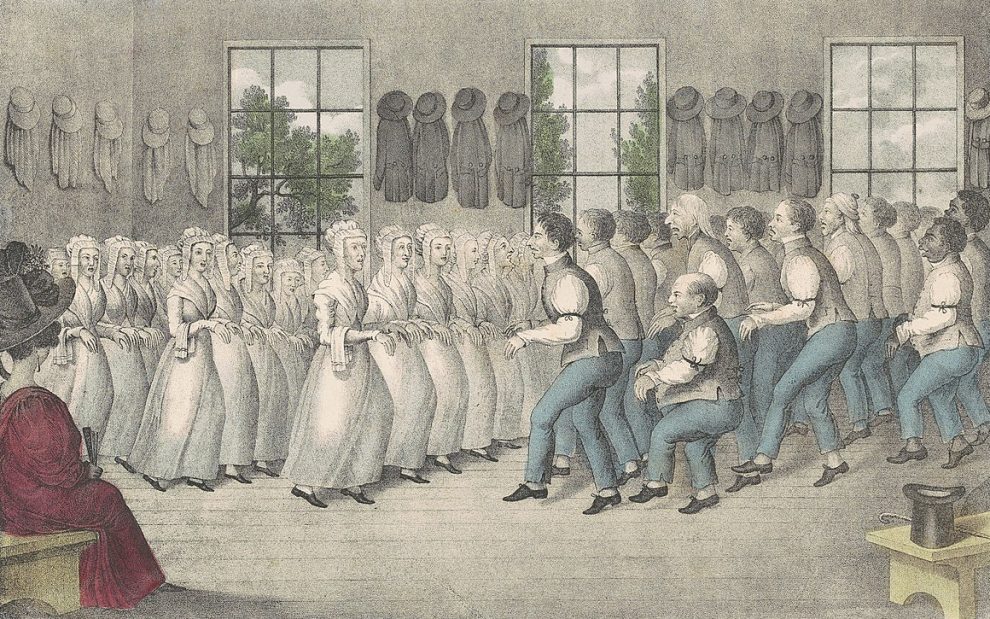
The Shakers—formally called the United Society of Believers in Christ’s Second Coming—were founded by Jane and James Wardley in Manchester in 1747. The Wardleys were Quakers who split off to form their own religious community. They became colloquially known as the Shaking Quakers, or Shakers, because of the ecstatic shaking and dancing that defined their worship, which they would engage in for multiple days at a time. At their height in the mid-19th century, there were close to 5,000 Shakers. Today, there are only three living Shakers.
The Shakers came to America in 1774, led by Mother Ann Lee, who was an illiterate factory worker. She became the community’s spiritual mother, and the Shakers believed she was Christ’s second coming in female form.
Lee preached utopian ideals inspired by the early Christian communities in Acts: holding property in common, gender and racial equality, and pacifism. In the new communities in America, she required celibacy among members and abolished private property. Lee was persecuted for her preaching, often violently, and she died at 48.
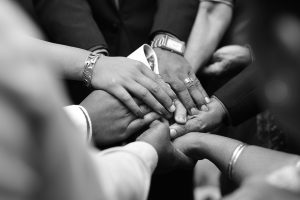
About 50 or so years after her death, from about 1837 to 1857, a period of Shaker history called the “Era of Manifestations,” Shaker women began receiving visions and messages. This is when they created many of the gift drawings. The women’s enormous creative outpouring included paintings, drawings, music, and dances, all depicting holy visions, symbols, and scenes. They believed their visions came from the Holy Spirit and from Mother Ann herself, who communicated directly with “instruments,” the creators of these works. (They did not use the term artists for themselves.)
The most well-known gift drawing is the Tree of Life by Hannah Cohoon, who was 29 in 1817 when she and her two children joined the Shaker community in Hancock, Massachusetts. Cohoon also created Tree of Light or Blazing Tree, a symmetric tree with green leaves and the thinnest of filaments spreading from the leaves like electricity. Cohoon’s blazing tree appears a few times in The Testament of Ann Lee, a 2025 film about Lee and the early Shakers.
I don’t believe Lee was the second coming of Christ in female form, but I don’t deny she felt a calling from the Spirit. She courageously acted on that calling in ways that supported the work of God. The influence of her teachings and the communities she founded continues to ripple through our world. Now a small and little-known religious movement, the Shakers’ commitment to gender and racial equality, communal living, and the abolition of private property, as well as their courage in living their values despite persecution, can still resonate with Catholics today.
Gender equality
Although the Shakers, like the Quakers, rejected ordained ministry and sacraments, our church would benefit from their teachings on gender diversity and women in leadership. In fact, in an era when many Catholics and clergy continue to dismiss or deny women’s spiritual authority and agency, the Shaker story might enrich the lives and faith of us all.
The Shakers affirmed and elevated women’s spiritual gifts of leadership, preaching, teaching, and more. They did this despite the very real risk, in Lee’s time, of being accused of being witches.
Until the mid-19th century in the United States, married women were legally considered their husbands’ property. Lee’s call to celibacy was a radical refusal of a system that created inequality and dehumanized women. In her mind, this was the only way true equality and agency between men and women could be achieved.
Communal living
The Shakers lived in self-sustaining communities where the needs of each person were met, and all things were held in common. In a spirit of simplicity, they denied themselves superfluities and indulgences such as jewelry or decorations. They sustained themselves through manual labor and saw labor as worship—“hands to work and hearts to God” was their motto.
The dignity of labor and living simply so that everyone’s needs are met is also part of Catholicism. The universal destination of goods, an important principle of Catholic social teaching, emphasizes that the Earth’s resources are meant to provide for the needs of all human beings. The common good always takes precedence over private ownership. This is the same ethic the Shakers followed.
Their communities—with their denial of private ownership, practice of celibacy, and vows of stability and obedience—were in some ways similar to monastic communities. For Shakers, though, their obedience was to the “inner voice” rather than any human authority figure. I understand this as a call to heed the Spirit’s voice in our lives, whether through creative outpourings, in our work, or in our relationships.
In the Rule of St. Benedict, Benedict lays out similar values that focus on manual labor and worship through the Divine Office. He taught that the opus Dei—the “work of God”—requires simplicity, humility, hospitality, and the cultivation of communal poverty, both material and spiritual. “The vice of private ownership must be uprooted from the monastery,” Benedict writes.
Living values despite persecution
The Shakers were persecuted in America because of their controversial beliefs. Not only did they have a woman leader, but they were also pacifists and abolitionists. In the Testament of Ann Lee, when the Shakers arrive in New York, they see colonists selling enslaved people. Lee says: “Sinful as it is incomprehensible. Every man, woman, and child is a child of God.” The Shakers walk by and yell, “Shame! Shame!” at the slaveholders and auctioneers.
Many Shaker communities were stations on the Underground Railroad. Because Shakers had always valued racial equality in their communities, fugitives could hide in plain sight, working alongside the other members of the community as they made their way to freedom. One prominent Black Shaker, Rebecca Cox Jackson, founded a Shaker community of mostly Black women in 1859 in Philadelphia. Considered a prophet by her followers, she preached about her visions and “gifts of power.”
Today, despite the daily news of racism, violence in our streets, wars and genocide, and other forms of human cruelty and ignorance, the Shakers’ example challenges me to live the values of my faith and conscience. The Shakers suffered persecution while remaining true to who they were and what they believed. Do I have a similar courage? Am I willing to accept the risk of standing up for God’s love?
Proclaiming the kingdom of heaven
The kingdom of heaven, said Jesus, is like a mustard seed that grows into a hardy shrub where birds can make their homes. The Shakers’ lives proclaimed the faithful labor that’s required to plant the tiny seeds of justice. Lee and her followers demonstrated their trust, letting God cultivate and prune as those seeds grew into bushes. Their example reveals the holiness of this work—and as modern-day Catholics, we can learn from their freedom and authenticity.
“Trees had to be bent but not broken,” Sally Promey writes in Spiritual Spectacles, a book about the Shaker gift drawings. Like trees, Shakers “had to respond freely and faithfully to God.” May we learn from their example.
Image: Wikimedia Commons/National Gallery of Art, Shakers Near Lebanon, Nathaniel Currier