Last summer, several Jewish and Christian clergy members condemned the Department of Homeland Security for using Hebrew scriptures in a recruitment video. In a video posted to their social media channels on July 7, 2025, the Department of Homeland Security superimposed the verse of Isaiah 6:8 over scenes of border agents tracking down migrants. Pictures of fully-armed agents in helicopters flying over the U.S.-Mexico border wall were juxtaposed with the words of the prophet Isaiah: “Then I heard the voice of the Lord saying, ‘Whom shall I send, and who will go for us?’ And I said, ‘Here am I; send me!’”
Rabbi Joshua Hammerman accused the department of “cherry-picking verses”; chasing down immigrants is diametrically opposed to the meaning of Isaiah’s mission. A Presbyterian minister called the ad blasphemy; an Oklahoma pastor said the agency was taking God’s name in vain.
“In our current context, the Bible is misused so often in so many ways,” says Rhonda Miska, the founder of Catholic Women’s Preaching Circle. “If someone is quoting the Bible and using Christian language and Christian imagery, but what they’re saying or doing doesn’t match the dignity of the human person and the preferential option for the poor,” then, she says, that should raise red flags. She adds that a good test for interpreting scripture is: Does this make me more loving?
Miska sums up the challenge of encountering scriptures in its messy complexity in one slick Pinterest mantra: “I can do all things in the power of Scripture taken out of context.”
Becoming more familiar with scripture
Although every Catholic liturgy includes readings from the Hebrew scriptures and the Christian gospels, as well as a smattering from Psalms and the Christian epistles, Catholics have long had a reputation for being Bible-illiterate. Unfortunately, the stereotype has some basis in fact. In 2010, for example, only 42 percent of Catholics polled by the Pew Research Center knew that Genesis was the first book of the Bible.
Miska, who works as director of communications at the Church of St. Timothy in Blaine, Minnesota, says that when she led a study group on women in the Bible, some of the older women in the group were delighted and surprised to read stories they had never heard before. Reading the scriptures, they told Miska, was not how they were raised to practice their faith. “They told me, ‘We never read the Bible—that wasn’t something we did.’” The members of the group had never known, for example, that the Song of Songs’ sensual love poetry is included in scripture. “That sense of discovery coming from a lifelong Catholic is really joyful for me,” says Miska.
Miska notes that Catholics have a different culture built around the Bible from that of other denominations, such as Evangelical Christians. Evangelical Christians are more likely to own a personal Bible, and they feel empowered to pick it up and read it frequently. Pew Research Center’s 2025 Religious Landscape Study found 51 percent of Evangelical Christians read scripture at least once a week. Meanwhile, the same Pew study reported that only 12 percent of adult Catholics read scripture weekly. A decade ago, however, the American Bible Society found that 86 percent of Catholics had “a high regard for Scripture” and 77 percent said they wanted to read it more than they did.
Today, technology is making the Bible easier to read than ever before. In 2021, for example, Ascension Press’s The Bible in the Year podcast skyrocketed to number one on the podcast download charts. Earlier this year, it approached one billion total downloads. Miska says that podcast, among other programs, has promoted a greater interest in and familiarity with the Bible.
One of the benefits of a program like The Bible in the Year,” she says, is that it walks listeners through the entire Bible. While Catholics hear scripture each week—or day—at Mass, the lectionary’s readings reflect a preselected perspective on the text.
“The lectionary is an interpretation,” says Sr. Carolyn Osiek, RSCJ. “The decisions to use these texts and not others gives an interpretation of scripture.”
Challenges of interpretation
Catholics who want to deepen their encounter with the Bible and incorporate it into their daily prayer practice may need to begin by understanding the interpretive lenses through which theologians, scholars, and faith communities have encountered scripture.
“There’s all this unlearning we have to do about the Bible before we can really learn,” Miska says. Reading the Bible through lenses other than those of the clerical class can be helpful. “If the primary interpreters of our scripture are men and mostly celibate men—that’s a lens of interpretation.” She goes on to explain: “The problem is when I assume I am not wearing any lenses, that my particularity is interpreted as simply a given as a white Western thinker. And Jesus was not a white Western thinker.”
Osiek, who has served as the president of the Catholic Biblical Association and the Society of Biblical Literature, says that Catholics have always looked to the tradition to help them understand scripture. “The sola scriptura principle is not Catholic teaching,” she says. Sola scriptura—“only scripture,” Martin Luther’s sixteenth-century motto—means the Bible is the Christian’s only source of authority. But scripture, Osiek says, “comes mediated through tradition and through the efforts of people to try to understand these texts.” She adds, “To read the text and say, ‘I know exactly what it means,’ is not the Catholic approach.”
Alicia Batten, professor of religious studies at the University of Waterloo, says scripture will always need cultural interpretation, since the Bible comes from a Near Eastern culture that’s thousands of years and miles removed from our own world. “Jesus lived in first-century Palestine, a place that is very different from twenty-first-century North America,” Batten says. She emphasizes the importance of cultural context in approaching scripture. “We risk imposing our own culture if we don’t recognize that [the scriptures] are coming from a very different context.”
The words we read in the United States in English or Spanish are translated copies of a copy of a copy, many times over. “Jesus spoke Aramaic, and it was written down in Greek,” Batten adds. Centuries of translation create another lens for reading the Bible, one we may not even realize is there because it has become so familiar.
The canon’s variety of voices and texts also complicates its meaning. Even a seemingly straightforward message like “Blessed are the poor” (Luke 6:20) has led to much debate, Batten says. After all, what does it mean to be poor? Batten notes that Matthew’s gospel offers its own interpretation of Jesus’ statement: “Blessed are the poor in spirit” (5:3).
Although we call the Bible a single entity and print it in a single physical volume, it contains multiple texts, books, and sources. Over the centuries, as the canon of scripture took form, Batten says, the recorded stories contained variations and different details. Far from this being a source of scandal or an indication of historical inaccuracies, the gospels’ variety was a valuable resource. The early church “knew they were not identical to one another. They were comfortable with this diversity,” Batten says.
The four gospels, Batten notes, are themselves forms of interpretation. They interpret the same figure—Jesus—in four different perspectives. Each of the gospels, which many biblical scholars believe emerged from a specific community’s oral tradition, interprets Jesus as was needed for its own particular geographical and cultural context. “They interpret Jesus and his life, ministry, significance,” says Batten, “because they have particular questions and challenges, not identical to one another.”
The need for discernment regarding God’s word was present even in Jesus’ day. The disciples, for example, ask Jesus to interpret what he is saying (Matthew 13:18–23). On another occasion, a scholar of the law asks Jesus how he interprets the scriptural injunction to “love your neighbor as yourself.” “How do you define my ‘neighbor’?” the scholar asks. “Who qualifies?” (See Luke 10:27–28.)
No foolproof rubric exists, Batten says, for determining what is a bad or wrong interpretation of the text. Bible scholars do well to go back to the text’s original language—whether Hebrew, Greek, or Aramaic—and then consider the text’s historical and cultural context.
Certain texts require new interpretation, says Batten, since they are problematic or have a tradition of poor interpretation. She points to Matthew 27:25 when the crowd at Jesus’ trial says, “His blood be on us and on our children.” European Christians interpreted that text to mean their Jewish neighbors were responsible for Jesus’ death, using it to justify their antisemitism. “It would not be right to say all Jews were condemned in that text,” Batten says.
How to grow in biblical literacy
Miska encourages readers to be aware of the nature of the voices that have interpreted scripture over the centuries—in art, in literature, in movies, in homilies—and then ask: What other lenses might be possible? What is it like, for example, to read and interpret the Bible as a woman? As a Nicaraguan rural farmer? As a Black American? As an LGBTQ+ person?
Miska says she has encountered students who believe the Bible says verbatim: God hates LGBTQ+ persons. “There’s assumptions, biblical illiteracy, and emotional responses.”
While homilies can do a lot to make scripture more accessible to the average Catholic, Miska believes Catholics can empower themselves to create a culture of scripture study on their own. “It’s easy to say that the homily on Sunday should do a million and four things,” she says. As a board member of Catholic Women Preach and a doctoral student at Aquinas Institute of Preaching, she says it is challenging—if not impossible—to do all the work of contextualizing scripture and imparting a spiritual lesson or reflection—“something that people take away with them that helps them live their lives”—in the 8 to 10 minutes of a Sunday homily. But, Miska says, Catholics can cultivate their own practices to foster a culture of study and actively deepen their encounter with the liturgy’s scripture.
She recommends reading the Sunday readings before attending Mass. “Get a good study Bible that has notes and cross-references,” she suggests. She also appreciates when churches have missalettes with the readings printed, so that parishioners can look at the texts the homilists reference. And finally, she encourages Catholics to understand that the lectionary for Mass is complicated and selective. If the only time you read the Bible is during Mass, “there’s tons of scripture that you’ll never see or hear or read.”
Movies about the Bible or visual art portraying biblical scenes can influence Catholics’ understanding of scripture both positively and negatively. The ways in which Jesus and the disciples have been portrayed in the Western visual artistic tradition and in movies have great power over our imaginations—and, as Osiek points out, “The visual tradition has been pretty much masculine and male-controlled until very recently.”
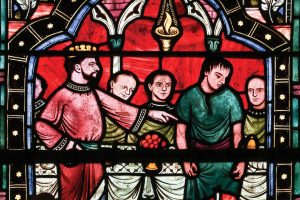
She points to paintings of the Last Supper as an example. If this was a Passover meal, as stated in the synoptic gospels, a dozen Galilean men traveling to celebrate the holiest night of the Jewish year would not have left their families behind. “Are they going to exclude their families from this dinner?” asks Osiek. This means that rather than only 13 men in a room, women and children would have been there as well (but seated separately, according to first-century Jewish custom).
At Miska’s home parish of St. Thomas More in St. Paul, Minnesota, their Ignatian Spirituality Center promotes the Ignatian practice of using the imagination to encounter scripture. “It is drawing people in to be protagonists, to use that great word of Pope Francis. That’s a really great tool,” she says.
Ultimately, scripture is not supposed to be full of easy answers or simple comfort. When reading the Bible, it is okay to walk away with a lot of questions, with multiple interpretations, scratching our heads. Scripture has a prophetic element to it, Sr. Osiek says—and “prophecy is meant to raise questions—what we think is all right, is it really all right?” Prophetic speech shakes listeners out of their routines. It questions their assumptions, priorities, and privileges.
Unlike the militaristic application of Christian nationalists, a genuine understanding of scripture challenges our status systems and our social hierarchies. We see in the Bible God’s way of looking at the world—and we must ask ourselves: Do I perceive the world around me the same way God does?
“The Bible does raise a lot of questions when we take it seriously,” says Osiek.
Image: Unsplash