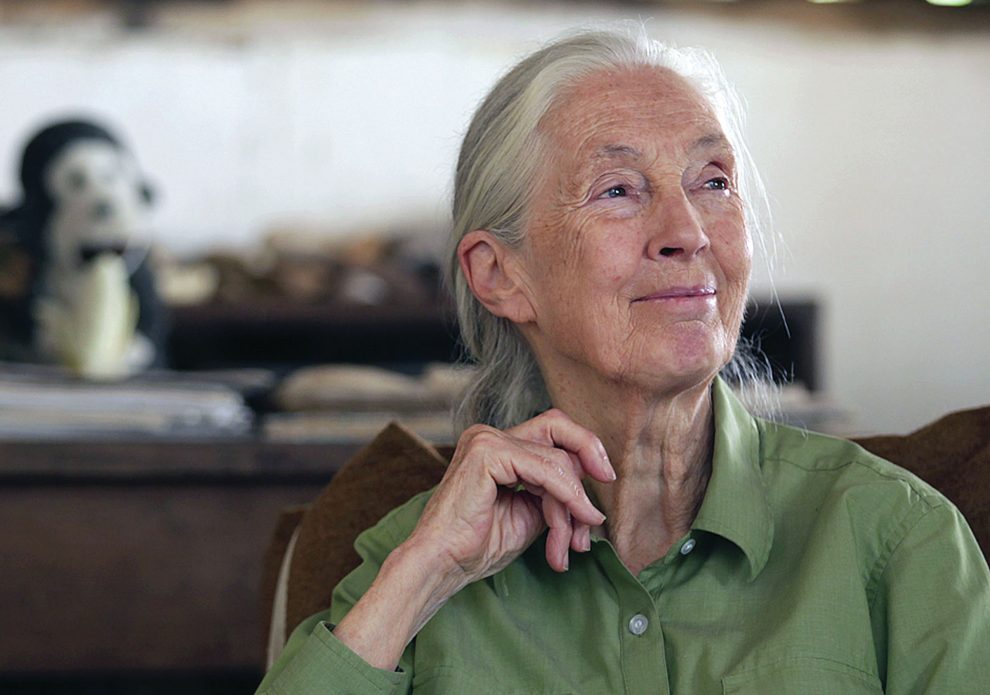
Few modern figures have been as universally respected and admired as Jane Goodall. Goodall was known first for being an anthropologist and primatologist, famously immersing herself with chimpanzees in Tanzania to advance significant scientific understandings of how chimpanzees and humans share qualities. Her life’s work included the establishment of wildlife sanctuaries, reforestation projections, wildlife conservation efforts, global youth programming, and global peace work. She was, to the very end of her days, a prolific author and lecturer who traveled the world promoting care for the Earth, conservation, and action for the common good.
Known for her exceeding calmness, gentleness, and thoughtful wonder, which attracted an inquisitive chimpanzee as much as the attention of global humanitarian organizations, Goodall’s advances in our understanding of the connectedness between humanity and the natural world spilled over into her efforts to bring about more peace, more contributions to the common good, and more sustainable ways to make our world better.
Meeting Jane Goodall
Admittedly, I had a particular experience that informed my outlook: When I was a child of intermediate school age, my public school had a robust Roots and Shoots program and an engaged student and faculty population. I loved wandering the verdant and well-cared-for grounds of Hillside School, so named for its enviable location on a hill overlooking the Raritan Valley, and had a special fondness for an enormous tree that sat just beyond the wooden playground. Still very much an introvert, I vastly preferred to read a book under the shade of that tree rather than cavort with my peers.
Because of Katrina Macht, our enthusiastic program advisor, we were able to secure a visit from the founder of Roots and Shoots herself: Dr. Jane Goodall. Due to my involvement in our Roots and Shoots chapter—and my having a “tiger mother” whose oversight of the before-and-after-school programs ensured her only child’s presence—I was able to be part of the group that hosted Goodall. At the age of 10, I was able to walk alongside Goodall, who asked me about my interests, listened thoughtfully to my opinions about the tree, and made me feel like my small idea of protecting that tree held some weight. Just as she honored the divine spark in all of creation, she made a precocious 10-year-old feel honored in our brief encounter.
Now, as an adult, I can recognize that Goodall adeptly straddled the natural and supernatural worlds, not placing them at odds with each other, but treating them as inextricably linked. She was raised Christian, studied theology and philosophy for pleasure, and was unapologetic about the quiet staunchness of her own spiritual beliefs while operating in a context—the world of science—that was often presented as being at tremendous odds with religion.
God in all things
She wrote a book called Reason for Hope: A Spiritual Journey (Grand Central Publishing) that argued for respect for life in all forms as the tie that binds our care for the natural world and care for all humanity, and credited her experiences in Tanzania living amongst the chimpanzees with her own spiritual reawakening.
“When I was in Gombe,” she once said, “I felt very, very close to a great spiritual power. I felt this spiritual power in every living thing. We call it our soul. Well if we have a soul, then that spark of energy is in chimpanzees, they have souls. And the trees, they have a soul, too. They’ve got a spark of that divine energy.”
Goodall’s spiritual development was not bound singularly to the forests of Tanzania; in Reason for Hope, she details an experience of visiting the Cathedral of Notre Dame in Paris and reflecting in front of the Rose Window while an organ played a piece by Bach:
That moment, a suddenly captured moment of eternity, was perhaps the closest I have ever come to experiencing ecstasy, the ecstasy of the mystic. How could I believe it was the chance gyrations of bits of primeval dust that had led up to that moment in time—the cathedral soaring to the sky; the collective inspiration and faith of those who caused it to be built; the advent of Bach himself; the brain, his brain, that translated truth into music; and the mind that could, as mine did then, comprehend the whole inexorable progression of evolution? Since I cannot believe that this was the result of chance, I have to admit I am anti-chance. And so I must believe in a guiding power in the universe—in other words, I must believe in God.
The awe that Goodall experienced when surrounded by nature in the Gombe forest of Tanzania aligned fluidly with the ecstasy of hearing a classical piece performed in the Cathedral of Notre Dame in Paris; sacred space, to Goodall, was everywhere and with everything; nothing could be denied that divine energy. It was as plain and simple to the great scientist as any other fact: immovable and clear, thus freeing our minds.
A growing reverence
In my lifetime, as the Catholic Church strengthened its articulation of an ecological spirituality—most acutely in the wake of Laudato Si’, Pope Francis’ encyclical on care for our common home—I found myself deepening my own understanding of what it meant to find God in all things and what honoring the dignity of God’s creation looked like for me.
I continue to take inspiration from Goodall’s gentle yet resolute outlook and understand care for creation as stemming from a sense of wonder and reverence for God’s fingerprints on every living thing. To care for “the least of these,” as Christ challenges us to do in Matthew 25, includes caring for those beings that have no voice to speak for themselves. For Goodall, there was no “us versus them” in the relation of humans to animals or plants. We are all God’s wondrous creation.
Twenty-five years later, I believe that tree is long gone from the property of Hillside Intermediate School. My old advisor is enjoying a well-deserved retirement somewhere in Texas. Hillside Intermediate School is still a Roots and Shoots school with an active membership. Goodall has gone on to her eternal rest. And I firmly believe that the fullness of the beatific vision which we all yearn to be granted at the end of our lives included, for her, the clarity of how interconnected all living things truly are, confirmed by a God she quietly served with her witness.
This article also appears in the April 2026 issue of U.S. Catholic (Vol. 91, No. 4, page 42-43). Click here to subscribe to the magazine.