The only thing I really knew Iceland for was its hot dogs, sold from a stand called Bæjarins Beztu Pylsur. Novelist John Green reviewed them on a five-star scale in his book, The Anthropocene Reviewed (Dutton). The essay moves me in ways difficult to put into words.
In it Green says, “We should get out of the habit of saying that anything is once-in-a-lifetime. We should stop pretending that we have any idea how long a lifetime is, or what might happen in one.”
This became a phrase I would repeat again and again to myself, in moments both of joy and sorrow. I started listening to Green’s audio version of the essay any time I traveled, or any time I was feeling lost. I listened to it as my plane took off in Newark, headed toward the small island of Iceland for myself.
We touched down on National Day of Iceland, a day spent celebrating Iceland’s independence from Denmark in 1944. We wove our way around the city, spying young people with braided hair and Icelandic flags painted on their cheeks. There were dancing and drums, balloons and kites, a marching band and costumed characters on stilts. I got to take part in their joy.
At the end of the day, we ate the hot dogs from Bæjarins Beztu Pylsur, seated together at a picnic table. Icelandic hot dogs are served with both raw and crispy onions, ketchup, brown mustard, and remoulade. Somehow, I was here, in a remote corner of the world, after months of imagining it. It felt like a pilgrimage of sorts.
Our visit coincided with the summer solstice, a unique time where the sun barely sets for an hour before rising again. We spent our time driving around the little island, eating at restaurants owned by local farming families and sleeping in hostels and wooden camping pods.
To witness the Earth’s turning from spring to summer as I experienced a rebirth of my own felt like an offering. I got to shift alongside the Earth and appreciate its capabilities, recognizing that a balance must be held between our bodies and the Earth. We can’t claim to appreciate the power of creation unless we tend and explore it well.
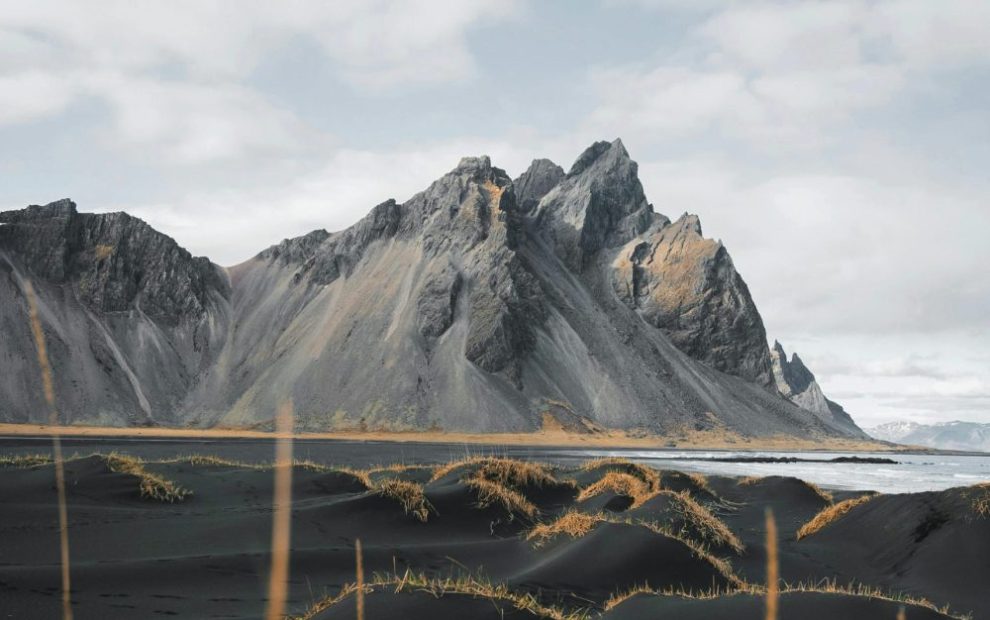
Over the next seven days, we drove around the island, and I discovered that Iceland was at once everything and nothing that I had imagined. It is a land of improbabilities. I marveled at both the vast and immeasurably small details that make up the island.
The landscape was otherworldly, made up of rocky layers of lava that have cooled and been overtaken by moss. Tiny waterfalls and plumes of steam billow out of fissures in the earth. Churches with red roofs peek out in front of a looming volcano across the green and misty landscape. At the end of each day, I’d shake a tiny collection of sand, rocks, and ash from my boots.
Here in this ancient landscape, an undeniable spirituality moves. Each time we’d arrive at a new waterfall, I’d repeat Psalm 42 to myself: “As the deer pants for streams of water, so my soul pants for you, my God. My soul thirsts for God, for the living God. When can I go and meet with God?”
Again and again in scripture, people convene with God in the wilderness. They wrestle and walk off their doubts before becoming clean. Iceland is my wilderness, harsh and sacred.
At Thingvellir National Park, the site where Iceland officially became an independent nation, I hiked to the top of a gorge that formed as Eurasian and North American tectonic plates split apart. Part of a fissure that runs from the Arctic Ocean and down through the Atlantic, the plates continue to drift further apart, creating ongoing volcanic activity.
Kerid was at one point a volcano, which erupted and left a crater in its place. Its hidden power was realized and a great lake was left in its stead. I walked the heights and depths of the crater. To hike something requires a lot both physically and emotionally. Up on the ledge, I began to feel a nagging pang of doubt. To stand on the edge of something so volatile and powerful felt like a kind of wrestling. And yet I felt like something abiding and transformational took place in me. The earth beneath our feet can shift without warning. A volcano can erupt and become a lake. And yet that change can create another fathomless wonder. Or as we read in Ephesians 3:18, “how wide and long and high and deep is the love of Christ.”
At Lake Laugarvatn we ran shrieking into the icy waters, hoping to discover some of the pockets of naturally heated water that pop up in the lake.
Laugarvatn Fontana, a local spa, harnesses the mineral-rich waters for pools and steam baths. The spa is also host to a bakery that cooks its rye bread in the hot black sand along the lake’s shore. Along with other travelers, we took a geothermal baking tour, where they showed us how the sand cooks the bread.
The land and its capabilities are for everyone to share, our guide explained. The spa can’t claim the space to bake the bread, in the same way that they can’t say the hot spring water is only for them. Anyone can swim the geothermal lake, can bake their bread on the shore.
I gleefully buried the dough for a 24-hour nap as our guide prayed to St. Anthony for the bread to turn out well. Next I dug up the pot that someone else had buried the day before. I relished in the grittiness of resurrecting something from the bubbling earth, removing the lid to find a loaf of fresh rye bread. Together as strangers we broke the bread, slathered it with butter, and topped it with smoked trout. This was communion.
Our time in Iceland concluded with a morning at Blue Lagoon, a geothermal spa. The area surrounding the Blue Lagoon had recently experienced a series of volcanic eruptions that blocked the main road. We were surrounded by fields of cooling lava as we drove to the lagoon, smoke pluming around the car accompanied by a burnt smell. On our detour, the GPS kept pinging at us, letting us know we were nowhere it could identify.
Time felt unreal when I was in the waters. At some point, we realized we had been there for nearly three hours. When we left, it felt like my soul had been cleansed, the muck stripped away.
For the six-hour plane ride home, I did nothing but eat sourdough and read Sister Julia Walsh’s memoir, For Love of the Broken Body. In it she details the moment she fell from a great height and quite literally had to claw her way out of the ordeal.
In one part, she writes out the lyrics to the hymn “How Great Thou Art”: “ When I in awesome wonder / Consider all the works / Thy hands have made . . . Then sings my soul, / my Savior God to thee.”
When I read that portion of Walsh’s book, I broke down crying. The whole trip came together for me at that moment. I walked the depths and heights of Iceland, its waterfalls, crevices, caves, and craters. I marveled at God’s most perfect creation. I saw the great care that God put into the intricacies of this small island. And the same amount of care God put into creating Iceland was also put into creating me. It was on this small island in the Atlantic that I discovered just how intricately God loves and cares about me specifically.
Nearly a year later, I returned to Iceland with my husband on the final leg of our three-country honeymoon. During our time there, I found myself again and again humming along to “How Great Thou Art.”
How miraculous it was to show my husband around the country that, for me, represents eternity, possibility, and goodness. We got to be somewhere that at one point felt unreachable. Being there was a gift. We ordered hot dogs from Bæjarins Beztu Pylsur, strolled through the rainbow-painted road that leads to Hallgrimskirkja, sat on a bench hunched over cinnamon rolls and coffee on a windy day. I realized that I didn’t know what once-in-a-lifetime meant anymore.
Iceland is filled with endless marvels of God’s creation that I will continue to be surprised and delighted by. Part of that beauty is in knowing that its wildness can change in a moment, that it cannot last, but that it can last a little longer if we continue to treat it with the same care that God put into creating it. This possibility and goodness can only be if we take up the collective responsibility to care for creation. One of the highest forms of praise we can offer to God is respecting what has been created and looking after the Earth that has been given to us to share. Our bodies will not last, but the places where our feet have walked will remain.
I’ve traveled the great expanses of Iceland with my friends, walked the ledge of Kerid, where I’ve never felt so small. I found God at the top of Skógafoss falls as I caught my breath from the trek, as I hunted for snails at Djupalonssandur Beach while the tide came in. How wonderful a gift it has been to delight in creation, to participate in it and be creation itself.
The greatest gift I’ve been given is the chance to traverse Iceland’s great heights and depths, to become the dirt itself. Bury me with the bread at Lake Laugarvatn. Make me something new.
This article also appears in the April 2026 issue of U.S. Catholic (Vol. 91, No. 4, pages 18-19). Click here to subscribe to the magazine.
Image: Pexels/Thibaut Tattevin