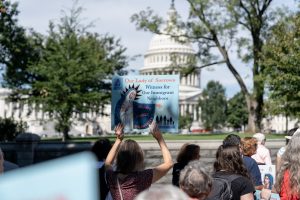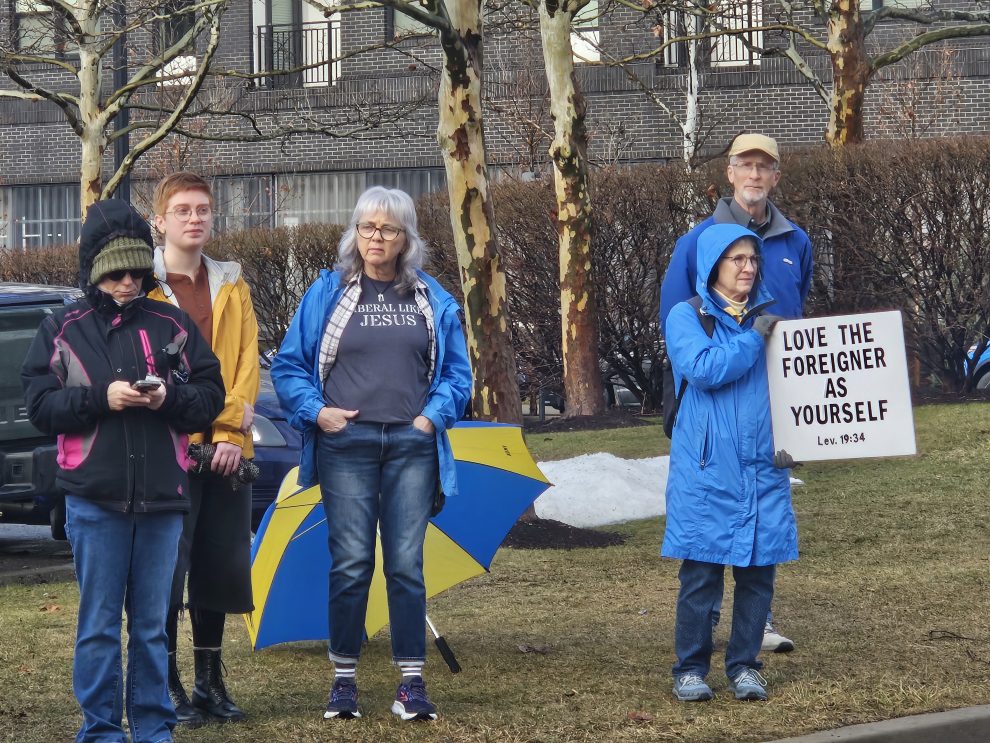
When Gretchen Jezerc learned of ICE raids ramping up in her hometown of Pittsburgh, she knew she had to do something. Along with thousands of others, she signed up for a local training to observe—and when possible, prevent—neighbors from being deported. She was able to put her skills to use sooner than she wanted.
“Someone called in about ICE activity near a local restaurant,” she says. “Rapid response volunteers came down and began documenting. We got the idea to call news teams, and someone had tipped off the employees inside, so they stayed inside after the restaurant closed. When the videographer from the news started filming, the vehicles left, and workers were able to go home to their families.”
Unfortunately, in this case ICE came back and completed the raid three weeks later. “But at least the workers had time to prepare,” Jezerc says. “There’s a lot that people facing deportation need to do. They need power of attorney, guardianship for their kids, and so much more.”
Jezerc is one of thousands of volunteers involved with Frontline Dignity, a new organization focused on building rapid response teams to observe and, when possible, to prevent ICE raids.
“We’re focused on building community capacity to respond lawfully, effectively, and with dignity to the situation of the most vulnerable,” states Jaime Martinez, Frontline Dignity’s 23-year-old founder. “There’s a specific recognition that it’s not only about immigration. How we protect our neighbors from ICE raids has consequences for other issues that affect our dignity, like homelessness, drug addiction, and mass incarceration.”
Martinez founded Frontline Dignity in late 2025 after working to build ICE rapid response teams with Casa San José, a Pittsburgh organization that connects local Latino communities with social services. Sister of Saint Joseph Janice Vanderneck, who cut her teeth as a missionary in Latin America and then sought to respond to the needs of Latinos in her parish, notes that for anyone aspiring to do on-the-ground immigrant solidarity work, proper training and preparation are key—both for the communities affected and those who seek to help them.
“Our first step was to do Know Your Rights sessions with the community in Spanish as extensively as possible,” Vanderneck explains. “We gave people cards with instructions—a basic summary of what your rights are: to not open the door without a warrant, to not speak to authorities or answer questions.”
They then worked to train teams of people to be on call when ICE is present. “The primary responsibility is to record what you see going on as evidence. That was important with Renee Good and Alex Pretti,” Vanderneck says. “We need rapid response volunteers to get the name and information of the person being taken: their country of origin and an A number that identifies the person.”
The rapid response team, Vanderneck says, “tells the family members what kinds of resources they can get from an organization like Casa San José—our bond fund, lawyers, the ICE locater to find what facility their loved one is in, instructions on how to deposit money in a commissary for someone in detention. When the breadwinner is taken, we have places where families can stay,” she says, mentioning that a local parish has offered their rectory.
Vanderneck describes Frontline Dignity as adding another layer of support on the ground. “We need as much support for our immigrant neighbors as we can get. Frontline Dignity is sending patrols out into neighborhoods. Immigration enforcement has stepped up in our geographic area, as it is doing in other immigrant-friendly cities,” she says. Vanderneck notes that there are more ICE agents, Homeland Security enforcement, and Customs and Border Patrol—“they usually only identify themselves as police, which is a deliberate attempt to confuse people. Frontline Dignity is sending people out to patrol areas where we have seen patterns of arrest, to say ‘we see ICE here.’”
Jezerc, who serves on the leadership team of the Catholic lay organization Catholics for Change in Our Church, joined Casa San José’s and Frontline Dignity’s rapid response teams after feeling disturbed by our current political reality. As a Catholic, she affirms that immigrant solidarity and rapid response work need to be de-politicized and presented as human dignity issues rather than political ones. “This approach of sending rapid response teams out to provide support in the moment to people in need is in concert with Catholic Social Teaching,” she states.
Jezerc adds that Pittsburgh’s bishop, Mark Eckman, “recently sent a letter about welcoming the stranger. We now have statements from the USCCB, bishops and cardinals speaking about the importance of standing in solidarity with our immigrant brothers and sisters. This is not a fringe issue. It is mainstream Catholic Social Teaching. It’s a human dignity issue. That is one of the most important things for us to keep in mind as we are positioning it.”
Martinez, a cradle Catholic who seeks to take Frontline Dignity’s rapid response approach nationwide, states that this work is deeply rooted in his faith. “Christ has called us to care for our neighbors, to love and support and care for others, and to stand for truth in the process. If we can scale this rapid response approach to a national level, we’ll recognize that we are all human beings and cannot stand to see others dehumanized or unjustly treated.”
Martinez urges people seeking to make a difference to work at a hyper-local level. “We need to organize block by block. It starts by getting to know your neighbors on our own street. This could be the difference between a family together and a family torn apart.”
He recognizes that getting people into a “neighborhood mindset” is difficult and does not happen overnight, and our digital environment does not help. “People online are lamenting the state of the world, calling each other Nazis,” he notes. “How do we pull people out of the mindset of hopelessness and channel that valid anger and frustration into a real purpose: dignity, which everyone understands, from the most conservative Catholic to the most radical anarchist? We are all made in the image and likeness of God.”
Martinez sees this work as holding the potential to bring neighbors together across ideological divides. “At a moment when we face so much crisis, when we are being discouraged to come together as a community, we have a real opportunity to act on behalf of vulnerable neighbors, but also to reinstate dignity into how we interact with one another and build a community we can be much more proud of.”
Perhaps not everyone is prepared to join a rapid response team. For people overwhelmed by work and family responsibilities, Vanderneck states that there is still much to do. “First and foremost, talk to all your elected representatives, from your town council to your state representations to Congress. Tell them you find what you see going on as counter to our faith. There’s a moral obligation to work together in a bipartisan way to resolve everyone’s concerns in a way that is humane and moral,” she says.
Vanderneck agrees with Martinez that de-polarization is also important. “Seek opportunities in conversation with people to speak in a dignified manner, to refrain from using language that is demonizing anybody—either the immigrant or those who are in favor of seeing immigrants deported. Any demonizing language on any side of the issue is divisive and contributes to polarization in our country.”
For people who have a little more time to help, Vanderneck cites the most basic need as food. “Food insecurity has grown among immigrants who are afraid to go out or have lost their jobs. Contributing to food banks, finding out which food banks service immigrant clients is a help. You might help those food banks by driving food to families. We at Casa San José drive food to families who are afraid to go out.”
For those who have money to donate, Vanderneck says, contributing to a bond fund can help some people get out of detention.
“And if you can commit time,” Vanderneck says, “get involved in rapid response teams like Casa San José and Frontline Dignity. Teaching English to newly arrived immigrants is another way contribute.”
On April 12, the Sisters of Divine Providence awarded Martinez and Vanderneck the Kettler Award, established in 1998 to honor individuals who demonstrate a strong commitment to social justice.
For Martinez, this work is central to our calling as Catholics. He cites Saint Pier Giorgio Frassati, who resisted fascism in Italy, and Maximilian Kolbe, who gave his life for another man in Auschwitz. “Our church is meant to be apostolic, to reach to the ends of the earth preaching truth and justice, to choose goodness and love through our own free will,” he says.
“I think about how saints are ordinary people choosing to say yes, transforming how the church sees itself, our understanding with each other and with God,” Martinez says. “I see this work—the holy work of getting to know our neighbors—as fundamentally a gospel calling.”
Image: Courtesy of Jeannine Pitas