

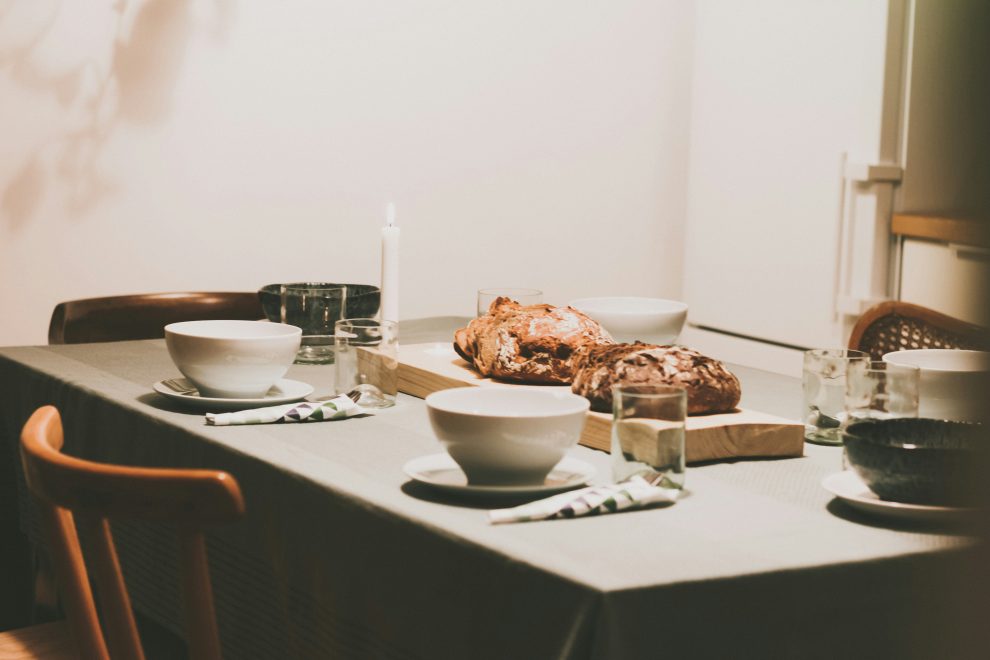
Some of my earliest memories take place at the dinner table.
Ours was in a sunroom with floor-to-ceiling windows that gave the effect of eating outside. When I got antsy in my seat, I would crane my neck to see the tops of trees and what they might drop onto our skylights. Sometimes pine needles would build up in the windowpanes until the wind blew them free.
Usually, though, there was plenty to observe around the table. As the second oldest of six children, I was rarely bored at mealtimes. To my eyes, our eight-foot-long table was about as big as a swimming pool. It was also usually crowded, noisy, and entertaining. Sometimes special guests or grandparents would be brave enough to join us for a meal, and we’d encounter new stories or menu items.
One particularly social evening—probably a holiday, when food and people filled every square inch of space, and all the special dishes were out—I thought I might take advantage of the crowd and slip under the table undetected. My plan was to sneak past the rows of adult feet to the end of the table where the butter dish lay, unattended and enticing. I reached up for it, took a large bite out of the middle of the soft yellow stuff I always wanted more of, then slid it back onto the table above my head. I thought it was the perfect heist; nobody could possibly suspect me. When I climbed back up into my seat, every adult in the room was grinning in my direction.
When I reflect on how I felt after getting caught in my first act of theft, I remember incredulity. How did they all know? I also remember disappointment. Apparently, butter tastes much better on bread. But I do not remember shame. There was a safety in that first community around the table, a permission to become myself through trial and error and the input of wise guides. I wasn’t perfect or the center of things, but I belonged. In my early years, I enjoyed the kind of stability that children can intuit even if they can’t articulate.
The stability was short-lived.
After a series of cross-country moves, we were living in a temporary home—with plans to build my parents’ dream house nearby—when my father was diagnosed with an aggressive form of cancer. For the next four years, our family life was in constant flux. We moved again, but not into the dream house. We changed schools three times.
My parents made every effort to save my father’s life, which required a fair amount of travel. While they pursued experimental medical treatments at top hospitals, my siblings and I were split up and sent to various other homes. We stayed with friends and relatives who could keep us for three or four weeks at a time.

My first extended stay away from my parents was over Thanksgiving. I was eleven. For the most part, I had a great time playing with my cousins and hearing my aunt tell stories from when my dad was a kid. On this trip I learned to shuffle a deck of cards and use the (dial-up) internet on the family computer in their kitchen. But it was also when the insomnia began. At night, I was haunted by an aching sadness I couldn’t explain or understand. I just knew I wasn’t home and that nothing was the same as it was before. At the borrowed tables of friends and relatives, I was always a partial outsider.
My father died slowly. This was a gift because it meant we got more time, more memories with him. But it was also a curse because as he declined, those memories grew more tragic. One winter, my younger brother and I were in our school’s production of A Christmas Carol. My dad insisted on coming to see it. We set up an armchair in the auditorium for him to attend comfortably, but during the performance he began seizing and had to be carried outside by four other men.
After he died, the bank foreclosed on our home and we moved again, into an old parsonage behind a Lutheran church that gave my mom a good deal on rent. Either because it was a smaller space than we’d ever lived in, or because my mother couldn’t bear to look at my father’s empty chair every day, she shoved our massive dining table against a window in the new dining room. It now only seated seven.
Childhood loss interrupted my sense of safety and belonging in the world. Ordinary transitions, like a move to a different house or visits with cousins, were colored by traumatic transitions—like death. The result was a cumulative feeling of homelessness, a displacement and disconnection in the presence of others. Subconsciously, I internalized this vulnerability as shame.
This was the subtext of my story when I began taking weekly Communion at my church.
I was halfway through seminary by then and had already experienced a fair amount of healing. Committed mentors, skilled therapists, and a praying mother had helped to preserve my Christian faith and nourish my burgeoning call to ministry. But when I began worshiping at a church that invited me to walk to the front each week with empty hands outstretched, to look another human being in the eye in hopes of being fed, all my childhood insecurity rose straight to the surface.
Every week, I struggled to come forward and receive Communion. But at the end of each service, we prayed a prayer that interpreted my tears. In unison, the congregation said:
Almighty God, eternal Father,
we have sat at your feet,
learned from your word,
and eaten from your table.
We give you thanks and praise
for accepting us into your family.
Send us out with your blessing,
to live and to witness for you in the power of your Spirit,
through Jesus Christ, the firstborn from the dead.
(Anglican Church of Kenya, Our Modern Services [Uzima Press, 2002], 83).
In the practice of Communion, I was invited to rehearse bodily what I believed doctrinally: By grace, we are grafted into God’s family. I knew this intellectually, but was undone by the tangible, liturgical expression of Christ’s profound welcome. Week after week as I came to the Table—his Table—he confronted my fear of abandonment, my feelings of displacement, my shame. And in exchange he offered me himself. Slowly, I found a new sense of belonging at this Table.
The Bible describes Christian faith primarily in familial terms. Those who follow Jesus are called his bride, his body, his brothers and sisters. In teaching his disciples to pray, he instructed us to call God “Father” (See Mt 6:9). And in teaching us to worship, he instituted a meal. In my tradition we call this meal a “sacrament,” which stems from the word mystery: When we share the Lord’s Supper, we mysteriously experience fellowship with him. We eat from his table. We are accepted into his family.
Belonging to God’s family doesn’t replace our family of origin. It doesn’t erase traumatic memories or the ache of personal losses. But it does write them into a larger story of hope. Communion with Christ reorients us to face our various griefs from a place of safety and strength. In him we find a home.
I’ve been receiving weekly Communion for about twelve years now. As a priest, I am often on the other side of the Table from where I first began receiving. When I hold the bread and wine before my congregation, I extend to them the same invitation that healed me: “Taste and see that the Lord is good!” (Ps 34:8). I do so even though my own healing isn’t complete—and won’t be until he comes.
Taken from Feasting on Hope by Hannah Miller King .Copyright (c) 2026 by Hannah Miller King. Used by permission of InterVarsity Press. www.ivpress.com.
Image: Unsplash/Brina Blum




Add comment