

I’ll admit, I’m judgy. For example, I once grew irritated with a good friend after they went a few weeks without communicating. Then I received their apologetic email, and I realized my friend had simply been swamped at work. And this is one of the milder instances of me being judgmental.
This inclination of mine is probably the reason I bought Isaac Slater’s “Do Not Judge Anyone”: Desert Wisdom for a Polarized World (Liturgical Press), though I did hesitate because of the subtitle.Slater is a monk of the Abbey of the Genesee in New York, and I’ve often thought that most of us—parents with autistic children, ICU nurses, spouses caring for Alzheimer’s patients—need a spirituality that is less monastic, more from the trenches.
Good thing I got past that judgment, because my journal for the last couple months is studded with quotes from the book, and exclamations like, “so glad I bought it!” And if the author had dedicated it to those who most needed it, my name would be right there on page one.
Slater has a witty, well-informed style that avoids the standard cliches about forgiveness and offers some startling new metaphors. I especially like one drawn from improv theater, where a player can either accept or block cues offered by another actor. The skilled actor, as he describes it, “overaccepts”—they take on the cue “with a kind of wild generosity spinning it in some new unforeseen and imaginative direction.” This feels to me like God’s style, marked by creativity, spontaneity and freedom.
Think of Jesus with the adulterous woman—deflecting the murderous frenzy of the mob. Or the father of the prodigal son, who sets aside his paternal dignity to run and welcome the younger son, then plead with the older. Like the divine father, he treats each son precisely as son, trying with lavish love to awaken his generous likeness in each. Whether or not he reconciles the sons, he calls forth their true natures as images of the father, and he focuses on the joy of a reunion, creating a space without judgment.
If we have been forgiven, over and over, how can we deny that grace to anyone else? One desert father compares it to a trade we learn through practice and repeated failure. God sees our apprenticeship and helps us along.
Slater points out that when we judge, we overlook the enormous complexity of the person, reducing a unique individual to one bad decision or off-handed comment. How little we really know about someone’s background, motives, wounds, dreams—even those closest to us.
It was inspiring to learn the concept of dilatatio cordis, or heart-expansion. This willingness to suffer with others contrasts with judgment that constricts the soul—narrowing, stiffening, reducing our sense of possibility. When our hearts are set on God, Slater reminds us, distractions—including the negative judgments others may make of us—seem trivial and can’t gain a foothold. Or, as Abba Macarius suggests: “If we keep in remembrance the bad things said to us by people, we are suppressing the power of the remembrance of God.”

Slater may be pointing us toward a remedy for the rigid separation of Us and Them, in which judgments fly fast and furious. “If ultimately ALL will be together… gazing on the face of God forever, it’s harder to lose sight of the redeemable kernel in even our most deplorable adversary. Each person expresses a unique, irreplaceable facet of the divine, however disfigured,” he writes.
Furthermore, if we obsess about the flaws of others, we may lose sight of God’s kindness, the mercy encircling us, the divine power that will ultimately bring all to account. Appearances may deceive us, but God sees clearly, brilliantly. As fractured selves, we live in the tension between two horizons: the experience of grace and the “punitive storylines woven by sin,” Slater writes.
When we are aware of these disharmonies, we can slow our response to discord and look for imaginative means of repair, remembering that we are “a mosaic of broken pieces, only coming together in Christ.”
Some people carry a small pebble in their pockets to remind them not to throw stones. If it were slightly smaller, I’d wedge this book in my pocket, lightly brushing its cover to remind me to pause, whenever the impulse to judge arises.
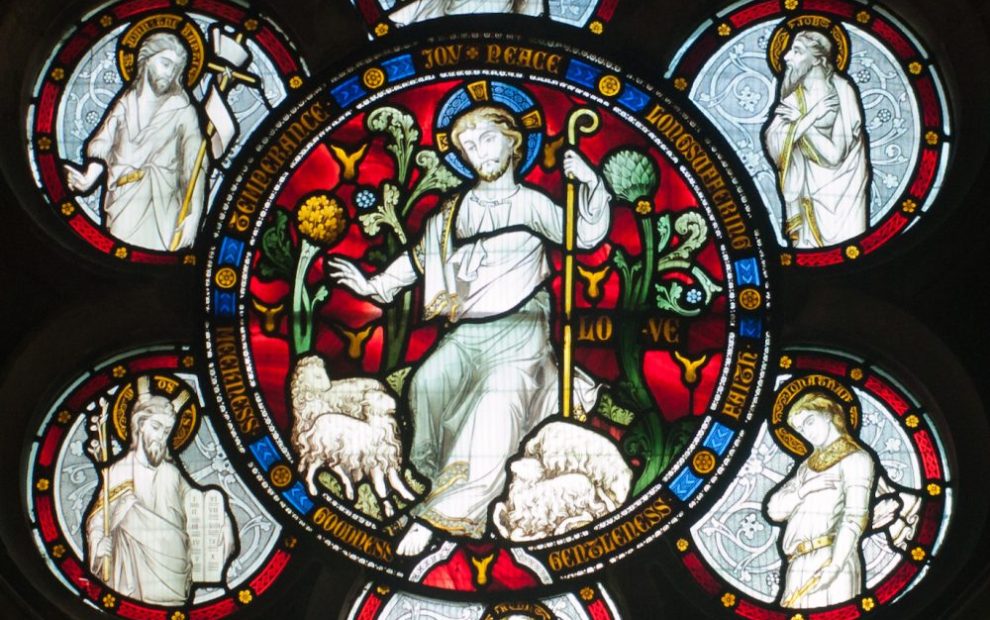
Image: Wikimedia Commons/Andreas F. Borchert (CC BY-SA 3.0)






Add comment