

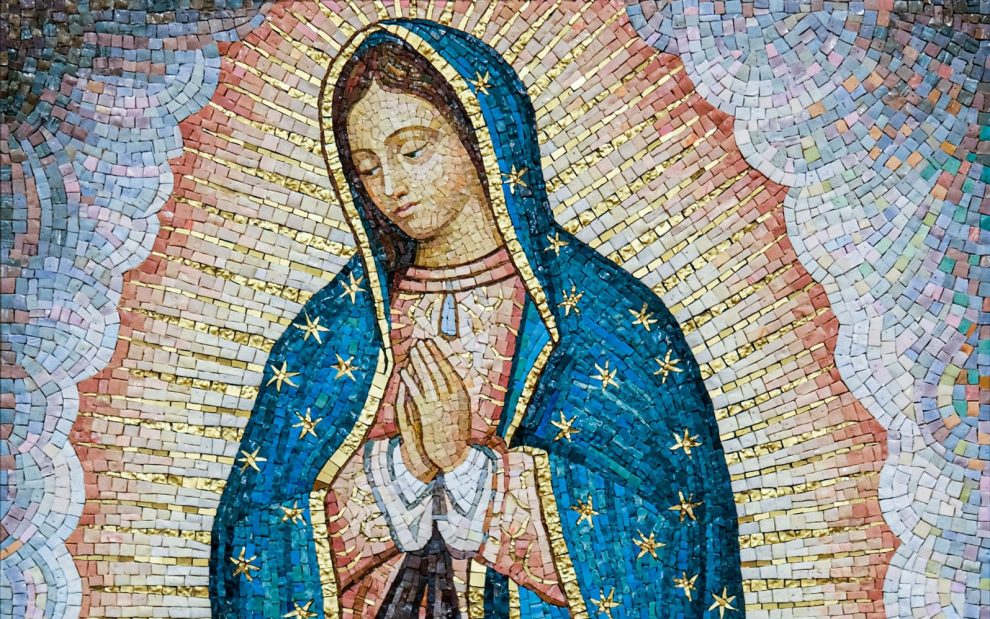
Theologian Kat Armas started thinking seriously about Mary’s role in the Catholic faith when she wrote her first book, Abuelita Faith (Baker Books), which centers around her grandmother’s life and how mothers and grandmothers pass on their theologies. “I began to wrestle with the way Mary was idealized and held up as something that women—particularly Latin American women—couldn’t attain, no matter how hard they tried,” she says. “I began to wrestle with the ways Mary’s story and how it’s been told to both liberate and oppress women.”
Then, in the five years since Abuelita Faith was published, Armas gave birth to two children, and that also changed her perspective on Mary. “Mary kind of came back into my consciousness at that point,” she says. “The idea of the incarnation and Jesus being quite literally birthed into the world. I wrestle with a lot of aspects of Mary’s story: her as a mother, as a birthing woman, as a figure that has been used to oppress and suppress, her as someone who has been politicized.”

This leads to a compelling question: Is Mary a symbol of devotion or something more radical: a revolutionary? By wrestling with the ways in which Mary’s story has been idealized, politicized, and sometimes used to constrain women, Armas invites people of faith to consider Mary as a figure who challenges power and embodies resistance.
The word revolutionary can just mean a dramatic change. But today when we call someone a revolutionary, there’s usually a political dimension to the word. Do either of these definitions apply to Mary?
In my book Abuelita Faith, I write about my grandmother’s life. I talk about how, after her first husband, Roberto, died, Mario—who basically came to be my grandfather—fell in love with her. For 30 years, he proposed to her over and over again. But she would always say, “No, my heart will always be with Roberto.”

But Mario never left. For 30 years they remained super-close friends. He raised me. He might not have lived with her, but he was always around. It wasn’t until he was on his deathbed that she, as we all stood around, whispered into his ear: “I will marry you.” It was a beautiful moment.
But as I grew up, I realized that this wasn’t some grand declaration of love. She did this because Mario had no family. He was about to die, and no one was going to be able to sign for his death. So her choice of marrying him was a very subversive act. It was her saying, “I’m going to do this thing for him to shame the systems. I’m going to marry him not because of love but just to do the right thing.”
I share this story because if you would have asked my grandmother whether she was a subversive, anti-imperial feminist, she never would have agreed. But through my own interpretive lens, I can say that she was wildly subversive and very feminist in a lot of ways.
So when we ask this question about Mary—was Mary a revolutionary? Did Mary think she was? I don’t know—I don’t think she would have said she was. But we’re interpreting her from our own political and sociocultural lenses. And I think in this context, there are so many ways that we can say, yes, absolutely Mary was a revolutionary.

As far as the political dimension of the word, there’s a few ways I want to respond to that. First of all, birthing and motherhood is in and of itself a political act. Things like abortion, women’s rights, health care for mothers, and the help that mothers need in the process of birth and afterward are all political questions. So even in simply her motherhood, that is 100 percent a political action.
But I also think about Mary’s context and the world that she lived in. She lived under occupation. She was a brown refugee, a Jewish woman who lived under Roman rule. Her people were heavily taxed. For political reasons—the census—she was not in her hometown when she gave birth.
Even her hometown, Nazareth, has political connotations. The gospels say, “Can anything good come from Nazareth?” It was a place that was mocked. And, again, just the circumstances surrounding her pregnancy could be considered political: She could have been stoned for being pregnant outside of marriage.
And then look at the Magnificat, where she’s declaring these words that Caesar or others would have assumed are political statements. She calls Jesus “son of God,” “Lord,” and “savior.” Even the birth announcement of Jesus, when the angel says that he will be the son of the most high, is very political. These aren’t just sweet, fluffy sentiments: They are deeply political statements.
Think about Herod, the acting king who was basically sponsored by Rome. He wanted all the infant babies murdered because of the declaration of who Jesus would be. This entire story is deeply political.
And because of all this, there are so many things we can wrestle with as far as Mary being a political revolutionary within the context of the gospel stories. But would she have called herself that? No, probably not.
In Marian theology, we often focus on that moment when she says “yes” to God. What’s the significance of that moment?
I think you can look at it as a form of resistance against the culture of the time. She was an unmarried woman in a patriarchal system. But Joseph isn’t consulted in this decision: It’s between her and God. Joseph is just a blip in the narrative.
Many people grow up thinking that Mary is this passive spiritual figure. But the Magnificat talks about Mary challenging those with political power in really concrete ways. How do you come down on the line between spiritual or political resistance in Mary’s story?
In general, I think that so much biblical interpretation has become spiritual because we don’t read it through the political context in which it was written. But Jesus never actually said anything like, “Hey, please accept me into your heart.” All of his messages had to do with the physical people he lived among. And I think the same is true of Mary’s revolutionary Magnificat: She’s literally speaking about the poor and lowly. This is not metaphorical. These are actual people living in real time who were deemed unworthy. And so I think we have done a disservice by over-spiritualizing the Bible.
I talk in Abuelita Faith about how we’ve over-spiritualized so many things in scripture, including the idea of survival. I argue that in the Bible, survival is in and of itself a holy endeavor. Look at the story of Ruth and Naomi—they’re quite literally trying to survive. That’s a sacred thing: It doesn’t need a whole spiritual twist to it.
I think the same is true when we talk about Mary. We listen to what she says and assume, “Yeah, but she just means in the heart or in the soul.” But Mary is talking to actual physical people, poor people, people suppressed by empire, who are silenced or rendered invisible.
What I love about Mary’s Magnificat is that it’s sort of like a deconstruction and a reconstruction. God will bring down the rich and those with power and also lift up other people.
In Abuelita Faith you talk about everyday women whose faithfulness is in itself a form of rebellion. Is this also something we can connect with Mary—are there quieter parts of her life that can be read as a model of quiet revolution?
Yeah, I’m OK with calling it a quiet revolution. I think we assume that because something is quiet, it’s tame, but this isn’t always the truth.
As I’ve been working on Liturgies for Resisting Empire, I’ve realized that empire seeps into our lives in ways that we don’t realize. Empire doesn’t always shout; a lot of times it whispers. It whispers lies and it whispers things that we think are normal and right and true, the way things are or the way they’re supposed to be. And a lot of times this just seeps into our lives in very subtle ways.
And if this is true of empire and of its ideologies—hierarchy, domination, power over others instead of power with others—then I think in the same way, resistance can also be just as powerful in equally as subtle and quiet ways.
If we look at Mary’s life, I think it’s loud in that she quite literally declares liberatory truths with her voice. But it’s also quiet, in the way that these subtle truths can seep into our lives quietly, changing and transforming us from within.
So yes, Mary declared liberation with her voice and with her body. But her pregnancy and labor resulted in one of the most transformative things that could ever happen—the incarnation. And I think quiet is a good word for this. But just because something is quiet, that doesn’t mean it’s not powerful.
You’ve started to touch on the fact that many of the stories we tell about Mary are sanitized. How does this happen and what does that look like?
Mary has been idealized just by her title—the Virgin Mary. And I get it; she conceived Jesus as a virgin, yes. But it also becomes this title that hangs over her head.
I saw this meme once that said, “I wonder if Mary’s ever like, ‘You can drop the Virgin, really. I’m just Mary.’” And it’s funny, but it’s also true that to say she is the Virgin Mary implies so much about purity and her context in which empire demands this sort of cultural and moral purity to assign value to people.
We have taken parts of Mary’s story and done exactly this, assigned value based on her purity, adding our Western ideals into the mix. In my books, I talk about how our image of the nativity scene is Mary in this beautiful, clean dress kneeling by a perfectly swaddled and clean baby with animals almost acting on cue.
I live on a small farm, and I know the stable doesn’t look like that. It probably smells, and it’s not clean. And I’ve given birth, and I know that birth isn’t this sterilized, sanitized, sweet experience. I probably wouldn’t want to kneel on the floor next to my baby immediately after giving birth.
These are silly things, but they matter. The image we present about holiness and about the incarnation, arguably the most holy event in human history, is this sterilized, pristine image of Mary, Jesus, Joseph, the angels, and animals. And it’s fine, it’s cute. But it’s worth challenging, because it’s not reality. And because this image of holiness has seeped into our cultural consciousness, we start to assume that holiness is pure and sterile and uncontaminated by the realities of the world.
You can even see this in the Bible. The gospels talk about the incarnation and the politics of them having to leave one land and go to another. And then Mary…just has the baby. If a woman had written this account, that’s where she would have put in something like, “And there were primal groans and blood.”
Because it is unescapable that the birth of Jesus was this very profane moment compared to what we imagine holiness to be, considering the cultural conversation about virginity and purity. There was probably screaming and blood. It was messy and there were no cute little animals arriving on cue and no sweet little angel. That image matters.
So yeah, we do idealize not just Mary, but the whole scene. It serves us well as people of faith to challenge that and say, “Well, what would the incarnation really have looked like? And what
does that tell us about holiness and about God?”
Well, it tells us that God entered the world through blood, sweat, and tears. God entered the world through the broken, naked body of a woman. And that is so much more powerful than the images we often receive of the nativity. I want to see a naked woman on my nativity scene; it’s offensive, but it’s real, and it’s how God chose to enter the world.
Is calling Mary a revolutionary anachronistic?
I used to say things like “Jesus was a feminist”; I don’t do this any longer. I still believe that he empowered woman. But there’s also the reality that Jesus called the Canaanite woman a dog. We can explain that away—many people have—but I don’t think it’s helpful to just explain away the difficult aspects of the Bible because we feel uncomfortable about them. These passages have done actual harm to people.
So I think it’s worth wrestling with the fact that while Jesus was someone who empowered women, he was also a man of his time. There were things that Jesus did and said that were in line with his cultural context.
The same goes for Paul; if we read his letters and some of the ones attributed to him, I think we can say things like, “Wow, Paul was 100 percent an anti-imperial revolutionary. He said so many things that were anti-Caesar.” But at the same time, Paul did a lot of things where he bent the knee to the Roman Empire for survival, because there were many moments where he was going to be imprisoned and killed and had to submit to keep his ministry going.
The same is true for all of us. We all can find ways to resist and divest; we’re all living in this ebb and flow of resistance and compliance and trying our best. I try not to shop from Amazon, but there are moments when I run out of diapers and need them as quickly as possible.
Going back to the idea of purity, I don’t think resisting is about moral purity; it’s about honesty and integrity. When we look at Mary—or the story of my abuela I shared earlier—their lives were this constant ebb and flow of resisting and subverting and also trying to survive.
Are there any risks in calling Mary a revolutionary?
I don’t know if there are specific risks, but I will says that Mary was a person, just like you and I. She was standing against systems trying to oppress her, and she was trying to survive. And while we idealize her as this perfect, virgin, submissive mother, it’s also true that she was a woman in a context that was trying to suppress and oppress her while saying incredible things like, “God will lift up the lowly.”
To be honest interpreters and readers of the Bible, we have to hold both of these truths at the same time—she was prophetic and she was a woman of her time trying to survive. Just like I am both someone who resists empire and who bends my knee to it because of convenience, sometimes, or whatever else. Mary is a big entanglement, just as we all are.
What would it look like to take Mary’s revolutionary actions as a model for ordinary Christians?
What I love about the Magnificat is that Mary is speaking about her people, her community. Maybe not directly, but as a woman who lived in occupied land and under the heavy hand of the Roman Empire, she was speaking to those people who also lived in the same context. And it’s so beautiful that she used her agency, her voice, to promote this “on earth as it is in heaven” vision.
For women, there’s something really profound about that. Yeah, we received this image of a submissive virgin and pure mother, but we also receive the message of a woman who uses her voice and her body to enact change in her community. I argue in Abuelita Faith that so much of marginalized women’s faith is embodied, lived out in the body.
And this isn’t just Mary. In Acts chapter nine, Tabitha is one of the very few people in the Bible besides Jesus who are quite literally resurrected from the dead. That’s a detail we pass over, but I continually ask: Why? Why her when so many people died? All we know about Tabitha is that she made clothes for her community. I love that some interpreters call her an early community activist.
She’s one of so many women quite literally using their bodies in the Bible. You have Miriam, who leads her entire community in song and dance after she and Moses bring the people out of Egypt and cross the Red Sea. I like to say that they moved out of empire, and then they had to quite literally feel that liberation in their bodies through song and dance before they could keep going.
All of this is to say that Mary exists in a tradition of biblical women who have quite literally used their bodies to bring forth liberation. I think there’s a lot there for women to emulate and find meaningful.
This article also appears in the March 2026 issue of U.S. Catholic (Vol. 91, No. 3, pages 16-20), and it is available as Episode #85 on our Glad You Asked podcast. Click here to subscribe to the magazine.
Image: Unsplash/Grant Whitty






Add comment