

Who knew that a Gen-Z hippie appreciating the Latin Mass would be so controversial?
I am the creator of the HippieCatholic, an online ministry that creates community for progressive Catholics, religious folks, academics, and seekers of truth. This ministry is dedicated to fighting for social justice within the institutional Catholic Church and in the world.
I also find meaning and grounding in traditional liturgical practices such as incense, hearing Mass in Latin, and the rosary. And this combination—a social justice Catholic who also loves the “high church” rituals—often confuses people, especially those who identify as “radical traditionalists”—conservative Catholics who object to the reforms of the Second Vatican Council.
But I see these two parts of faith as inextricably connected. At the time of the early church, many well-learned Romans were Stoics who worshipped the divine Logos of the universe; but they also worshipped their emperors as lesser deities. Worshipping the Roman emperor was a patriotic ritual more than an exclusively religious one—a bit like saying the pledge of allegiance, standing during the national anthem, or having a portrait of the president in a government office.
When Christians refused to worship the emperor, acknowledging no king but Christ, this led to the horrendous persecution of the church. Rejection of emperor-worship is one of our religion’s oldest traditions. Progressive Christians who stand for justice are tapping into true Catholic traditionalism.
St. Ignatius of Antioch, who was the first to use the term catholic to reference the church, wrote before he was martyred: “The only thing I ask of you is to allow me to offer the libation of my blood to God.” He was later devoured by lions. He and many other Christians were martyred because their refusal to worship the Roman emperor was seen as an anti-imperial political statement.
At its root, the Catholic tradition is one of justice for the disempowered and subversion of power. Our faith conflicts with any idolization of worldly power and makes a mockery of the starkest power in our world: death.
Traditional Latin Mass and altered states of mind
One reason many people love the performance of sacred ritual in the traditional Latin Mass is that it appeals to the senses to create an encounter with the divine. Other religions through history have also used the senses to draw their believers into an altered state of consciousness. In Ancient Greece, oracles and devotees of the Eleusinian Mysteries used rituals to awaken awareness of the divine.

Participating in the Mass is not an exclusively rational experience, since by its nature it transcends reason. The modern, post-Vatican II liturgy, also called the Novus Ordo, however, focuses more on the written words of the gospel, less on external stimuli—so it appeals more to the worshippers’ sense of reason.
I enjoy the traditional Latin Mass and believe that religious experience cannot be reduced to reason. I enjoy incense, beautiful music, and beautiful vestments. I think the study of Latin is cool. I also view claims about the superiority of the Latin Mass as subjective. African drumming and Aztec liturgical dance can also evoke emotions and stir the senses. We need to get past thinking that the “smells and bells” are a superior form of sensory engagement just because they come from a western European tradition.
It is often said that progress within the Catholic Church moves at a glacial pace. While princes of nations think in years, the church thinks in terms of centuries. And tradition is an essential dimension of Catholic faith. But tradition is a broad term that could refer to any era in Christian history: ancient Rome, the Middle Ages, even 50 years ago.
The Mass is intended to make us present not with any of those eras, but with Jesus’ sacrificial offering. When it comes to liturgical form, however, none is perfectly traditional, because you can never replicate a practice from the past; you can only recreate it in your current cultural context, making it something new. So no, Latin mass doesn’t perfectly replicate the Middle Ages, but that doesn’t take away from its sacramental meaning.
The revolutionary rosary
Catholics recognize that our prayer practices carry the spirit and intention of the saints and ancestors. One such well-loved tradition within the church is the rosary. Some people associate the rosary only with traditionalist Catholic practice. Yet the tradition of the rosary is revolutionary in that the prayer practice transcends social classes.
The medieval sumptuary laws forbade commoners from wearing the clothing and jewelry of the nobility, but rosaries were not included in these laws. Rosaries were also tied to the memento mori devotion, a spiritual practice with political implications. Monks sometimes used rosaries with beads shaped as skulls. Wealthy people often had rosary beads carved with their faces on one side and skulls on the other to signify that no day is promised to us and that the great equalizer is death.
While this devotion was intended to remind the rich of their own mortality, it also reminded the peasant class that their rulers were as mortal as they were and would suffer the consequences for their sins, in this life or in the next.
I cannot help but see that this inner rebellion deeply venerates Our Lady and mirrors her song, the Magnificat:
“His mercy is for those who fear him from generation to generation. He has shown strength with his arm; he has scattered the proud in the imagination of their hearts. He has brought down the powerful from their thrones and lifted up the lowly; he has filled the hungry with good things and sent the rich away empty.”
Rebellion becomes obedience when the kings are false. And many revolutionaries in the church have had a deep devotion to the rosary. Dorothy Day once compared philosopher and American political activist Angela Davis to the Blessed Mother. As the image of Mary of Nazareth continues to inspire activists and reformers today, the rosary may be a source of spiritual nourishment.
Veiling and solidarity
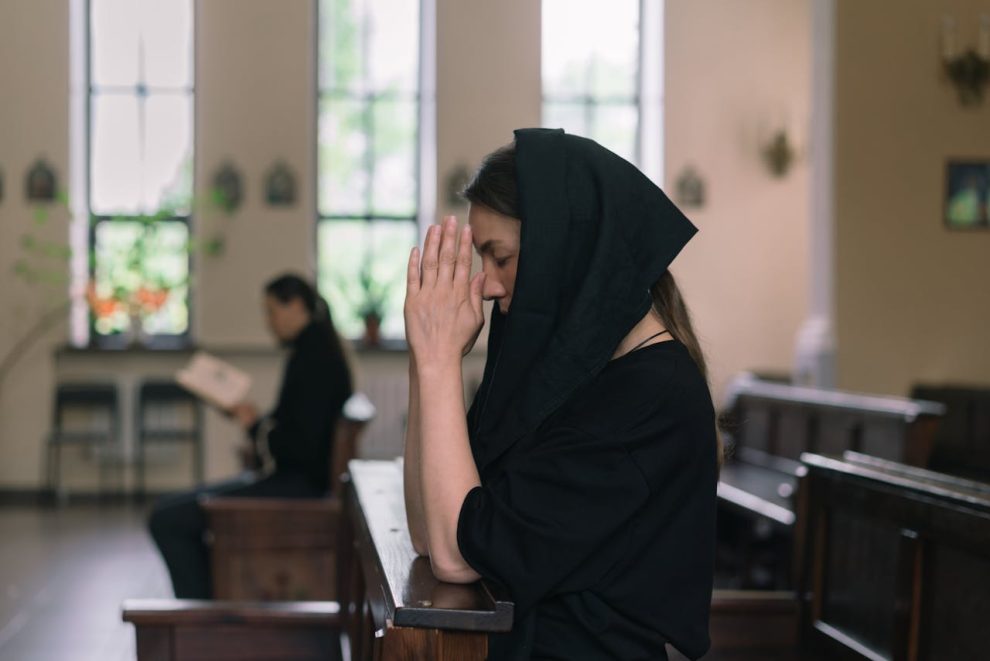
Another practice often associated with traditionalists is that of women wearing chapel veils in Mass. The practice of veiling became optional post-Vatican II in the 1970s, with a ruling made by the Congregation for the Doctrine of the Faith in the document Inter Insigniores (On the Question of Admission of Women to the Ministerial Priesthood) that states:
“It must be noted that these ordinances, probably inspired by the customs of the period, concern scarcely more than disciplinary practices of minor importance, such as the obligation imposed on women to wear a veil on their head (1 Cor11:2-16); such requirements no longer have a normative value.”
St. Paul’s original injunction for women to veil must be read in cultural context. Paul was no feminist by our modern standard; however, for a man shaped in the school of Hellenistic philosophy and rabbinical thought, St Paul was forward-thinking and had a higher regard for women than many men of his time, commending women deacons such as Phoebe in his writings.
So, why his insistence on veiling? One possibility is that it was intended as a class equalizer. Many converts to Christianity were wealthy Greek and Roman women who could afford to wear gold ornaments in their hair. But not everyone who was practicing Christianity, an underground religion, could afford such luxuries. Additionally, the Christian groups were made up of people from different cultural backgrounds. St Paul’s direction for women to veil may have been a practical solution to address social discord and emphasize equality among women within early Christian congregations.
Think of veiling as another iteration of the Catholic school uniform. I went to public school but had friends who went to Catholic school, and many of my friends wished they could wear their street clothes to school like I could. But the school uniforms made it harder to differentiate between poor students and rich ones and thus removed a tool that could be placed in the hands of bullies. Early church veiling may have served a similar class-inclusive purpose. Progressive Catholic women today can find in veiling a reminder of our equal status of children of God.
Christians worship a God who became human and ate with sinners and the poor but rebuked the proud and the comfortable, who allowed himself to be whipped, stripped, paraded in the streets, and crucified. Catholic tradition is not a return to emperor worship. It is a protest against it.
Image: Pexels/Mikhail Nilov





Add comment