

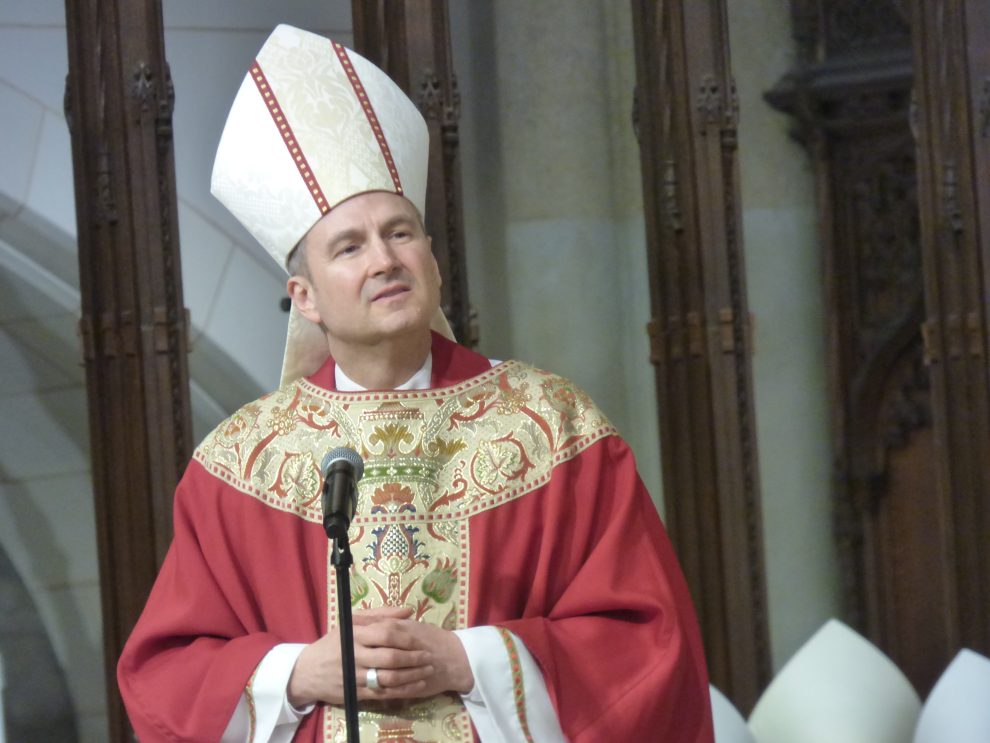
As public appearances for his February 6 installation came to a close, Ronald Aldon Hicks, the new archbishop of New York, repeated to those celebrating at a reception at New York’s Hilton Midtown his focus on the mission before him and his new archdiocese. He reassured them that, as a shepherd and his flock, they would undertake the journey together.
“The last thing I want you to hear from me today is that I’m going to give it my all: my mind, my heart, my soul. I’m going to do it with you in the name of the Lord,” he said.
Although it’s early to tell what a missionary church concretely looks like in a Catholic community of 2.5 million people—one of the largest, wealthiest and most influential in the country—his first homily as archbishop at New York’s Cathedral of St. Patrick pointed out what it is not: a country club to serve its own.
“The church exists . . . to go out and serve all people, on fire, with faith, with hope and charity, in the name of Jesus Christ,” Hicks said. “This is not a criticism. It’s simply an invitation to constantly renew who we are and to rediscover why the church exists.”
It’s something he credits with learning a little bit about in his five years as a young missionary priest to El Salvador, where he lived from 2005 to 2010 as Central America director for the nonprofit Nuestros Pequeños Hermanos (Our Little Brothers and Sisters). Since the 1950s, the nonprofit has served vulnerable children in Latin America, including some who have been abandoned.
Hicks often credits lessons he learned there with shaping his ministry, and in his first homily as bishop of the Diocese of Joliet, Illinois, in 2020, he recalled an incident during that time that caused him pain. After he kept a group of children waiting for a long time because he was doing administrative work, one of them said to him: “You are more like a lawyer than a priest.” He realized then that his first responsibility was to be a pastor, he said.
On February 5, at his first solo press conference ahead of his installation, he told reporters something similar: “I don’t want to be seen as only the CEO or corporate president of a group. I’m called here to be a pastor. I’m called here to be a shepherd, and as shepherd, my desire is to be a good shepherd.”
Experiences learned during his mission work, without a doubt, have marked his ministry, but so has his time among Spanish-speakers in the United States and Latin America.

His first official words after being proclaimed archbishop were in Spanish, not in English. He read the first few lines to “Alma Misionera” (“Missionary Soul”), a song as popular in Spanish-speaking parishes as “On Eagle’s Wings” is in English-speaking ones.
Hicks said that “Missionary Soul” is one of his favorites, because it speaks of a call to be missionary disciples. His episcopal motto—a short phrase at the bottom of a bishop’s coat of arms, which expresses a prelate’s spiritual philosophy—is “Paz y Bien,” which means “Peace and Good.” It is a greeting attributed to St. Francis of Assisi and popular among Franciscans.
The fact that the motto is in Spanish caused immediate grumblings when a photo of his coat of arms was posted on the @AbpNewYork social media account on X. One person wrote that “English is the official language of the United States.” A few others posted similar comments, but the majority congratulated him.
The day before his installation, a group of women from the Chicago area who said they were his comadres—a term of endearment among Latinas for close friends or a godparent—bumped into him at an intersection near St. Patrick’s Cathedral. They took photos with him, hugged him, and asked how he was settling in.
“You’re just strolling around?” one of them asked, as Hicks, in a blue puffy coat, earmuffs, and gloves protecting him from the frigid temperatures, smiled.
The crowd at St. Patrick’s, at the reception, and at points in between reflected the English- and Spanish-speaking worlds he swims in and out of with ease.
At a December 18, 2025 press conference announcing his new post, he expressed his love for all communities but said that he was formed by the Latino/a Catholic community, adding that “this community is a vital part of the church.” In addition to his time in El Salvador, he also lived in Mexico and traveled around Central America.
His homily did not omit thornier issues that Hicks, 58, will have to contend with on matters pertaining to abuse at the archdiocese and helping victims, as well as issues that concern Catholic teaching on the protection of life, particularly in a place like New York, which recently adopted a Medical Aid in Dying Act.
No matter what was on his mind, he kept plugging away at the message he wanted to get across and mark the path he wants to take to address it all.
The church is not missionary because of its programs but “because of who we are,” he said, recalling Pope Leo XIV.
“The church exists to proclaim Jesus Christ and the Gospel to everyone, publicly, and credibly, without fear, in every culture and circumstance. A church that upholds human dignity in every way possible, a church that follows the example of Jesus, who reached out beyond his own community and held up the Samaritan as an example of goodness. That is the kind of church I believe we are called to be here in the Archdiocese of New York,” he said.
“We are called to be a missionary church, a church that catechizes, evangelizes, and puts our faith into action, a church made up of missionary disciples who go out and make disciples, passing the faith on for one generation to the next,” he continued. “A church that takes care of the poor, and the vulnerable. A church that defends, respects, and upholds life, from conception to a natural death; a church that cares for creation, builds bridges, listens synodally, protects children, promotes healing for survivors, and all for those who have been wounded by the church. A church that shows respect for all, building unity across cultures and generations.”
Sitting in the cathedral, Samuel Jimenez listened to the homily coming from the man whom he still thinks of as Father Ron, who had asked him to do the first reading at the installation Mass being watched around the country and beyond. He read in Spanish from the Letter of St. Paul to the Galatians: “I have been crucified with Christ; yet I live, no longer I, but Christ lives in me.”
Jimenez met Hicks when he was 15 after a series of stops at Salvadoran orphanages, a journey that eventually led to him to the doorstep of Nuestros Pequeños Hermanos, also called NPH, which he credits with changing his life, one marked with difficulty early on. The book Do Not Discard (Good Stories Publishing) describes how Jimenez was rescued as an infant from a trash pile, later abused by adoptive parents, and eventually saved by NPH, the nonprofit Hicks dearly loves and still visits.
Jimenez eventually migrated to the United States, earned a college degree, and now teaches math in Chicago. Hicks, as archbishop, is still the same person he met, he says, someone seeking to do good with those he encounters.
“If you gather 100 people and ask them about Father Ron, you will get the same answer,” he says. “He has always been a father, a father of the church, but a father like in a family, and that’s the way we see him.”
And that identity may be the one Hicks cherishes the most.
“I love being a priest,” Hicks told those gathered at St. Patrick’s.
It was what he wanted most, even when he was young, says José Juan Lizarde, who met Hicks in Mexico just before the latter was ordained in 1994. Hicks was volunteering in Mexico and learning Spanish. They developed a friendship that continued as Lizarde moved to work at NPH in El Salvador, got married, and had children. They still talk, and Lizarde says he considers him part of his family.
“I would always question him, was he really going to become a priest . . . and he would say, ‘Of course, of course, I will become one,’ ” he says.
Asking Jimenez to be present at the Mass was important to represent a people, place, and time he still values and holds dear, Hicks said in his February 5 conference.
“He is part of my life, of a mission I had in Central America. I left my heart there, and he represents part of my life there that is family, that is affection, love,” he said a day before his installation. “And it’s a pleasure to have him here representing not just himself but a community, the Hispanic family of Central America.”
Near the end of his homily, Hicks thanked his parents, saying “You are the best!”; his former Diocese of Joliet, and Papal Nuncio Cardinal Christophe Pierre “for giving me the advice to just be myself.”
He also thanked churchmen from Chicago who had been influential in his life, particularly Cardinal Blase Cupich, who mentored him for 11 years.
Image by Rhina Guidos: Archbishop Hicks speaks at his installation in New York.




Add comment