

“The Body of Christ.” These words are so ubiquitous in the life of Catholics going up to receive communion that they risk being taken for granted. This is problematic, to put it mildly.
The belief that Jesus, knowing he was about to die, instituted a sacrament embedded in the celebration of the Mass is what the Second Vatican Council called the “source and summit” of Christian faith. In the Eucharist, God takes the mystery of the incarnation one step further: from directly interacting with God’s beloved creation in the events of human history to the even more intimate connection of nourishing God’s people, body and soul, for all time with God’s own body, under the appearance of bread and wine.
Divinity incarnate becomes part of humanity incarnate, as God draws people to the altar and transforms their very creation, generation after generation. Even the second-millennium practice of eucharistic adoration, codified by Vatican II, nourishes countless believers in the way that spending time in the presence of a cherished friend gently comforts and shapes us.
This deeply profound part of the faith has not been without controversy. Fourth-century Milanese bishop St. Ambrose ordered the Roman emperor Theodosius I not to receive communion until he publicly repented of his role in a massacre of Greek citizens. Catholics and Protestants have sparred—and later dialogued—for centuries over the meaning of Eucharist, many denominations in the latter group often preferring to view it as a symbol, not Jesus’ real presence.
Bishops in the United States have threatened to deny communion to politicians such as John Kerry, Nancy Pelosi, and former President Joe Biden over their public support for legal abortion—an approach many people decried as weaponizing the sacrament and never widely adopted. More recently, the U.S. bishops—fueled in large part by a single Pew Research Center survey suggesting only a third of Catholics believe in Christ’s real presence in the Eucharist—launched a years-long education campaign called the Eucharistic Revival. (Its first stage ended in July 2024, with a large gathering in Indianapolis that closed, ironically, on the day Biden dropped out of the 2024 election.)
Scholars of the Eucharist insist that the sacrament is richly communal in the most embodied sense, profoundly connected to human suffering and ultimately reflecting how everything touched by God is forever transformed. Any believer who’s ever approached the altar for communion knows that the Eucharist is a source of awe, challenge, and consolation in what it says about God’s presence at work in the world.
Bodies, bodies everywhere
Catholic author and activist Amanda Martinez Beck defines politics as “bodies taking up space around one another.” The body of Christ is no exception. In this sense, the Eucharist is at once instantly political.
“Political power is largely about configuring bodies in space and telling stories with them,” says William Cavanaugh, professor of Catholic studies at DePaul University. This could mean excluding or scapegoating certain bodies, such as immigrants or the LGBTQ+ community. But Cavanaugh says the Eucharist is “telling a different kind of story with bodies and reflecting on this whole idea of the body of Christ as both what you receive in the Eucharist and [that] we become part of the body of Christ.”

María Teresa (MT) Dávila, associate professor of religious and theological studies at Merrimack College, agrees with the description of the Eucharist as an array of bodies.
“It’s part of the ritual” to see people in line for communion approaching the altar, she says. “It doesn’t happen to a private person. It’s a sacrament that happens to a community. It’s a sacrament that’s celebrated by a community.”
Emily Reimer-Barry, professor of theology and religious studies at the University of San Diego, focuses with her students on what this means for pregnant members of the community.
“We linger on the symbol of pregnancy as eucharistic, ‘This is my body, given for you.’ The pregnant body nourishes,” she says, “and the pregnant person experiences discomfort and even sometimes danger/sacrifice as a result of that self-giving love.”
Rather than connect pregnancy and Eucharist to the politics of abortion, Reimer-Barry says the political implications of this are to “focus on compassionate accompaniment of pregnant people and structural responses to social injustice.”
Social sacrament, social action
As a community coming together for a feast, the Eucharist is about active participation, an understanding urged by Vatican II. First is to respond to an ultimate, lavish gift from God: the presence of Jesus at communion. Hence eucharist literally means “giving thanks.”
The second action flows from the meaning of the word Mass: to be “sent forth.”
“Eucharist sends us out. It’s not just about being around the altar of the Lord: We’re sent,” says Bishop Gerald Kicanas, retired bishop of Tucson and former vice president of the U.S. Conference of Catholic Bishops.
But as the believers who’ve just been transformed into the body of Christ go out to be Christ in the world, what does it mean to spread the grace of a sacrament—that is, God’s presence moving through and among us?
Dávila started attending a Spanish Mass at a church that isn’t her local parish. For her, it’s an act of solidarity and direct reaction to the terror and suffering inflicted on Latino/a communities under the current administration’s immigration detention and deportation policies.
“This is what I have to do. I have to be in communion with this group of people and worship with them and be in the Eucharist with them,” Dávila says.
Cavanaugh affirms Dávila’s view and offers a more public example of outdoor Masses celebrated at the U.S.-Mexico border. This effective expression of Eucharist is a “sign that people on both sides of the border fence are part of the same body of Christ and that the border fence is a kind of artificial border. We are a communion that is transnational and transcends borders,” he says.
Kicanas has celebrated such Masses for years. “Migrants today are experiencing a great deal of pain, and border Masses are a way of showing solidarity,” he says. As a photo of Kicanas distributing communion through the slats of the border fence circulated following one such Mass a decade ago, critics accused the bishop of politicizing the sacrament, but Kicanas dismisses this: “Sometimes, in our politicized world, everything takes on a political dimension. But that’s not what the church is.”
The mystery of the Eucharist is inexhaustible, with countless layers of meaning that intersect with human reality, whether joyful or sorrowful. Phrases like “fruit of the earth and work of human hands” reflect not only that it is food given to us by God, but also the deeper richness of how, in eucharistic theology, the bounty of creation and the dignity of work directly contribute to the salvation of the world.
Connecting the Eucharist to suffering humans immediately pulls other social—or political—issues into the discussion. For Dávila, an obvious choice is food insecurity and hunger, given that the Eucharist literally involves feeding people.
“Eucharist is a feast, a banquet, but it’s also a remembrance of pain, a remembrance of state-sanctioned violence. It’s a remembrance of the death penalty being dealt unfairly,” she says. “That remembering ought to connect us back to the suffering of Christ. That it was unjust suffering by the state connects us to contemporary forms of suffering by the state.”
The chaos of eucharistic living
God touching human suffering and messiness, as well as acknowledging the connection between Eucharist and social justice, are real parts of daily life for the Catholic Worker movement. Margaret “Margie” Pfeil, a teaching professor at the University of Notre Dame and cofounder of the St. Peter Claver Catholic Worker community in South Bend, Indiana, says that being involved in a Catholic Worker community feels like a “glimpse of the reign of God, because where else would you find this particular group of people?”
Her community also operates the Our Lady of the Road drop-in center, which has a chapel on its upper floor where they celebrate Mass on Wednesday evenings. Pfeil recalls James Joyce’s “here comes everybody” description of the Catholic Church: that the church overall and the group at Our Lady of the Road are “this wide panoply of humanity, and that’s what it’s all about. That’s the whole point, that Jesus is gathering us.”
Even the celebration of Mass can tend toward the chaotic in this setting, which Pfeil sees as in keeping with the turmoil that Jesus and the apostles must have experienced at the Last Supper. “I can identify with that,” she says. “It all kind of gets folded into this mystery of Jesus’ life, death, and resurrection.”
The west windows of the chapel face the county jail, a proximity to incarcerated people that isn’t lost on the gathered worshipers. “As we’re praying in the Mass, we’re united with [people who are imprisoned] in the mystery of the body of Christ,” says Pfeil. But with the jail only two blocks away, the connections to the Catholic Worker are not merely liturgical, especially when an inmate is newly released onto the streets wearing only what they had on when they were arrested.
“They often show up at Our Lady of the Road store as the first stop to get the basics and to get out of the elements,” says Pfeil. “There is that element of the grittiness of the incarnation. It makes Matthew 25 very incarnate: When did I just get out of prison and show up at your door? That’s real, and it’s enfleshed.”
Catholic Worker founder Dorothy Day had a tremendous devotion to the Eucharist and wrote expansively on it. But Day’s understanding of the relationship between the Eucharist and her work wasn’t that the sacrament drove her out into the world to perform acts of justice, a sort of using of the Eucharist. Rather she saw the celebration at the altar as the culmination of all works of justice and mercy carried out “on the altar of the world,” truly a summit.
Harming the body
Cavanaugh began to think more deeply about the Eucharist while he was living in Chile in the 1980s, working with the church in impoverished areas of Santiago during the last years of General Augusto Pinochet’s dictatorship.
“One of the things that the bishops did was issue a blanket excommunication for torturers, making the connection between receiving the Eucharist as part of the body of Christ and actions like torture,” he says. “Clearly, when you’ve got a situation in which torturers and tortured are approaching the same communion table, then something has gone wrong.”
Echoing Dorothy Day’s sense of the Eucharist as a culmination, Cavanaugh recalls a story about fugitives of the Chilean military regime getting turned away from a house of formation. Afterward, one of the seminarians said, “We can’t have Mass tonight, because we just turned Christ away at the door.”
In the 21st-century United States, the opposition of Catholic bishops to harsh immigration policies has only briefly veered toward questions of communion. During a 2018 meeting of the USCCB, during the first Trump administration, Bishop Edward Weisenburger (then in Tucson, Arizona, now the archbishop of Detroit) raised the question of whether canonical penalties should be weighed for Catholics involved in carrying out these policies. This never gained traction, but as the aggressive tactics of Immigration and Customs Enforcement (ICE) continue to worsen, perhaps some people might wonder whether any Catholics sporting the unlabeled uniforms and black masks need a message from their bishops about harming the body of Christ.
Cavanaugh and Dávila both recognize the theological logic behind this question but also raise serious concerns about using the Eucharist as a political tool.
“There are all kinds of degrees of cooperation with evil and all kind of degrees of evil. And I think that needs to be looked at very carefully,” says Cavanaugh. “There are clearly ways in which this can be used in nonproductive ways.”
“I don’t think any human ought to have the power to control access to grace,” Dávila says. “Our hope in God is the transformation of this reality, as well as a transformation toward building the kingdom to come,” and barring someone from receiving the Eucharist “tells me, ‘God can, except with you.’ ”
But Dávila also acknowledges that it would be a “big deal” to apply the bishops’ standard for pro-choice politicians to those who support current immigration policies—policies that involve direct, concerted government action in ways that legal abortion never has. But even then, she recalls how a figure like Archbishop Óscar Romero in El Salvador approached people who were part of structures of death not by gatekeeping but by inviting them in, telling them to put down their weapons and remember they are children of God.
Cavanaugh says that Romero’s response after the murder of his friend Father Rutilio Grande at the hands of the junta was to say there would only be one Mass in the archdiocese—at the cathedral—the following Sunday. This shocking gesture was meant to remind all Catholics in San Salvador that “we’ve all got to come together in the same space” to receive together.
Kicanas also cautions against using the Eucharist as a tool for publicly chastising politicians. “There is a place for confronting positions and views that are contrary to our teaching, and that’s why you see bishops going to court to be present to migrants who are being deported, why you see a bishop marching in a procession,” he says. “It’s not to take a position politically as much as to make statements that witness what our faith teaches.”
Reviving the body
Communicating what the faith teaches was a major rationale given for the U.S. bishops’ multi-year Eucharistic Revival. Looking back one year past the 2024 Eucharistic Congress, Cavanaugh says the bishops tried, but that such an effort has to be “connected with this broader notion of the body of Christ and what that means in the world,” as opposed to catechizing on transubstantiation and emphasizing the practice of adoration.
“I don’t think eucharistic revival is just a matter of rallying people to talk about personal devotion.” he says. “There’s nothing wrong with that in theory,” but it should be approached with depth and not a lot of “personal piety and cheerleading.”
Kicanas says that people from his diocese who attended found the Eucharistic Congress personally meaningful but cautions that follow-through is a challenge with any major assembly in the life of the church. And that poses a challenge as to how to bring people along.
“I think Catholics feel many times our role is to attend Mass and to say the rosary,” he says. “Well, those are important, but it’s not the fullness of what it means to be a disciple.”
Dávila says she thinks the Eucharistic Congress would have been perfect if it had helped “bring a much fuller understanding of the Eucharist as a shaping force for community and transforming force for the politics in which that community lives. So that a eucharistic community is able to live out the life of Christ and be evidence of that in the world.”
As for the stated impetus of the revival—to educate Catholics to recognize Jesus in the Eucharist—she adds that not recognizing the Eucharist is a failure that “was almost guaranteed to happen within a capitalistic society.”
Consumed, not consumerist
The most political statement the Eucharist makes in 2020s U.S. culture is that it invites people to receive the abundance of God’s love in a joyful, communal way.
Dávila contrasts this with our current culture’s focus on individualism and consumerism. “When we see church as something we consume,” she says, “it becomes a market. It becomes a service, rather than ‘I’m going to this to be with this community.’ ”
Pfeil of the Catholic Worker also sees the frames of U.S. consumerism as at odds with the Eucharist.
“We live in a culture that emphasizes scarcity” and are wired to expect it as a source of anxiety, Pfeil says. “The invitation of the Eucharist is just the opposite.”
The question becomes: Can we allow ourselves to bask in that overflow and trust in that providence? It’s living in community that makes it possible, Pfeil says. “I’d rather live that way than operate out of scarcity and fear.”
To achieve this in the U.S. church, Reimer-Barry says, “would presumably mean that people in the pews at Sunday Mass would not hear church teachings weaponized but instead would be invited to consider our collective failures to live out Christ’s message of mercy and justice.”
Kicanas finds encouragement in the church reaching that point, largely through “helping to form our people with an understanding of why the church speaks so often about social justice,” from Pope Leo XIII to Pope Leo XIV.
Reimer-Barry adds, “Eucharist should create space for parishioners to encounter the reality of our world’s injustices, and to form our consciences as we consider how the Holy Spirit is inviting us to respond, personally and collectively.”
Dorothy Day’s image of the entire world as an altar gets at how the totality of human life and experience is encompassed in the Eucharist. While enmeshed in the reality of the material world, it is not materialistic. It is abundance. It is care. It is community in solidarity, not closed in but going forth in love. This is countercultural, even political. And it certainly tells a different story.
This article also appears in the January 2026 issue of U.S. Catholic (Vol. 91, No. 1, pages 10-14). Click here to subscribe to the magazine.
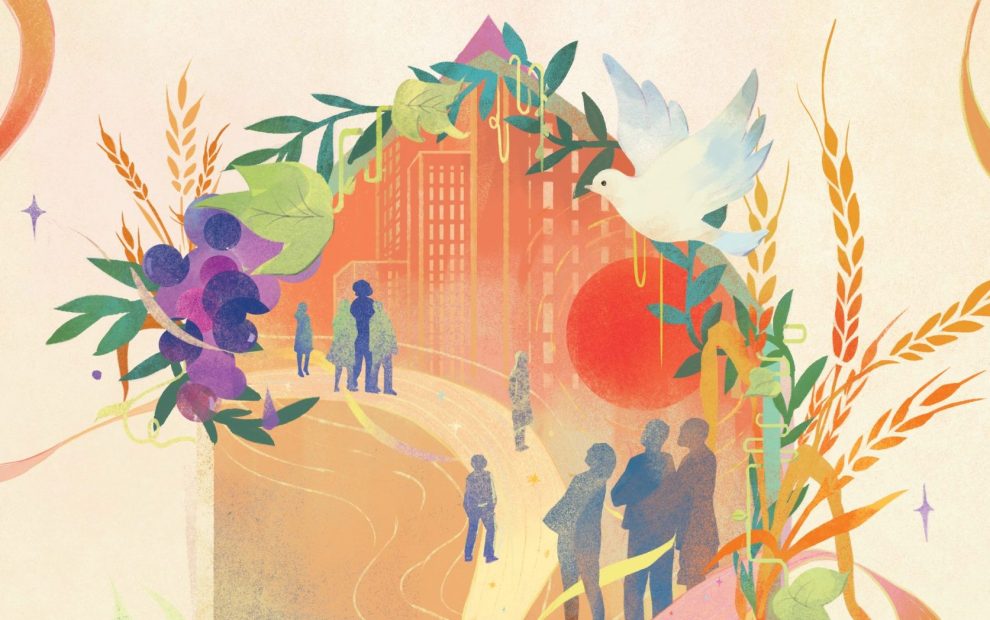
Art by Jianan Liu






Add comment