

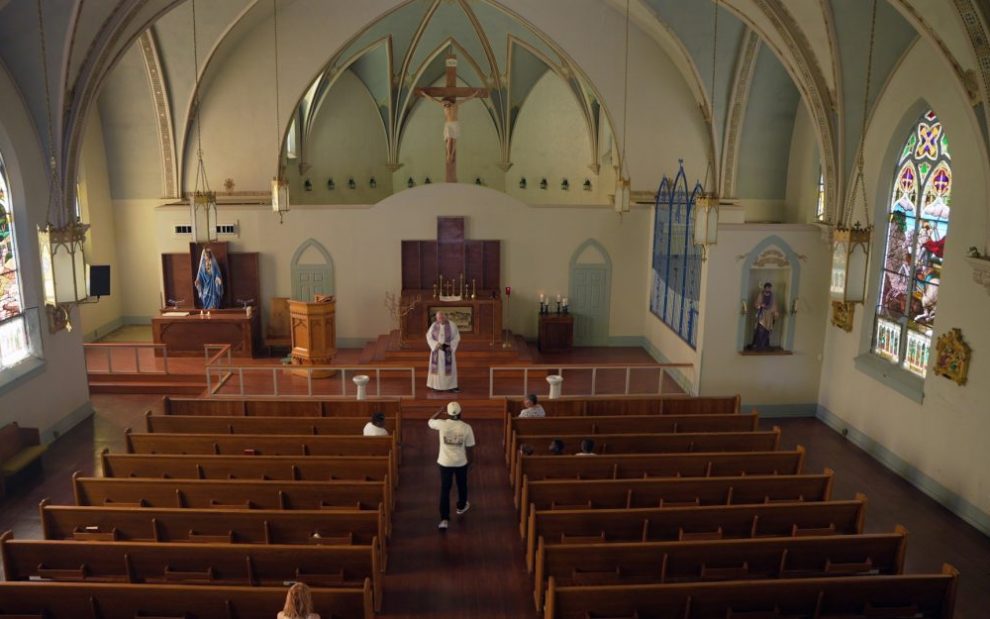
For our Sounding Board column, U.S. Catholic asks authors to argue one side of a many-sided issue of importance to Catholics around the country. We also invite readers to submit their responses to these opinion essays—whether agreement or disagreement—in the survey that follows. A selection of the survey results appear below, as well as in the January 2026 issue of U.S. Catholic. You can participate in our current survey here.
The survey says . . .
How often do you attend Mass?
- Every week – 74%
- A few times a month – 16%
- A few times a year – 4%
- Rarely – 4%
- Never – 2%
How often do you engage in justice work/acts of service?
- Every week – 55%
- A few times a month – 27%
- A few times a year – 10%
- Rarely – 4%
- Never – 3%
Mass attendance is an accurate measure of someone’s engagement with their faith.
- Agree – 33%
- Disagree – 67%
The church should broaden how it defines “active participation.”
- Agree – 87%
- Disagree – 13%
Every time new survey results on Catholic religiosity are released, I tense up in frustration before even looking at the outcomes. Not because I expect to see the reported number of so-called “active” Catholics in the United States continue to wane, but because I’m tired of seeing this type of research use Mass attendance as the litmus test for someone’s level of engagement with the faith. Honestly, whether or not a person attends Mass is the most passive way I can think of to measure whether someone is an active member of the faith. There is so much more to being Catholic. There is so much more that counts in this roughly 2,000-year-old religion, full of countless stories, traditions, teachings, and saints.
In full disclosure, I haven’t been to Mass in about five years, save for a wedding and a funeral. My household paused the habit during the COVID-19 pandemic when we couldn’t trust that the church was a physically safe space for a family experiencing pregnancy, new babies, and autoimmune disease. In the tumultuous years since 2020, we’ve struggled to find a parish that feels welcoming and provides spiritual enrichment. So perhaps I have some personal Catholic guilt around this topic, too.
And yet I wouldn’t hesitate to call myself a Catholic—and an engaged one at that. Beyond my baptism and my career in Catholic media that requires me to think critically about the faith every day, I’m intentional in how I live my life and establish my values based in Catholic teaching, and how I talk about God and faith with my children. I intentionally uphold a narrative of abundance not scarcity, community not individualism, gratitude not greed. We cultivate a relationship with God because we want to, not because of a mandate. I’m not saying these things make up for missing Mass, but I have a hard time convincing myself they’re not at least equally as important to a life of active faith.
Yes, the Code of Canon Law states Catholics are obliged to participate in the Mass on Sundays and other holy days of obligation throughout the year, but that rule is but one sentence among thousands in the canons detailing many laws that govern the church. There’s nothing, really, that suggests this law should be more important than the other ones, but many people have come to treat it that way in popular practice and as an easy-access way to measure Catholicity. But ease rarely equates to accuracy. Looking at additional faith resources for guidance can offer a fuller picture of what Catholicism lived well might look like. And I think it would yield a more accurate idea of what actually is happening within an active body of Christ on Earth today.
The basis for the Mass obligation prescribed in church law can be traced at least in part to the third commandment found in the Book of Exodus (20:1–17) in the Hebrew Bible. Here, the requirement is not even specifically to attend Mass or liturgy, but more vaguely to keep the Sabbath day holy, to rest rather than work, and not to cause anyone else to work either—including family members, servants, foreigners, and even animals. Even just adopting a more comprehensive understanding of the commandment upon which the Mass obligation rule rests provides some ideas for how to better assess adherence to the faith.
Going further, to include the other nine commandments in consideration of what constitutes an active Catholic, suggests an even more complex picture of what a vibrant Catholic life and community might look like. How many Catholics have refrained from prioritizing things other than their relationship with God and promoting God’s will for the world? How many have avoided invoking God’s name for causes that go against gospel teaching, or twisting scripture to support unjust behavior? Who has honored their ancestors this week?
Moving into the New Testament, someone’s level of Catholic activity might be assessed more directly by how often they act in accordance with directions given by Jesus himself, including the Beatitudes delivered during the Sermon on the Mount—the basis for the works of mercy—or how well they follow the dozens of teachings given by Jesus throughout the gospels. Did you show anyone mercy this week? When did you last contribute to peaceful gatherings? Has the glory of God been reflected in your good deeds today?

Catholic social teaching might be used to assess religious activity. Beginning with Pope Leo XIII’s encyclical Rerum Novarum (On Capital and Labor) in 1891 and continued most recently with Pope Leo XIV’s exhortation Dilexi Te (On Love for the Poor) in 2025, these teachings are not optional add-ons to the faith; they are essential instructions, which Pope Francis pointed out explicitly in his 2015 encyclical Laudato Si’ (On Care for Our Common Home). While Catholic social teaching includes dozens of documents on diverse topics, the seven broad themes of Catholic social teaching might raise questions like: Have you treated others with dignity this week? Are you participating in community? Did you acknowledge today the rights of others and rise to your own responsibilities? When did you prioritize the most vulnerable? How have you cared for the Earth?
Readers weigh in:
Our church needs to be less focused on judgment, more welcoming and enabling of spiritual growth! Small faith communities and access to service projects that are rewarding while also building community, and a sense of living one’s faith would help. Positive reinforcement goes much farther than guilt-tripping!
Ann Connolly
Mercer Island, Wash.
Our entire faith life should
be centered on the Eucharist, which is the source and summit of an authentic Catholic life. Our participation in the liturgical life of the church should inspire and fuel our work toward peace and social justice. Focusing on including social justice works in what counts as an active Catholic gives folks the excuse to not attend Mass or fully practice their faith in the name of serving the poor.
Desmond Francis
Dallas, Texas
Growing up, my understanding of what it meant to be a Catholic meant Mass on Sundays and holy days of obligation, avoiding sins, venerating Mary, and knowing my low place within the hierarchy. My understanding as an
adult has expanded to include a commitment to serving the poor and social justice activism.
Maria West
Bethesda, Md.
What if being an active Catholic today meant standing up for the rights of migrants? The clergy who recently issued an open letter about their willingness to be harmed while supporting migrants in Chicago amid the danger of ICE (Immigration and Customs Enforcement) attacks and detainment would check that box. Maybe for them right now, honoring the Sabbath looks like putting on gas masks to stand with the most vulnerable in the community amid tear gas and pepper bullets.
What if being an active Catholic today meant advocating for protections against environmental threats that disproportionately affect poor communities? The thousands of people of faith, including bishops, who submitted public comments to the U.S. Environmental Protection Agency in opposition to the proposed sweeping deregulation of greenhouse gas emissions that contribute to climate change and endanger public health would check that box. Perhaps for them honoring the Sabbath means ensuring everyone can rest in the glory of God’s creation without breathing toxic fumes.
To be clear, I don’t think it’s useful or necessary to measure how Catholic a person is in the first place, but I understand the church sometimes needs ways to count its members and gauge their engagement levels. And these state-of-Catholicism surveys typically do ask about other things too—What issues do you care about: Immigration? Abortion? Capital punishment? Which practices do you observe: Fasting? Pilgrimage? Novenas? But when someone wants to cite the number of active Catholics today, what they’re usually referencing is that number associated with regular attendance at the Sunday liturgy. And when church teaching is narrowed and applied to specific, modern-day, measurable actions, something is missed about the fullness of a life of faith. It seems silly at best, but perhaps as serious as sacrilege, to think the status of someone’s faith can be known by noting any one thing alone.
My issue with the Mass metric isn’t with the requirement itself; it’s that simply attending Mass does not guarantee anything about participation, whether someone was paying attention, received the sacrament of the Eucharist, tithed to the collection basket, or took seriously the liturgy’s parting directive to “Go in peace to love and serve the Lord.” But ultimately, I think what really bothers me is the perceived level of singular importance surrounding Mass attendance, even at the expense of other equally important things. If someone attends Mass but neglects other parts of the faith, they are still considered an active Catholic. Yet if someone is inconsistent with Mass attendance but living out other faith practices extremely well, it doesn’t seem to matter at all.
Bodies in pews are a lot easier to count than actions taken across a swath of local and global issues and experiences related to centuries of varied teachings, let alone the difficulty of knowing the interior motivations for someone’s actions. It would in fact be impossible to calculate every thought and act that contributes to one’s expression of faith. Perhaps that says something about the unimportance of qualifying and quantifying people’s faith. But if it must be done, it seems to me there are some equally valid alternatives to Mass attendance.
Catholicism offers countless examples of what a holy life might look like—just think of the saints. We dilute Catholic teaching, the commands of God, and the message of Jesus Christ when we minimize what a witness to faith looks like today by using too narrow a definition of what an active Catholic looks like.
Survey results are based on responses from 128 uscatholic.org visitors.
This article also appears in the January 2026 issue of U.S. Catholic (Vol. 91, No. 1, pages 31-35). Click here to subscribe to the magazine.
Image: Unsplash/TopSphere Media




Add comment