

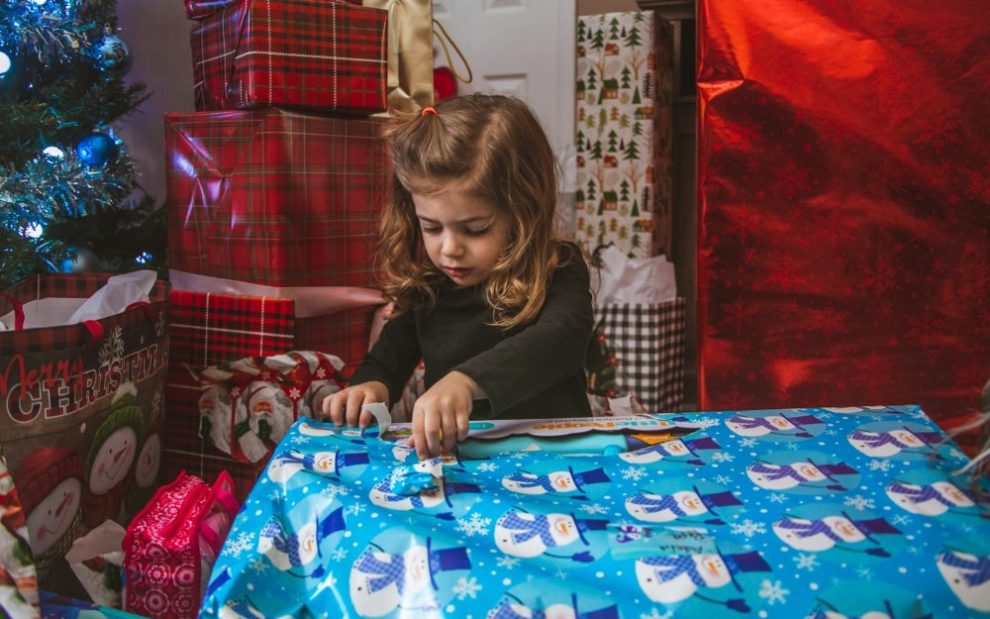
Do you ever feel like you’re “accomplishing Christmas” rather than savoring Christmas? Ironically, in this season designed to celebrate and enjoy God-with-us, we can easily rush past traditions intended to help us connect with God and one another—such as the ancient tradition of gift-giving.
In our era of fast consumption, the “love language” of gifts can easily get lost in an avalanche of too many presents exchanged too quickly. Maybe you’ve experienced it. . . .
Everyone tears into the gifts at once. There isn’t time or space to read a card, notice the reaction of the giver or receiver, or make conversation about the item. The whole exchange is over in 20 minutes, and the floor is littered with bows and boxes ready for the trash can. Kids don’t remember the individual gifts or who gave them. And adults may not remember what they gave. (One Christmas, I actually forgot a whole bag of presents and didn’t find them in the back of my closet until February!)
No single approach is the “right way” to go about gifting. But we need to review our family traditions to see whether the way we “do” presents supports—or clashes with—the spiritual purpose of giving gifts. Deep within our hearts and our children’s hearts, God has planted the impulse to give as God gives. It seems to be a primal human instinct—perhaps part of what it means to be made in God’s image—that we show love by giving presents, and we experience joy when we receive something thoughtfully chosen just for us.

To reclaim a soul-nourishing way of gifting, we need to slow things way down. Here are some practices that have helped our family:
Limit the number of gifts.
We’ve scaled back to just three presents for each child, plus a stocking. This isn’t a magic number, but restraint has helped us savor the presents, on both the giving and the receiving ends.
For those who are concerned that occasions like Christmas will feel anticlimactic with so few gifts, just consider how one heirloom pocket knife passed from grandad to grandson is more significant in the long run than a whole shelf of toys from Target. And other nonmaterial ways can further enhance the celebration: Go caroling to your neighbors’ homes, or invite someone from outside the family to join you for the day’s festivities. Showing love with gifts is wonderful, but it isn’t the only language we have to express our care—and kids thrive when we use a broad range of expressions.
Be extravagant.
I do not mean to suggest that we should teach kids to expect more extravagant gifts but rather, that we show them how to be more extravagant toward others. Extravagant generosity doesn’t require more money, but it does mean giving sacrificially from whatever you have—time, energy, creativity. A birthday card made by a child, sticky with glue and missing capital letters, is more personally costly on the child’s part than a sleek store-bought card bought with Mom’s money. Extravagant gifts can be homemade or purchased, tiny or grand, symbolic or practical. But in some way, the giver of a heartfelt gift puts something of herself into it.

If your family is less than artsy, just remember that creativity comes in many forms. Some perennial favorites at our house include:
- coupon books (for doing someone’s chores or giving a back rub)
- homemade activity sheets and scavenger hunts
- simple artwork
- baked goods
- personalized stationery
Being generous with others to the point of extravagance aligns us with the heart of God. “Observe how Christ loved us,” Paul wrote to the Ephesians. “His love was not cautious but extravagant. He didn’t love in order to get something from us but to give everything of himself to us. Love like that” (Eph. 5:2 MSG).
Wrap with care.
Gift wrap used to be a personalized and effortful part of giving before it was all store-bought and disposable. By putting more care into your presentation, you can reclaim wrapping as a gift in itself. My sister Catherine does this with her little girls by decorating wrapping paper each Christmas. You could try Catherine’s method (stencils and paints on butcher paper), or have your kids make tags, collect and reuse bows, or decorate plain gift bags with handprints and love notes. Here’s what Catherine says about why she goes to the extra trouble to involve her girls: “Kids don’t have a whole lot of say in what presents get bought, but making the wrapping gives them ownership in the gift-giving process. It also teaches them intentionality—ironically, by putting care into something that is typically discarded without much thought.”
Extend the unwrapping.
Instead of all diving in at once, give some order to the festivities to provide time for deep regard and attention. My family’s tradition is to unwrap gifts one at a time in age order, starting with the youngest in the room. (If you think you have too many gifts to take turns within a reasonable amount of time, you might have too many gifts.) Rituals that slow our unwrapping create time and space for kids to look longer at each gift and see beneath the surface to the heart of the giver. Watching and caring about what other people receive is an important step in growing out of self-centeredness.
If you are the host, you can say how the group will take turns opening presents. But if you are a guest at someone else’s home, be aware that people can be easily offended if you try to shift their traditions. You can still suggest a rhythm, though, and see if they warm to your idea—but be a gracious participant even if they don’t.
Hold things back for later.
A friend mentioned to me that she puts away half of the presents her kids receive from out-of-town family and then staggers them out over the 12 days of Christmas. She had asked her family to pare down the number of gifts, but it was beyond her control to enforce it. What was in her control, however, was when the kids opened the presents (and whether they kept them or regifted them). If you have a similar situation, work within your circumstances to slow down the onslaught of presents as much as you can.
Follow up.
After the gifting is done, a time for show and tell can help kids remember and appreciate what they got, while everyone takes delight in each other’s gifts. Adults, show and tell your gifts to model how it’s done: “I got a scarf from Grandma and a book from my brother.” A few minutes is all it takes to let each person recap for the group what they might have missed seeing opened.
There are many unique individuals involved in our kids’ lives, each with their own ways of gifting. When gift exchanges fall short of heartfelt intentions—and they will!—you can gently discuss the situation with your kids. Without being overly critical, simply ask your child questions like, “Did you get to see if Grandmom liked her present? Well, maybe next time we can ask her to wait and open it when we are near her.” Honest conversations between adults and kids are surprisingly powerful ways to help young people form healthy values.
Practices like these may feel like very small acts of resistance in a fast-consuming world, but every step to slow it down expands your child’s capacity for loving others by giving—and for living in closer communion with the Giver of all.










Add comment