

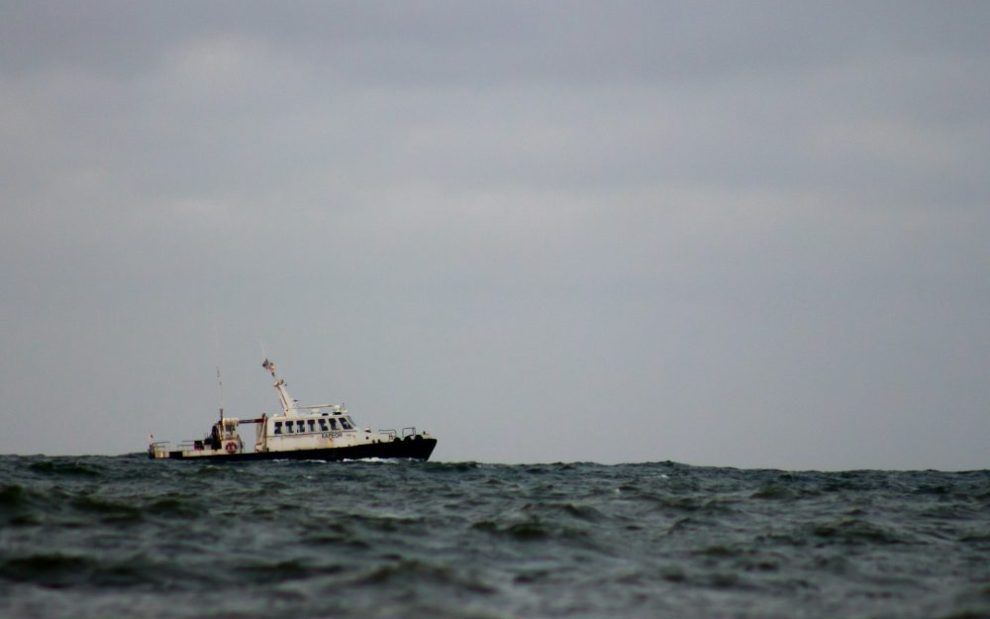
Since September 2025, the United States has been authorizing drone strikes on people operating small boats from Venezuela and Colombia. These strikes have destroyed over 20 boats and killed more than 80 people in Latin America and the Caribbean. Additionally, it appears some drone strike survivors were intentionally targeted and killed after their boat was already destroyed.
The U.S. government alleges that the boats leave South America transporting illegal drugs headed for North America. However, experts say that blowing up these boats will not stop the flow of illegal boats into the nation. Some analysts say the strikes are illegal and unconstitutional. Former Secretary of Homeland Security Jeh C. Johnson, in an article in the New York Times, argues that these are extrajudicial killings.
The administration continues to perform legal gymnastics to defend the killings it authorized. However, the tenuous legality of the boat strikes aside, the church’s stance on such preemptive violence is clear: You shall not kill. Acts of aggression like this, against civilians, with no evidence of criminal action and no declaration of war, are antitheses of what it means to be pro-life. They do not even meet the basic requirements of Just War Theory.
In the face of these direct assaults on human life, the Catholic Church is called to continue lifting its voice in emphasizing pro-life values to a government that seems indifferent to them.

Church leaders, including bishops, have raised objections to the U.S. military action in Caribbean waters. Pope Leo XIV advocates for dialogue with the “good of the people” in mind. Likewise, in a joint statement released in October 2025, the Caribbean bishops appeal for peaceful dialogue, respect for the sovereignty of independent nations, and no more violations of the sacredness of human life.
The Washington Post recently reported that that, after a strike in early September left two survivors, the administration ordered a second strike, specifically to kill them. Archbishop Timothy Broglio, head of the Catholic Archdiocese for the Military Services, USA, responded to this by stating that it is “illegal and immoral” to attack and kill “survivors on a vessel who pose no immediate lethal threat to our armed forces.” Broglio called for the due process of any suspects under the law, and adherence to just war principles.
While most Americans find themselves somewhere between the polarizing political extremes of pro-life and pro-choice, in current U.S. politics, many equate being pro-life with being anti-abortion. While the church does condemn abortion, this is in the context of a much broader life ethic. The church teaches that a human being’s right to life begins at conception and endures until their natural death. To be pro-life means to promote justice and human rights for all persons at any age and stage of their lives. This is what is meant by a “consistent ethic of life.”
Drone strikes on fishing boats are injustices against humanity. No human being is ordained with the authority to determine which of God’s children lives or dies, irrespective of their moral culpability. Aside from the issue of international law forbidding killings of this nature, Catholic teaching is clear that criminal guilt does not license lethal attacks—as we see in Jesus’ defense of a woman caught in adultery (John 8:1-11).
Additionally, the idea that some lives are worth less than others, even when their worth is based on their moral goodness, fails to line up with pro-life values, Catholic social thought, and the truth of the gospel. The church maintains that all human beings have inherent, inviolable dignity, based in natural law, objective moral order, and the fact that we are made in the image and likeness of God (Gen 1:27). To murder someone is to suppress the Holy Spirit—God’s very breath in every human being (Gen 2:7).
While there are complex geopolitical issues at stake here, the moral lines in the sand remain fixed.
It is also important to note the indirect costs to human dignity, of which there are many, that these extrajudicial murders in the Caribbean Sea cause. One example is fishermen in countries like Venezuela, Trinidad & Tobago, and Grenada, who no longer venture far from shore, afraid they may be the next boat hit by a drone.
Already vulnerable economies, with fragile food security, face potential food insecurity as a result of the military action. A threat to food security increases the cost of food. Food insecurity is a threat to the dignity of human beings, especially to people who already live frighteningly close to, or below, the poverty line.
Another example is the collective trauma and anxiety children in the Caribbean are experiencing when they see or hear the U.S. military. A consistent ethic of life mandates we address these issues.
It is morally impermissible to make excuses on behalf of the U.S. government in the name of partisan ideologies. Before party lines divided Americans, the church acted (and still acts!) as a beacon of moral authority, particularly in defense of the vulnerable. In other words, Jesus trumps this administration’s policies—policies which the Caribbean bishops have determined “the arbitrary and unwarranted taking of life.”
Though the U.S. government has cushioned its anti-life position in a narrative of opposing terrorism and narcotrafficking – which are certainly real threats – the Caribbean has long ratified itself as a zone of peace—a resolution found within the Havana Declaration of 2014, which designates Latin America and the Caribbean as a region of peace upheld through friendly relations among nations, dialogue, and peaceful resolutions to conflict, without the use of force, in accordance with the UN Charter and International Law. Since the drone strikes on the boats began, deviations from the peace policy by some of the region’s political leaders have raised sharp questions of Caribbean solidarity.
There are enough Christians in the United States, enough members in the Body of Christ, to lift the voice of Christ in defense of our genuine pro-life values, through the action of the church. This is an opportunity for the Catholic Church, the universal church as well as every local diocese, to declare the Americas a zone of life—a zone with a consistent ethic of life, where persons need not fear drone strikes, weapons of mass destruction, or any possibility of an unnatural death.
Furthermore, there are more practical, doable actions you can undertake within the U.S.’ democratic framework. Contacting your government representatives and decrying double standards of pro-life values is one option. Another is dismantling their political power by making it clear they no longer have your vote to be in office.
Parishes and lay movements can drive these and other creative actions in organized ways. If our church does not will murder (and it most certainly does not), then the faithful must advocate elected officials to reject policies that sanction murderous military aggression at the command of a president and his administration. As our church is painfully aware, if we do not do what we can, history will look upon our failure to act as indifference.
To be taken seriously as a church our message must remain consistent in light of the truth Christ reveals to us. As St. Paul reminds us, we are one body and many, many parts—enough parts to execute meaningful action, and enough parts to hold political leaders accountable to uphold the sanctity of human life. Many people who uphold pro-life values are the fire behind denouncing abortion; there should be just as much thrust behind holding the U.S. government accountable for crimes against humanity.
Our church has a responsibility to the Caribbean, Latin America, and all places affected by regime sanctioned violence, to maintain its pro-life posture in all scenarios. Over 80 persons’ lives have met unnatural deaths on the orders of an administration with apparently little intention of actually being pro-life. There is already more than enough blood crying out to God (Gen 4:10) from the Caribbean Sea and the Pacific Ocean. In order to be a zone of life, will the church lift its voice in emphasizing pro-life values to a government which campaigned on this very idea?
I can’t help but wonder: Christ and his disciples were fishermen themselves. Would they be the next victims?
Unsplash: Aleksey Malinovsky






Add comment