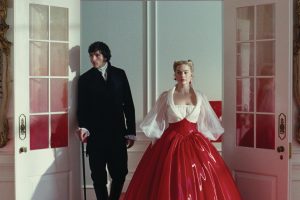
About two-thirds of the way through Wake Up Dead Man—the exhilarating third installment in Rian Johnson’s Knives Out series starring Daniel Craig as gentleman sleuth Benoit Blanc—a young priest makes a phone call to a local family-owned business. This business may have a critical piece of information bearing on the murder that Blanc is trying to solve, and on the priest’s own uncertain future. The chatty woman who answers the phone is familiar with the church and the murder, making it challenging for the agitated priest to get a word in edgewise; and, with Blanc impatiently gesticulating at the priest to get the information that is their priority, the halting exchange initially plays as small-town comedy.
Then the phone call takes an unexpected turn, and the woman on the other end (Bridget Everett) is no longer merely a humorous impediment to a murder investigation, but a human being with her own cares and woes. As the conversation continues, Rev. Jud Duplenticy (an ingenuous John O’Connor) arrives at a moment of clarity regarding what his real priorities are. The Knives Out movies have always existed in a moral universe larger than the mystery du jour, but that universe has never been larger than in Wake Up Dead Man.
Blanc’s third adventure is both a welcome departure and a gratifying return to form. On the one hand, where both Knives Out and Glass Onion are set among wealthy, privileged elites whose smug superiority the films delight in skewering, Wake Up Dead Man is Johnson’s version of a cozy small-town mystery, centered on the very ordinary parishioners of an insular Catholic parish in upstate New York. On the other hand, where Glass Onion stands out as a vengeful fantasy about sticking it to the world’s exploitative, incompetent overlords, Wake Up Dead Man, even more than Knives Out, honors compassion and competence in serving others. Knives Out turns on the heroine being a good and caring nurse; that Fr. Jud is a good and caring priest is even more important here.
Blanc’s adventures all blend self-consciously stereotyped murder-mystery conventions with of-the-moment topicality and satiric sociopolitical commentary. Wake Up Dead Man is about an impossible murder, among other impossible mysteries; it is also about the sociopolitical implications of two opposing conceptions of Christianity and of Catholicism in particular. One is an adversarial model, a culture-war siege mentality associated with the term “fortress Catholicism.” This approach is embodied in Josh Brolin’s formidable Monsignor Jefferson Wicks, the fire-and-brimstone pastor of the improbably named Our Lady of Perpetual Fortitude. The other model, embodied by Fr. Jud, evokes the language of Pope Francis, and now Pope Leo XIV: the church as a “field hospital” called to build a “culture of encounter” of friendship; to build bridges rather than walls, encouraging dialogue and welcoming with open arms.

Open arms, in contrast to raised fists, is literally and physically the stance that Fr. Jud adopts to model the kind of church he believes in and the kind of priest he wants to be. Raised fists come all too naturally to the priest, a former boxer with a dark secret in his past. (As a deacon, I can neither confirm nor deny ever wanting to treat a fellow deacon the way Jud treats one when we first meet him.) But Jud’s experience is that God loved and accepted him in his brokenness, and he wants to bring that love and acceptance to other broken souls.
All of this presents maximum contrast to Msgr. Wicks, a warrior for his church and for Christian America who rants about “holding the line” against “feminists, Marxists, and whores,” and whose harsh, accusatory homilies often result in walk-outs. Wicks’ brand of Christianity is so nakedly devoid of grace that Christ and the cross are literally absent from the sanctuary: A bare ghost outline of the crucifix that once hung above the high altar, destroyed long ago in a notorious incident that has passed into parish lore, is all that remains. Can Jud, recently assigned to this parish, bring grace to the Christ-shaped hole that is this church?
A stellar ensemble cast fills out the small but loyal cult of personality forged by Wicks’ methods. His flock includes Martha (Glenn Close), tight-lipped church lady extraordinaire; Vera (Kerry Washington), a quietly resentful attorney who has raised her presumed younger brother; an influencer and would-be demagogue named Cy (Daryl McCormack); Dr. Nat Sharp (Jeremy Renner), recently abandoned by his beloved wife; Lee (Andrew Scott), a once-successful sci-fi writer who has lost his way; Simone (Cailee Spaeny), an accomplished cellist hoping for a miraculous cure from a mysterious nerve condition; and Samson (Thomas Haden Church), the groundskeeper, who is as devoted to Martha as she is to the church.
Outside the church, Mila Kunis is excellent as a small-town police chief who, though not quite up to this case, is competent and professional, avoiding the clichéd bumbling helplessness of police in detective fiction. I also love Jeffrey Wright as a blunt, compassionate bishop. Lurking in the back story are two dead characters: the monsignor’s locally notorious mother, Grace (Annie Hamilton), who conceived Wicks out of wedlock and died in a fit of rage; and his grandfather, Rev. Prentice Wicks (James Faulkner), a widower. (In what follows I can promise only to try to be as spoiler-averse as I can.)

With impossible mysteries in a church context—closely tied to the rituals of Holy Week, at that—Wake Up Dead Man inevitably invokes questions of the miraculous. (I love my friend Alissa Wilkinson’s characterization of Christianity’s founding story as “the original locked-room mystery story.”) At times the film suggests one of G. K. Chesterton’s Father Brown mysteries: a kinship explicitly acknowledged when Blanc, impressed by outside-the-box thinking by Fr. Jud, says approvingly, “Go to town, Father Brown.” In the Father Brown mysteries, any suggestion of the supernatural was a red herring; the explanation was always mundane, and the priest was always the most hardheaded skeptic in the room. Fr. Jud is never that, at least not any time he shares a room with the “proud heretic” Blanc, but the Chesterton connection is apt in another way.
“I like detective stories,” Chesterton once wrote. “I read them, I write them; but I do not believe them.” Like Chesterton, Johnson fills Blanc’s entertaining cases with all manner of unrealistic conceits and far-fetched contrivances: a character who can’t lie without vomiting; a murdered celebrity with an identical twin; a character who is so deathly allergic to pineapple that even a trace amount kills him within seconds (and who carries a gun everywhere, but not an EpiPen). But, also like Chesterton, Johnson laces these stories with things he does believe about wealth, power, and corruption; about rigged systems, hateful ideologies, and the necessity of resistance; about fragility and the power of truth; about the importance of solidarity and empathy in the face of self-interest, injustice, and apathy.
Johnson’s detective stories, like Chesterton’s, illuminate the storyteller’s beliefs. One remarkable thing about Wake Up Dead Man is that Johnson is driven by his own empathy to treat seriously things that he does not believe, though Chesterton believed them. Johnson’s humanistic critique of the perversion of religion calls for a righteous counterpoint. For that he needs a credible, sympathetic priest—one capable of absorbing a thoughtful skeptical salvo about the church’s neo-Gothic architecture from an unbeliever of Blanc’s intellectual caliber, and of responding with comparable thoughtfulness (his words cinematically underscored by sunlight peeking through the stained glass).
At the end of the day, these movies are meticulously constructed, rather cartoonish puzzle boxes. My wife Suzanne, a nurse and an inveterate fact-checker of medical scenes, says that a good nurse always, always checks the label on a drug before administering it, which is not what happens in Knives Out.
Here, the sacrament of confession is treated sloppily, particularly as regards privacy; one exchange under confessional privacy is surreptitiously videoed, and another, under admittedly exceptional circumstances, is openly witnessed by third parties. (These incidents concern not the seal of confession, which is absolute, but confessional privacy, which admits rare exceptions; still, the issue isn’t even raised.) At times Johnson’s evangelical background peeks through the dialogue, as when Msgr. Wicks as well as Blanc speaks of a priest not hearing but “taking” someone’s confession, as if both men were more familiar with detective jargon than sacramental idioms.
Despite such asterisks, Fr. Jud is so credible that he alters Blanc’s moral trajectory, if not his worldview. “You have listened to this flock’s stories with empathy and grace, but we are done with that now,” Blanc sternly admonishes the priest. But it is the detective, not the priest, who finds himself compelled to change course, so that both men offer grace to an enemy—at some cost to Blanc in particular—allowing open arms to prevail over clenched fists. Not only that, even the enemy is prompted to recognize the wrongs done to a character thought beyond mercy.
After the spectacularly destructive revenge of the Glass Onion finale (the vindictive torching of the Mona Lisa in particular), which I find sour and unsatisfying, the grace of Wake Up Dead Man is so moving that it actually makes me like Glass Onion better retroactively, as a stage in a redemptive arc. I like the idea that Benoit Blanc is on a journey. So are we all.
Image: Netflix