


In September 2022, my wife and I started trying to have a baby. We were sure that we would be pregnant within a few months, and have a child within the year. We told our friends and family confidently about our plan, and began making adjustments to our lives (especially around money and travel) with the assumption that we would soon be parents.
Unfortunately, our journey was not that simple. We tried to conceive for many months before we finally became pregnant, only to lose that pregnancy in a miscarriage at six weeks. In July 2024, we began the process of working with a local fertility clinic, which ended up being filled with incompetent and deeply frustrating administration. Finally, in early 2025, we were able to begin trying again with our fertility clinic, and became pregnant this past April.
While we weren’t the first people in our social circle to start trying to get pregnant, we were certainly the most open. Very few of our friends or family members had shared their fertility stories with us, and the ones who had shared had gotten pregnant quickly and easily. We were deeply underinformed about the challenges of becoming and staying pregnant, and had few models with which to compare our experience. Given that reality, our fertility journey often felt isolating and hard to explain, even to our closest circle, especially in moments of particular pain.
I have to admit, I was often not my best self in our fertility process. I became intensely jealous of people who became pregnant easily, even close friends and family members. I frequently ranted about couples who did not have to spend any money or send any emails in their attempts to have a baby. I avoided discussing pregnancy with my pregnant friends, because it felt too painful. I was filled with dread—not excitement—every time I talked with a friend or family member who I thought might become pregnant before my wife did. Like it or not, my spirit was crushed and my heart was hardened.

So much of the trying-to-conceive process involves counting. Every menstrual cycle runs on the predictable rhythm of trying, counting two weeks, taking a pregnancy test, and then (if it’s negative, which ours almost always was), counting another two weeks before being able to try again. Fertility communities even have a name for those first two weeks of counting, labeling them as the “two-week wait.”
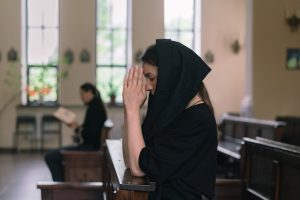
For some time, this counting was a grueling cycle: the two-week wait an attempt to balance optimism and realism, and the last two weeks working to recover and build up the hope needed to try again. But after a while, I realized I needed to tap into something deeper and older in order to carry on. And my faith showed up, as it so often does, when I was desperate.
I was looking at a church bulletin somewhere in this timeline and was struck by the subheading, reminding me that today was the such-and-such Sunday of Ordinary Time. “Counting,” I thought. “Counting weeks, even.” I began to feel a strong connection to the lineage of Catholics who had counted weeks and days before me: four weeks of Advent; 33 weeks of Ordinary Time; 40 days of Lent, 50 days of Easter; the great three days of the triduum, and so on. Catholics count annual dates, too: holy days of obligation; feast days of saints; commemorations such as All Souls’ Day and Christmas; and more. Since the origin of the liturgical calendar over 1700 years ago, Catholics have counted.
This counting is not so dissimilar from my own: Catholics count to mark times of waiting (Advent) and times of lament (Lent). Catholics count to mark prayers answered (Easter) and moments of tangible grace (Pentecost). Catholics count to remember the dead (All Souls’ Day) as I count the day of our miscarriage. Catholics count to remember our Mother, Mary (Jan. 1) as I count the days until I am a mother. Maybe most importantly, Catholics count to be connected with the faithful across time and space, across culture and language, from the earliest days of our tradition to the present.

Our baby was conceived during Holy Week and is due right around Christmas. The liturgical calendar connection writes itself: This little one began their existence in a week of pain turned to life and will enter the world in a season of preparation, expectancy, and great joy. The timing even feels a little divinely heavy-handed, but sometimes that is just God’s way.
To be honest, if given the choice, I would not have chosen a Dec. 22 due date. As someone who works for a church, Christmas is one of my busiest times of the year. But there is something so sacred in this particular Advent season: every counted week, every lit candle bringing us closer to parenthood, right alongside Mary. We tell of Mary and Joseph traveling by donkey to Bethlehem, as my wife and I journey to and from the hospital for what feels like 100 appointments a week. We remember how there was no room in the inn for the infant Christ, as my wife and I ask ourselves how to make room in our lives and home for the newest member of our family. We light candles for hope, peace, joy, and love to symbolize what we long for in the coming of Jesus; my wife and I long for these in the coming of our babe, too. Although, perhaps more candid candles would include anxiety and restlessness—I wonder if Mary and Joseph felt the same.
As I write this, my wife is 28 weeks pregnant and entering her third trimester. We have counted every week of this pregnancy with trepidatious gratitude and much prayer. Every Monday—day one of our gestational week—we pull up our many pregnancy-tracking apps and see how our fetus has grown: one day with newly-opened eyes, another to the size of a cantaloupe, one more with organs mostly developed. Unlike those that came before, these weeks of counting are long-awaited and so precious.
Even when we felt most alone, our community showed up for us in incredible ways: driving us to and from the hospital during the miscarriage; bringing us a care package on the anniversary of our loss; and, most importantly, never telling us that we were talking about our journey too much—even through three whole years of processing, tears, and eventual joy. Just this past weekend a few friends came over to organize the (seemingly endless) baby gear in our basement, and not one but two of our dear ones are throwing us baby showers.
A friend used a mantra during her labor that still hangs on the wall of her home: “Love got baby in, love gets baby out.” For a while, I wasn’t sure if I connected to the phrase. After all, it feels a little more accurate to our situation to say “science got baby in.” But science and love aren’t mutually exclusive, and I firmly believe that this baby only exists because of the endless prayers, deep love, and faithful stubbornness of our beloveds who willed it into this world against all odds.
Maybe you’re counting, too: the months left in a heartbreaking prognosis; the days until a loved one gets a visa; the years until the next presidential election. Maybe you are, like I am, counting the weeks in a pregnancy or even the hours of labor. Whatever you’re counting, I hope you remember that you are not counting alone. You count in the ancient tradition of our spiritual lineage, you count in the company of all the saints, and you count beneath the wings of the divine. May you remember that your religious ancestors, across time and space, are counting with you and rooting for you. And may you remember that you, too, have been willed into this world—against all odds—by our mothering God.
Image: Unsplash/Karina Syrotiuk






Add comment