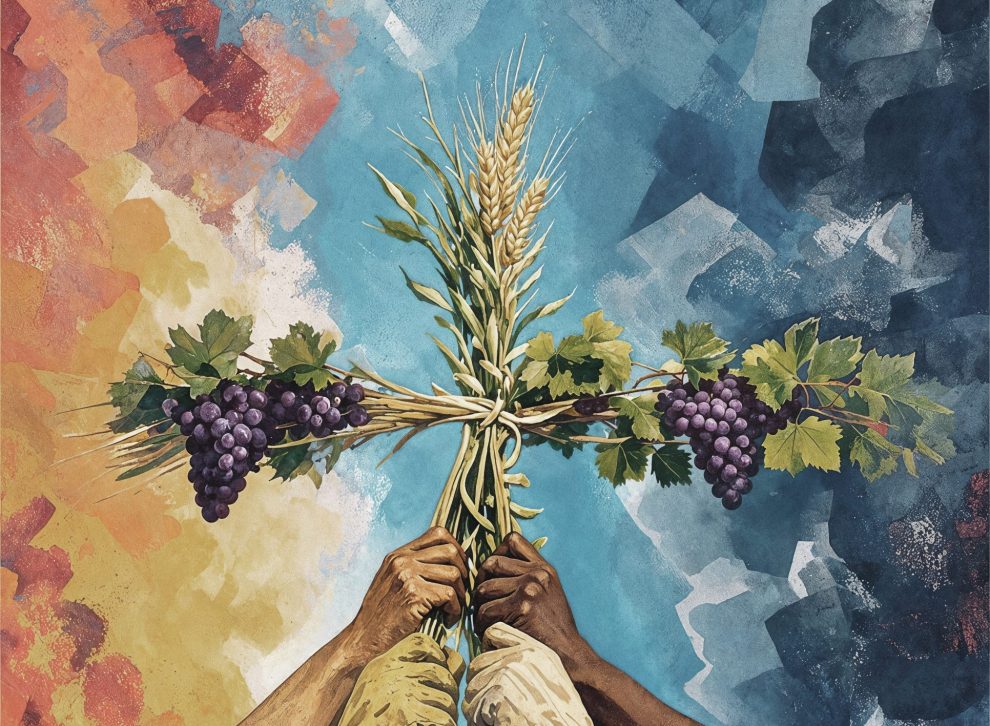
For your communion host to make it to your mouth during Mass, wheat freshly harvested from growers in states such as North Dakota, Kansas, or Washington must arrive by train to a flour mill in Illinois. It’s cleaned, ground, sifted, and blended into flour. Then it’s shipped from Archer-Daniels-Midland Company— one of the largest agribusinesses in the world—to Cavanagh Altar Bread, which produces 80 percent of the communion hosts used in the United States.
When 2026 totals are tallied, U.S. farmers are expected to yield the lowest wheat harvest in 150 years. In Kansas, warmer, drier weather destroyed some winter wheat before it could be harvested this spring. Globally, wheat yields could fall by up to 20 percent in dryland growing regions as early as the 2030s. While scientists work on breeding varieties that can withstand the coming challenges, some regions will also need to change what they grow.
Globally, agriculture accounts for about one third of greenhouse gas emissions that trap heat in Earth’s atmosphere. In turn, the warming climate is leading to food insecurity as weather becomes more volatile and crops become harder to grow. Heat, drought, disease, and pest pressures lower food production. Shrinking ice sheets, rising sea levels, unpredictable rainfall, and floods lead to water scarcity.
When the communion hosts arrive at Mass to be consecrated by the priest and consumed by the faithful, these climate impacts are largely hidden. But in the liturgy of the Eucharist, congregants receive the body of Christ and also a product from a supply chain that includes human, machine, and economic links. In the last century, modernization and capitalism have hidden our connection with the natural materials used in religious rituals, making the strain of climate change difficult to see.
Climate change is invariably impacting the world’s cultural and religious traditions. For Catholicism and other religions, too, religious rituals often require physical materials.
“This is anchored in the history of Jewish and Christian ritual practice,” says Teresa Berger, a liturgist and professor at Yale Divinity School. “For Christians, there are rituals that simply cannot be had without materials.”
Baptism requires water. Eucharist needs wheat and grapes. To anoint believers with oil, you need the fruit of an olive tree. To burn candles, you need beeswax. To celebrate Palm Sunday, one generally waves palms. The list could go on.
In the United States, many people enjoy enough security from smoothly running food systems and public utilities that the natural connection to resources and rituals never crosses their minds. “It’s just always there. There’s always water; there’s always bread and wine . . . there’s a lot of abundance,” says Sister of St. Joseph Carmel Pilcher, a liturgist based in Australia.
Part of adapting to and coping with the climate crisis will mean reconnecting with the physical elements used in our rituals.
Fruit of the Earth and work of human hands
Berger challenges Catholics to grapple with the history of extraction and exploitation that contributed to harmful ecological practices or oppressive labor systems—and that ultimately also contributed to climate change.
“Even our nice Sunday liturgies are already impacted by the largest societal, exploitative, ecological practices,” Berger says.
The Rhode Island-based Cavanagh Company invented new machines and methods for producing communion bread. Catholic studies scholar Antonio Eduardo Alonso writes in a 2023 article that the company began to “innovate, automate, and advertise” in new ways during the mid-20th century. Today, it sells hosts to many denominations, not just Catholics.
“One hundred years ago that production was in the hands of women who baked hosts,” Berger says.
At the beginning of the 20th century, Pope Pius X issued a motu proprio encouraging laypeople—who at the time would often only receive communion once or twice a year—to take the Eucharist frequently, even daily. Convents could not keep up with demand, and the commercialization of altar bread by outside entities enabled the production of larger quantities. Concerns about adulteration of the bread led the Cavanagh Company to seek ecclesiastical permission to sell altar bread in the 1950s.
“The few religious communities that were still making their own altar bread in the decades after the Second Vatican Council (in the 1960s) were forced to do something they had never done before: compete for customers on an open market,” Alonso writes.
Mary McGann, a theologian at Santa Clara University, thinks the commercialization of the hosts contributes to a disconnect with food scarcity. “Because people use hosts that are manufactured mechanically, they don’t have the same sense that food is threatened,” she says. “Most people don’t really bite into a piece of bread.”
McGann worships in a small monastic lay community. “We bake a lovely loaf of bread. It’s real bread, and you can taste and see that the Lord is good,” she says. You actually have to chew it.
Catholics also expanded the use of wine—taking viticulture and winemaking with them around the world. Grapes, unlike many other crops, reflect the places where they are grown.
“In the drama of wine, the land itself is a character—rough and brutal sometimes, but also tender and, ultimately, fragile. The wine that comes from it in any given year will never exist again,” writes wine expert Karen MacNeil in her book The Wine Bible (Workman Publishing Company).
In the fifth century, when the Roman Empire fell, vineyards in France increasingly moved under the control of the Catholic Church, where they remained for a thousand years.
In the 1500s, Spanish missionaries brought the Listán Prieto variety—known as mission grapes—to Mexico in order to make sacramental wine. And in 1629, one clergyman founded missions and planted vineyards near present-day San Antonio and Albuquerque. The Spanish also moved further north near present-day San Diego, eventually planting California’s first vineyards by the mid-1700s.
As they are able, U.S. churches select wines that are produced locally, such as those in central California or the Finger Lakes region in New York. While this practice connects congregants to the soils and environments in their local regions, they also take in the ecological changes that the grapes are experiencing. Today’s grapes may ripen faster in higher heat and change in flavor as slight shifts in climate affect chemical profiles. Wildfire smoke—which is becoming more common as the climate changes—also alters wine chemistry.
While labor practices can vary from business to business, as a whole, the wine industry does not safeguard the hands of the workers that produce it. Viticulture in the United States relies on farmworkers, many of whom occupy an underprotected immigrant status. Working in the field and picking grapes can involve exposure to heat waves, wildfire smoke, and harmful agrochemicals. Additionally, farmworkers are vulnerable to wage theft or abuse within the worker visa program.
Therefore, the whole truth of the story of wine includes not only the microclimate of a particular piece of land—and all the stress it may have faced that year—but also the sacrifice and suffering of workers.
Rivers of living water
One Saturday in 2015, the baptistery of a predominantly Black congregation in Flint, Michigan unexpectedly filled with black water from the tap as they prepared for a church picnic. Kristen Daley Mosier and Andrew Wymer documented how some churches adapted or suspended their baptismal practices when the tap water was found to be toxic during the Flint water crisis. In some cases, churches used bottled water in order to continue with baptisms.
Due to climate change, some areas face droughts, some face floods. Oceans are warming and rising. Many natural waterways are polluted or, like in Flint, aging infrastructure or careless officials obstruct communities’ access to clean water.
Residents from the archipelago nation of Kiribati already find saltwater in their groundwater well, which may soon no longer support human life. At some point, they will be forced to relocate, Pilcher says.
“We are seeing in the Pacific whole villages going underwater,” Pilcher says. “What they are having to do is move to higher ground, which means they can no longer visit their dead, because cemeteries are underwater.”
Berger says that for 2,000 years the Catholic Church has specified that “living water” should be used for baptism. In modern water utility systems, natural or living water comes from the ground, rivers, or lakes and is piped by the local municipality to the tap. These baptisms still happen within local living waters. Some people would not consider water that is bottled and shipped from other places living water.
Catholic theologian Timothy Brunk, concurring with Mosier and quoting ecotheologian Benjamin Stewart, writes:
I hold that in and through baptism “the baptized are invited to enter into solidarity with the greater watershed community of creation” starting with their own local watershed. If the water to be used in baptism must be “pure and clean,” then Christians have an obligation to work for the purity and cleanliness of water in their watersheds.
If people can’t access clean water, bottled water might be an adaptation, but it detaches us further from our local watersheds—areas of land that collect or drain snow and rain into one body of water.
Some Christians are asking how to make better local connections to water. In 2018, the Episcopal Church authorized local faith communities to experiment with the language in the baptismal covenant to include a commitment to caring for creation.
In some Lutheran churches, baptismal occasions adapt Martin Luther’s flood prayer—which thanks God that through Christ’s baptism the Jordan River and all waters are a saving flood of God’s mercy—and insert local waterways into the liturgy. “Praise to you for Isella Glacier and Railroad Creek, for Lake Chelan and Columbia River,” wrote one congregation in Washington State.
Berger appreciates how these thinkers remind people of their connection to natural waterways. In the Catholic tradition, she points to the 2001 pastoral letter from the Catholic bishops of the Pacific Northwest, which sought to bring together communities in the Columbia River watershed to address economic and ecological challenges that have harmed creation and created conflict. For believers there, participating in baptism with an understanding of the water source might mean acknowledging the tensions between municipal water, irrigation of farmland, hydroelectric power, and the local salmon populations and the Indigenous communities that rely on them as first foods.
Faithful climate adaptations
The physical materials needed for the sacraments have endured for centuries, and church law is unlikely to change. The Roman Missal—the liturgical book containing prayers, readings, and instructions for celebrating Mass—specifies that the hosts must be unleavened and recently made from wheat. For example, gluten-free hosts—which would have to be made without wheat—are not allowed. Sacramental wine must be from the “fruit of the vine” and produced without additives, such as grape concentrate, cane sugar, grain spirits, or carbonation.
In the sacraments, the “materiality is considered set in place by Jesus’ own practice,” Berger says. “He didn’t take rice and rice wine because of the bioregion he lived in. He took wheat and the fruit of the vine. Christians for the most part have accepted what bioregional rules are . . . we are faithful to them.”
Berger, who is working on a book that explores the relationship between liturgy and the other-than-human created world, says, “From earliest times, liturgical elements are reflected by regional realities.”
Berger says that wherever Catholic missionaries went, one of the first things they did was build vineyards to produce communion wine. So, “Christian missions have been in conversation with the natural environments.”
But part of the discussion about whether sacraments can be adapted leans into what it means to be a global church. For some parts of the world, wheat for the Eucharist has been difficult to procure ever since missionaries first arrived.
“When Christianity came to Japan, Christian liturgical practices continued to insist on wheat being used for the Eucharist even though it’s not native” in all places, Berger says.
Where it is not a common fare of the people or where importing goods is challenging, local theologians have written about what is at the essence of the eucharistic meal in the first place.
“The discussion could be had: Could we be faithful in other ways?” Berger says.
McGann wonders what’s implied by requiring wheat. Are there even other possibilities? What would be the criteria? “I think that’s a real issue for the world church,” she says.
In some Pacific Island nations, they’ve always imported wheat flour to make the hosts. “They don’t have flour. They don’t have grapes. It is extremely expensive. Only the priests would partake,” Pilcher says. Sometimes, the hosts become moldy because of the weather conditions.
Churches in the Southern Hemisphere experience opposite seasons and a climate with different crop availability and growing conditions that affect the physical materials required for Catholic sacramental and liturgical practice.
“We in the Southern Hemisphere have been adapting forever. Adapting is what we have always had to do,” Pilcher says.
“We celebrate a European liturgy. It was put together by Europeans and continues to be European,” Pilcher says. “We are trying to explore what liturgy means in the Southern Hemisphere.”
If Catholics are forced by climate change to take Eucharist less frequently, will they be more motivated to protect the sources of these natural materials?
Local liturgies for a global church
“There is generally more freedom with elements that are liturgical and not sacraments,” Berger says. “The regional realities have always to some degree shaped liturgical practices.”
For example, “when a palm procession moves from where it originates—from Jerusalem to medieval Europe,” people “find the branches of their own regional context to celebrate with. I’m from Central Europe; we often used willow branches or other regional materials,” Berger says. In Australia, olive branches are often used, Pilcher says.
Christians have long used olive oil for anointing, but the church merely requires the oil to be made from any natural plant, Pilcher says. Church law says it must be “pressed from olives or other plants.” In Fiji, the church now uses coconut oil.
In Alaska and other climates where the ground freezes in the winter, you can’t bury the dead for the season. So, you adapt body storage and create liturgies that take that into account.
Berger says that there are lots of other things in the sanctuary that environmentally minded congregants would like to change. For example, plastic comes from fossil fuels—can we remove plastic flowers? “Do you really want to have a major symbol of ecological devastation in your sanctuary?” she says.
Pilcher helps churches figure out how to create regional liturgies that remain faithful to the Missal. In the Broome Diocese in Western Australia, Pilcher built on five decades of work to gain official recognition from Rome for an Aboriginal liturgy.
In 2024, the Australian bishops overwhelmingly approved the liturgy created in the Bidyadanga region, where some Indigenous people were displaced as they sought safety from white livestock herders. “This Mass is different . . . it’s all sung. It arises from their language and their mindset and their way of thinking, not ours,” Pilcher says, yet “it follows the structure of the Roman rite.”
“We need to know our liturgy, because there’s a lot that can change,” Pilcher says. Processes like these “need people with a liturgical understanding to know what we can and cannot do. We don’t always have to add. We can heighten or replace.”
The new liturgy includes the water blessing, or the asperges, which is when the priest sprinkles the altar, clergy, and congregation with holy water. Many people don’t know the water ritual if their priest doesn’t use it, but it is an option in the Missal, Pilcher says.
In the new liturgy, women lead the water blessing. They invited the Australian bishops to the first Mass. “They prayed over the water. They didn’t wait for the bishop to do that. They prayed in their language and proceeded to bless each bishop,” Pilcher says. “Water is so precious to them. They come from the desert and had to find the water in the first place. When they found the water, [the women] would first thank the ancestors and throw the water on themselves.”
The original asperges “began from a pagan ritual, but we forget all that. Most of what we do has emerged from pagan rituals anyway,” Pilcher says.
Communities need these regional liturgies, Pilcher says. “Ritual is vital, but it’s got to be not a ritual for the whole of the world to use. We need to write our own.”
Pope Francis addressed the tension between the global and the local in a 2013 exhortation:
We need to pay attention to the global so as to avoid narrowness and banality. Yet we also need to look to the local, which keeps our feet on the ground. . . . We need to sink our roots deeper into the fertile soil and history of our native place, which is a gift of God. We can work on a small scale, in our own neighbourhood, but with a larger perspective.
Lament for the climate crisis
Many communities of faith are adapting rituals to include the environment, particularly lament. Rituals help people process losses—providing a public forum for expressing emotions and offering connection in community.
“In the times we live in, we have to learn how to dwell in grief over what is being lost and what has already been lost irretrievably,” Berger says. Rituals can help.
Pilcher embraces the ways the interfaith community has created rituals, particularly after disasters, but cautions using physical elements that may also trigger negative emotions. She recalls anointing with oil during prayers for healing after a tsunami. But she also remembers a gathering of liturgists that was cut short by a wildfire. When it was safe to do so, they offered a final liturgy. The words used went something like this: May the fire on the Earth go out and be fire to others.
“That was not appropriate,” Pilcher says. “I found myself crying the whole time. It was two days after the event. We went through this ritual that they had prepared without stopping to ask the 60 of us who went to stop and process. The kind of rituals we prepare have to tell the truth.”
Truthful liturgies might also unmask the climate costs hidden in our supply chains or the exploitation and harm already felt by communities living in degraded environments.
For Berger, growing momentum for an official feast day dedicated to creation in the Catholic liturgical calendar would begin to open the possibilities for Catholics to include climate impacts within church rhythms. Last summer, the Vatican authorized a new Mass formulary for the care of creation to be added to the Missal, but it is just an option that can be used on occasion.
Since the early centuries of the church, the Eastern Orthodox Church has celebrated the Feast of Creation on September 1, and in 1989 invited the global Christian community to join them. In 2015, Pope Francis established a day of prayer for creation.
With Francis’ 2015 encyclical, Laudato Si’ (On Care for Our Common Home), people began to shift their mindsets around the sacraments, for example. “The Sacraments are a privileged way in which nature is taken up by God to become a means of mediating supernatural life. Through our worship of God, we are invited to embrace the world on a different plane,” Francis wrote.
“There’s much more fluidity. We’ve had this mindset of seven sacraments. Now we have a broader mentality,” Berger says. “When Francis said we find God in the leaf, the pet, the beautiful sunrise, that has broadened our whole horizon. There is a groundswell with a whole different attitude toward creation.”
During the proceedings for the movement for a Feast of Creation, Aboriginal and Pacific Islander Catholic leaders also remind us that this mindset isn’t just about celebrating creation. “We have to reconcile first before we celebrate,” Pilcher says. “We can’t celebrate creation until we heal creation.”
Archbishop of Fiji Peter Chong wrote along with Pilcher about how he embraces a sacramental understanding of creation and proposes a theology of vulnerability to acknowledge the interconnectedness of humans with creation. He writes that when people share in the suffering of creation, they are embracing the cross.
“When we don’t have control over the elements anymore. When there is drought, heat, I think maybe it will draw us back to that connection and how we find God in creation,” Pilcher says. “Maybe climate change and the ecological crisis might draw us back to that.”
This article also appears in the November 2026 issue of U.S. Catholic (Vol. 91, No. 11, page s 10-15). Click here to subscribe to the magazine.
Image: Art by Jory Mertens