Sometimes it can be difficult to see what, if any, enduring legacy exists in the 21st century for a saint who died 800 years ago this October. But St. Francis of Assisi is someone who still matters today, and in some surprising ways. In our time marked by increasing individualism and isolation, which is exacerbated by social media algorithms and a decline in institutional belonging, Francis’ witness to the importance of relationship and active participation in community is a powerful message.
Francis lived in a tumultuous time not unlike our own. There were political and ecclesiastical tensions in his medieval community, which spilled over at times into violence and a growing distrust of neighbors and strangers alike. As a young man, Francis was involved in a violent conflict between his town Assisi and the neighboring city of Perugia. He was captured as a prisoner of war and later ransomed by his wealthy cloth-merchant father after months of isolation.
During his recovery from the trauma of violent conflict and separation from loved ones, and still a young adult in his 20s, Francis began to examine his life and committed himself to taking his Christian faith more seriously. The beginning of his lifelong, ongoing conversion resulted from a very relatable experience of uncertainty, doubt, and a desire to do something meaningful with his life.
At first, Francis believed this meant he ought to go and do charitable works on his own, dedicating himself to individual prayer, reflection, and service. But as he recounted near the end of his life in his Testament, Francis eventually came to recognize that he could not live the gospel life of Christian discipleship alone.
Reflecting on how his journey of faith and the eventual founding of a religious order and spiritual movement in the church began, he recalled: “And after the Lord gave me some brothers, no one showed me what I had to do, but the Most High Himself revealed to me that I should live according to the pattern of the Holy Gospel.”
Remarkably, Francis came to realize that authentic Christian life is always lived in community. As he tried to flee the society into which he was born in privilege and move to the margins to do good works, God continued to send people into his life to help him form community. He didn’t seek out these early brothers—and, later, St. Clare and her religious sisters—but Christ put them in his path. And from that point onward, Francis understood more clearly that Christianity was inherently about living in right relationship with others, God, and all creation.
The primacy of relationship is one of the most important insights St. Francis of Assisi’s life and legacy provides to us today, especially as we navigate a cultural context that promotes individualism over community belonging. Everything Francis did and every directive he gave to his followers can be distilled down or traced back to this fundamental notion of the importance of relationship.
Take, for example, the name of the religious community he founded. Whereas St. Dominic, a contemporary of Francis, would name his community the “Order of Preachers” after the apostolate that formed their identity and purpose, Francis would call his community the “Order of Friars Minor.” Friars Minor means “lesser brothers,” a designation of relationship that described how Francis and his followers would relate to one another and all they encountered.
Put another way, Franciscan life was not about a particular job or ministry shared by the brothers; it was a commitment to a kind of social positioning and openness to recognizing the familial bonds that unite all people in Christ. In our increasingly polarized, divided, and even antagonistic societies, Francis’ vision of universal fraternitas—brotherly and sisterly love—is desperately needed.
Another example of this prioritizing of relationship is seen in Francis’ commitment to evangelical poverty. Francis’ understanding and embrace of poverty followed the model of Jesus Christ. It was not a celebration or romanticizing of abject or material poverty, but a voluntary dispossession of anything that would inhibit one’s ability to relate to others.
As I previously explained in this magazine, when writing about poverty in the Regula bullata—the official religious Rule or way of life of the Franciscans—St. Francis doesn’t use the term people usually associated with religious vows. Instead, he says that the Franciscan friars are to live “without anything of one’s own” (or sine proprio in Latin). He understood evangelical poverty as a surrender of ownership, control, and power over anything that gets in the way of relationship. The more property one acquires, the more preoccupied one can become with protecting it and keeping it from others.
But this call to live “without anything of one’s own” also applied to nonmaterial or “spiritual” possessions. This means letting go of prejudices, perspectives, and judgements that prevent authentic relationship or that may negatively color our perception of others. In an age when social media has only magnified the ways people can embrace preconceived notions or traffic in superficial assessments of others, we would do well to heed Francis’ warning about how these distorted ways of viewing our fellow humans can prevent Christians from following Jesus Christ in accepting each person we meet as our sibling and a beloved child of God.
The thing for which Francis is best known is his love and admiration for creation, and this also stems from his commitment to relationship. His beautiful “Canticle of the Creatures”presents the whole cosmic community of creation like a family with human beings as siblings to all creatures and elements in the more-than-human world. Francis saw the universe united in kinship, with all creatures, including humans, living interdependently. This is why he called not only his human neighbors by familial titles but also extended this sense of fraternitas to the whole of creation, addressing all creation as his brother, sister, and mother.
A generation after Francis’ death, his follower St. Bonaventure, a theologian and doctor of the church, would lift up Francis as an exemplar of ecological piety. Like Francis, Bonaventure believed that all creation was intrinsically connected because we all come from the same, singular, divine source. As such, we are part of God’s cosmic family and are called to care for one another as we are called to care for our own children, siblings, and parents.
Bonaventure retrieved the ancient Roman civic virtue of pietas, which is primarily about the duty one has to care for their family members, not out of external obligation or because one is hired as an employee but simply because you are related to one another. Bonaventure saw that Francis of Assisi extended this care to his nonhuman creaturely siblings, acknowledging that the rest of creation already cares for the human family and that we ought to return the favor not as stewards or hired hand, not out of begrudging obligation or guilty consciences, but because such care is what family members owe one another.
In our time of climate catastrophe, with increasingly dire impacts felt around the world and especially by the global poor, we need a renewed sense of our inherent creatureliness and interdependence with the rest of the family of creation. Francis’ primacy of relationship extended to our nonhuman kin reflects the mutuality and communion that God envisions for creation.
There are so many other ways that Francis’ emphasis on the primacy of relationship unfolded in his short life and ministry, such as in his care for lepers and other social outcasts, as well as his refusal to see Muslim women and men during the Fifth Crusade as anything less than his beloved sisters and brothers.
While there is much to be grateful for as we commemorate the 800th anniversary of the Transitus—the “passing” or “transition”—of St. Francis of Assisi from this life to the next, his spiritual legacy can be summarized simply as a radical commitment to relationship in all aspects of life. As we continue to confront division, violence, inequality, ecological destruction, and increasing polarization, Francis’ vision of participating fully in God’s community of creation is one exceptional way he still matters today.
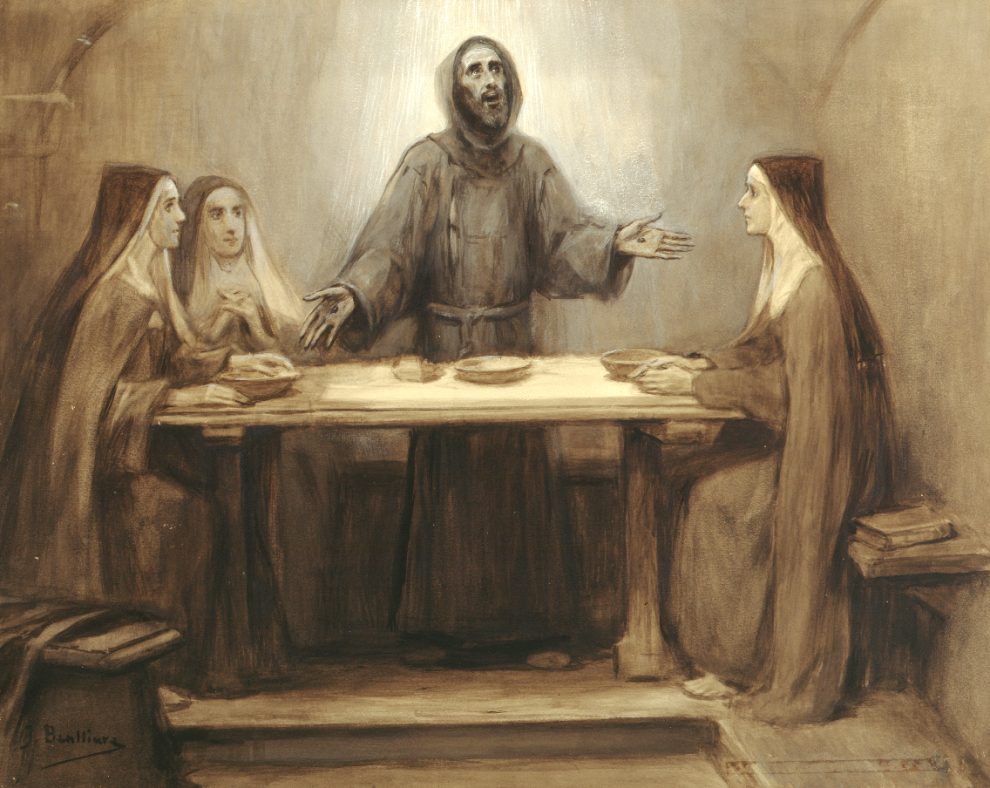
Image: Wikimedia Commons,. Josep Benlliure y Gil, painting of St. Francis