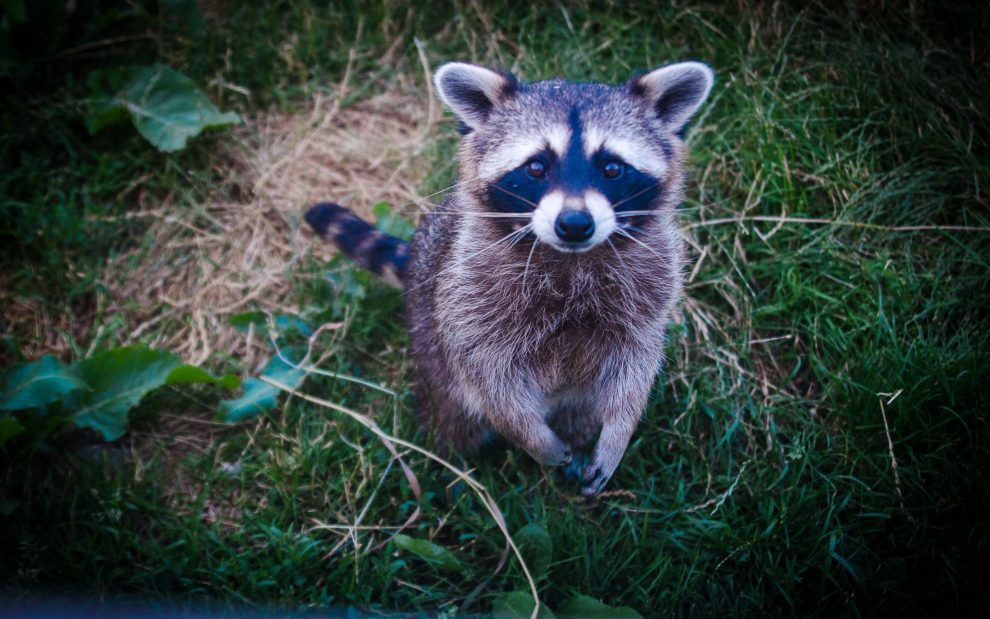
Caught up in some painful drama as a college student, many years ago, I sought solitude in a forest near the school and knelt to pray beside a fallen log. Hearing a rustling beside me, I opened my eyes and beheld a raccoon on its haunches, its tiny paws pressed together. Call me naive, but it looked for all the world like I had a ring-tailed prayer partner.
I have encountered a surprising number of people who have shared such moments of spiritual connection with their furred or feathered friends. It makes sense: We sometimes find comfort praying with another person but can’t always find someone to pray with us. Meanwhile, the ideal prayer partner may be rubbing against your leg or swishing her tail.
Sacred tradition testifies to the spiritual lives of our fellow creatures. Pope Francis wrote in Laudato Si’ (On Care for Our Common Home) that the “ultimate purpose of other creatures is not to be found in us. Rather all creatures are moving forward, with us and through us, to a common point of arrival which is God.” Scripture also points to the spiritual wisdom of animals. In Genesis, God establishes God’s covenant “with every living creature” (9:9–10). Job declares, “Ask the animals, and they will teach you” (12:7). In the Book of Daniel, the three men in the fiery furnace pray, “Bless the Lord, all birds of the air . . . all wild animals and cattle” (3:80–81). Jesus uses ravens, sparrows, and sheep to show us what it means to trust God.
The lives of the saints reveal a host of holy Doctor Dolittles. When an evil-minded monk tries to murder St. Benedict of Nursia with poisoned bread, a crow carries it away, saving his life. The Venerable Bede tells how, when St. Cuthbert returns to the shore after praying in the cold ocean, two otters follow, warming his feet with their breath and fur before receiving his blessing.
Francis of Assisi, patron saint of animals, invites fellow creatures to praise God with him. As Peter (Petra) Gardella and Laurence Krute write in Wings of the Gods: Birds in the World’s Religions (Oxford University Press), Francis “admonished all birds, all animals and reptiles . . . to praise and love the Creator.”
While theologians hold differing views on the spiritual lives of animals, scripture and the witness of the saints point to a belief that they, too, are in relationship with God. What, then, does it mean to pray alongside creatures who relate to God in ways very different from our own?
Perhaps poets—gazing through the windows of imagination—can help us glimpse the spiritual lives of animals. In her poem “I Happened to Be Standing,” Mary Oliver muses about a singing wren: “What could this be if it isn’t a prayer?” Irish poet William Butler Yeats also delves into the imagined spiritual psyche of animals. In his poem “The Indian Upon God,” various creatures describe their maker. At the poem’s end, the peacock envisions God as a kind of “monstrous peacock,” whose tail is filled with “myriad spots of light.”
Poetry and theology come together in John Scotus Eriugena, who served in both roles at the ninth-century French royal court. Eriugena believed that animals have souls and relate to God through senses surpassing our own: “What human can see as clearly as an eagle or boast a sense of smell like a dog?”
Centuries later, modern biology would give a name to this insight: umwelt. In German, the word means “environment.” German biologist Jakob von Uexküll and Hungarian semioticist Thomas Sebeok use the term to refer to the different ways creatures experience reality. An eagle or hawk soaring hundreds of feet above us can spot a tiny mouse or shrew in the grass, while dogs inhabit a world written in scents, detecting traces left by other animals hours or even days before.
Some Indigenous traditions say the eagle flies closest to the Great Mystery. Does the eagle glimpse God in the world spread sharp and luminous below, bridging heaven and earth? Does a dog catch scents of the divine in those invisible trails, sniffing out the connection between all living beings and the Creator? Our fellow creatures encounter the divine in ways different from ours, through their own unique senses and perceptions. Humans can take a seat beside these creatures, in the boundless congregation of praise.
Dogs, famous for their loyalty and affection, seem divinely designed for spiritual companionship. As you pray beside your dog, you might stretch your imagination and ask yourself: Just as we find signs of God in visual beauty, does a dog’s keen sense of smell pick up some trace of the divine or the sweet scent of grace?
Perhaps you have a feline family member who also has a life with God all their own. Scientific studies suggest that cats purr at vibrational frequencies shown to aid healing of fractures, wounds, and pain. Perhaps your cat’s purring is a kind of prayer for your mending.
As I write, my Scottish Fold cat, Bunty, is curled on the table beside me. I try to see the world through her eyes. I imagine curling into a comfortable ball, paws tucked beneath me, letting go of human worries and resting fully in the moment. The Creator has given Bunty effortless movement, eyes that pierce the darkness, and a safe and serene life. I suspect that, in her quiet way, she gives thanks for these gifts. My feline companion models a life of trusting prayer.
Perhaps you already pray with your dog or cat without realizing it. You may scratch your dog’s neck or stroke your kitty’s warm fur while talking on the phone or letting your thoughts drift. Next time, why not focus on your pawed companion with the intention of sharing in prayer or sacred contemplation? Say, “OK, boy, let’s pray now,” or pet your cat as you recite the rosary.
I realize that not everyone enjoys being around pets, and that’s OK. Some people are wary of animals because of traumatic experiences or phobias. But perhaps you can still pray with other creatures from a comfortable distance. I like to sleep with the windows open, so I awaken to songbirds tweeting, a flicker pecking, and crows cawing—a feathered choir inviting me to join their praise.
That raccoon beside me in the woods knew something I was only beginning to learn. Our creaturely companions seem remarkably at home in the divine presence: the dog with her wagging tail, the cat with his lazy stretch. Perhaps they have been waiting all along for us to join them.
This article also appears in the October 2026 issue of U.S. Catholic (Vol. 91, No. 10, pages 44-45). Click here to subscribe to the magazine.
Image: Pexels.com/anne sch