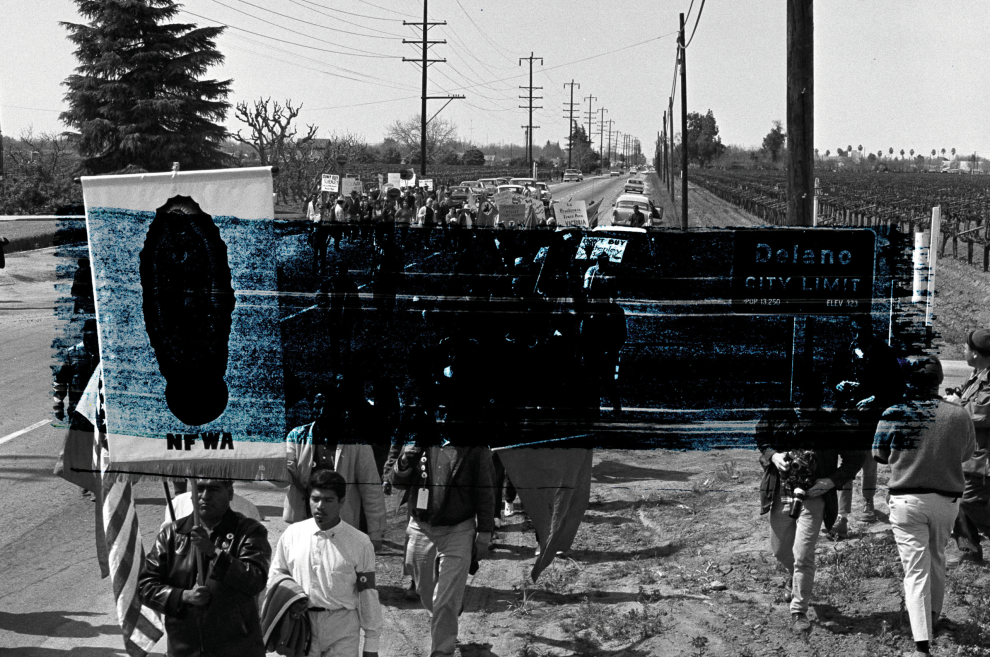
In March 1966, around 100 striking farmworkers started walking 300 miles from Delano, California, toward Sacramento. The mostly Mexican American and Filipino farmworkers had been on strike for six months and were marching to the state capitol to bring attention to their demands for higher pay and safer working conditions. Organized by Cesar Chavez and the United Farm Workers (UFW), the march included a lot of religious imagery: Someone carried a cross on their shoulder, and a banner with Our Lady of Guadalupe led their way as they walked under the sun along highways and through remote towns and fields.
The religious imagery signaled that the movement was Catholic and holy, says Nahomi Esquivel, a former labor and community organizer. Chavez even became an “uncanonized saint for some people,” she says.
“Their march to Sacramento isn’t a march, it’s a peregrinación [pilgrimage],” she says. “I think the reason why so many people joined and contributed is because of that. It becomes holier, and I think therefore harder to question. So there’s also this religious element to why you would trust [Chavez] and not question him.”
Sixty years later, in March 2026, the New York Times published a report that Chavez sexually abused, raped, and harassed teenage girls and women in the movement for decades, including Dolores Huerta, his coleader of the United Farm Workers.
When Esquivel first read the report, she wasn’t surprised. Esquivel is a postdoctoral fellow at the Johns Hopkins Stavros Niarchos Foundation (SNF) Agora Institute and has been doing critical work on the United Farm Workers for a while. She published an article in Dissent magazine about patterns of toxic organizational dynamics in the UFW.
Although Chavez was a saint to some, the culture within the movement was misogynistic and violent toward women. Many men, including Chavez, publicly humiliated women by calling them derogatory names and silencing their voices. “I let go of Cesar a long time ago because—it sounds kind of corny—but he was just very mean,” Esquivel says. “To me, the allegations were not surprising. How do we hold ourselves accountable in valorizing this person?”
Many social justice movements, both within and outside the church, have had histories of inequity, injustice, and abuse. The Chavez case is an opportunity for Catholics to consider what it means when a revered leader turns out to be an abuser. How do we remain accountable, and how do we make these movements and the church truly safe and liberatory? The Catholic tradition has resources to help us do so. The church also has a lot to learn about undoing harm.
Conscience and human dignity
When someone is abused, “oftentimes, [they] had a sense of what was going on in their conscience and overruled it because of the culture, because this person is so holy or people told them that couldn’t possibly be happening,” says Sister Theresa Aletheia Noble, cofounder, along with Sister Danielle Victoria Lussier, of the Sisters of the Little Way of Beauty, Truth, and Goodness. The sisters meet with abuse survivors several times a week and hear a variety of stories that include financial, sexual, and spiritual abuse.
Our conscience is a “really important aspect of our faith; to recognize when people are trying to override your conscience, to believe that God really is present to us in the sanctuary of our conscience,” Noble says, referencing the Catechism of the Catholic Church, which states: “Conscience is man’s most secret core and his sanctuary.”
In their work with survivors, Noble and Lussier try to instill the church’s teaching about moral conscience and the human dignity of following one’s conscience. As the catechism states in reference to the human conscience, “Its voice, calling him to love and to do what is good and to avoid evil, sounds in his heart at the right moment. . . . It is important for every person to be sufficiently present to himself in order to hear and follow the voice of his conscience.”
Noble and Lussier had been part of the Daughters of St. Paul for 12 years when they began to feel a call to start a new religious community with a mission “to people on the fringes of the church, especially those who have been wounded or abused by members of the church,” Noble says.
St. Thérèse of Lisieux’s “Little Way,” as well as the gospel’s emphasis on the preferential option for the poor and vulnerable, inspired their spiritual approach, Noble says. “When people abuse others, they’re going beyond their limits,” so living in a little way is a “spirituality of safeguarding, of being in God’s glory, but by embracing our fragile limitations and being real about those things,” she says.
Located in the diocese of Lexington, Kentucky, Noble and Lussier quickly realized how great the need was for their mission as they sought to provide resources for abuse prevention in the church. Their goal is to open a house in 2028 for discerners considering the community.
Following her conscience was part of Natalie Pucillo’s healing journey. David Haas abused Pucillo during her college years. Haas wrote popular liturgical music that was sung in parishes for decades; in 2020, allegations came out that he spiritually and sexually abused dozens of young women during his career.
Pucillo met Haas in 2016 when she attended Music Ministry Alive (MMA), a liturgical music ministry program that Haas ran for high school and college students. “He wrote the music of my childhood faith,” she says. “That is why I jumped at the opportunity when my parish offered to send me to Music Ministry Alive.”
Pucillo says Huerta’s words in the New York Times report resonated with her. “Her statement moved me so much,” Pucillo says. “She talked about not feeling like she could say no because [Chavez] was someone that she admired and her boss and leader in this movement, but also because she had dedicated so much of her life to the movement. That’s something that I felt very connected to, and something that might resonate with a lot of survivors, especially in communities where the organization is Catholic. There is a spiritual aspect to the work being done; it feels like a vocation as much as a profession.”
Even with boundaries constantly overstepped and lines crossed, Pucillo tried to reframe what was happening to her as something other than abuse, because she believed in the mission of MMA. “That was one of the things that was so horrifying to me in connecting with other survivors and hearing their stories: He did have a very clear playbook,” she says. “It shattered me to remember all the reframing I did.”
With the knowledge that Pucillo now has of abuse in the church, she realizes “there were so many red flags. There was such clear grooming that was happening to me,” she says. “Even in the moment, there were things that didn’t sit right for me. [Haas] famously had us all call him Papa Bear, which is really gross in retrospect. He rewarded our emotional outbursts if they led us to confide in him. Especially with the girls, he was very touch-oriented.”
In June 2020, a group of Haas’ survivors came forward with the help of Into Account, an organization that reports on abuse in the church. Pucillo is very involved with Awake, a community of abuse survivors, concerned Catholics, and allies responding to sexual abuse in the church. Awake offers spiritual care and several support groups for abuse survivors.
The Sisters of the Little Way and Awake partner with other organizations in providing resources and support for survivors. A few other groups are: Abuse Survivors Coalition, Spirit Fire, and SNAP (Survivors Network of those Abused by Priests).
For Pucillo, the church’s teaching on the dignity of each human person should prompt all Catholics to prioritize truth-telling and listening to survivors. “I believe that as Catholics, we have a responsibility to speak up and say, this is as much of a sin against God as it is against man and woman,” she says. “It’s part of our respect for one another and our respect for the dignity of the human person that we are commanded to talk about these things.”
The whole story
Despite the toxic dynamics within the United Farm Workers, the UFW permanently improved farmworkers’ conditions, Esquivel says. It was the first union to sign contracts with growers; it brought water and toilets to the fields.
“Farmworkers really become this symbol of chicanismo and Mexican American power,” she says. “They tell a very David-and-Goliath story of these oppressed, powerless people taking on some of the biggest corporations in the United States. It’s a history absolutely worth knowing and appreciating, but this is also why a lot of people are like, what are we going to do with this legacy?”
Karen Guth, a professor of religious studies at College of the Holy Cross who studies Christian feminist and womanist ethics, calls this a “tainted legacy”—when an institution or person has made an indispensable contribution of some kind yet has caused lasting trauma, whether sexual trauma, slavery, or racism, “that taints the goods of the legacy,” she says.
In organizations or movements with tainted legacies, a “legitimate authority betrays what’s right in a high-stakes situation,” she says, drawing on psychiatrist Jonathan Shay’s concept of moral injury. Guth wrote a book called The Ethics of Tainted Legacies: Human Flourishing after Traumatic Pasts (Cambridge University Press), in which one of the figures she looks at is John Howard Yoder, a Mennonite theologian whose work on Christian pacifism was highly influential. During his career, he sexually abused as many as 100 women, many of whom were his students.
Cases of tainted legacies often involve powerful, charismatic men. “They’re not just powerful; they’re smart,” Guth says. “When [Yoder’s] reputation rose, Mennonite institutions were really proud of him for putting them on the map. He was using his intellectual gifts as a way to evade censure,” and the places where he worked were less likely to hold him accountable because of the recognition he brought them.
Guth sees that same dynamic happening in Chavez’s case. “The connection between Yoder and Chavez is you have minority traditions who’ve made a lot of progress and have risen to prominence in a way that they might not have otherwise. People want to protect that, and you don’t want to expose your dirty laundry in a situation where you finally made it to the big stage,” Guth says.
Abuse survivors’ reluctance to speak out because of that “is a big part of this story,” Esquivel says. “It’s present in so much of our community work, even issues that aren’t as serious as this.” Esquivel has found herself in positions where she’s taken issue with certain policies or things people say. “At what point is critique helpful,” she asks, “or if I say this, does this undermine the movement?”
On the other hand, oftentimes victims do speak out and aren’t listened to. In Yoder’s case, women were reporting to authorities in the institutions where he worked, and “nobody was listening to them,” Guth says. “So you have people silencing victims, and victims silencing themselves out of greater interest in promoting the movement they care so much about.”
Another tainted legacy with Catholic roots is that of L’Arche, an international organization of communities made up of people with intellectual disabilities (core members) and those without disabilities (assistants). Jean Vanier, a Catholic theologian, founded L’Arche in 1964. For decades, Vanier spiritually and sexually abused L’Arche assistants, and he even used L’Arche as a cover-up for practicing his abusive “mystical-sexual” beliefs.
Vanier used his religious authority to abuse. Yoder did too; Guth says he wrote in unpublished memos that he was experimenting in “Christian sexual ethics.” In the 1970s, Chavez began claiming he could heal people through mind control and spiritual practices, which he used to molest a 13-year-old, claiming to show her her body’s “pressure points.”
It wasn’t that these men were “great theologians who then on the other side happened to do this bad thing,” Guth says. “They actually were using their theology, their leadership, and movement to cover or excuse the abuse.”
This raises the question: Is it possible to separate the “good work” from the abuser?
Esquivel doesn’t think we should try to separate them, because then “you’re not reckoning with the work that still needs to happen,” she says. “Even if the United Farm Workers completely won, and farmworkers today were well paid with health insurance and vacation days, that would be great and wonderful—but if the cost of that was people being sexually abused, this is what the work has led to.” The leader and the work can’t be separated so neatly.
For Pucillo, no longer playing Haas’ music is the right thing to do as it sends a message to all who have been abused—not only by Haas—that we take survivors’ stories seriously.
If a woman is silenced about her abuse “because of some concept of the greater good, either implicitly or explicitly, I have to wonder whether we’ve simply allowed that oppression to shift to a different, more acceptable group of people,” Pucillo says. “I don’t know that we can truly live liberation while allowing sexually abusive leaders to flourish without consequences.”
Texts of terror
Guth points out that the Christian tradition is itself a tainted legacy, with the central trauma being the death of Christ. “All the theological reflection that follows in the tradition is trying to make sense out of that trauma,” Guth says. “And the Christian tradition, like any other tradition, is affected by racism, sexism, classism, homophobia, on and on. Theologians try to draw on Christian resources to respond to those aspects of the Christian tradition’s own tainted legacy.”
Feminist and womanist theologians have also been thinking through tainted legacies for a long time with “texts of terror” in the Bible, Guth says. “What do we do with these texts about sexual assault in the Bible where God never shows up and says, ‘That’s wrong,’ or where God never intervenes?” Guth asks. “And here they are, canonized in sacred scripture.”
Our culture is influenced by Christianity, and “we have a tendency to elevate lone male savior figures,” Guth says, which isn’t a surprise given that Jesus is a lone male savior figure. “A lot of feminist and womanist theologians, my colleagues, have pointed out how dangerous this dynamic is in terms of social movements.”
Although Martin Luther King Jr. became, in a sense, a lone male savior figure during the civil rights movement, activist Ella Baker (1903–1986) said she didn’t want to lift up a lone savior, “because she wanted to empower the community to do the work,” Guth says. “There’s a real wisdom there, as you can see, because it avoids this problem of lifting somebody up who then ends up falling down.”
The catechism states that scandal is an attitude or behavior that leads someone to do evil, and Pucillo has seen this become weaponized against survivors. “That’s not the full reality of what the church tells us scandal is, because there’s also scandal in the silencing,” she says. The “process of reporting is equally or more traumatizing than the abuse itself,” and that too is a scandal.
Noble has likewise seen time and again that “what is more damaging to a person than even, in some cases, the original abuse, is the church’s response to that abuse when they report it,” she says.
Throughout her journey, Pucillo found companionship with Jesus in the passion narratives of the stations of the cross, in particular the 10th station, when Jesus is stripped of his garments. She sees this as a moment where Jesus experienced sexual violence, and she was able to “unite my pain with his in that moment,” she says.
Eucharistic adoration was also meaningful for Pucillo, “especially when Mass didn’t feel like an option.” Now, she is most drawn to the resurrection, particularly when Jesus tells Thomas to touch his wounds.
“I am somebody who has chosen to show my wounds, often to those who are doubtful,” Pucillo says. “Not so that I can be pitied for the suffering that I’ve experienced, but so that I can proclaim the truth of God through them.”
Accountability and responsibility
For Guth, the most promising response to tainted legacies, as opposed to trying to separate the work from the problematic person, is to “reform the systematic problems that led to the abuse in the first place,” she says.
That could look like changing the leadership model and addressing the reality of sexual violence, which affects almost every institution in the United States. Although changing streets and murals in Chavez’s name has its place, “the name of the street is not going to prevent someone from being sexually abused in the future,” she says.
Guth looks to restorative justice practices that “lift up the importance of truth-telling, learning, reparations, and honoring victims as moral agents,” she says.
Honoring a victim’s agency—not just seeing them as victims but as legitimate authorities in their own right—is part of accountability. Accountability is “work for justice over time, in all kinds of different ways, by all kinds of different actors; it’s a work that’s never finished,” Guth says.
Being in community with other survivors has been empowering and healing for Pucillo. In 2021, many of the women Haas abused filmed a public service announcement video inspired by the New York magazine cover that showed all Bill Cosby’s victims. “We have had several conversations of feeling a connection with Jeffrey Epstein’s victims and the work they are doing for transformation and accountability in the public sphere,” she says. “Those relationships have been completely transformational in how I operate in the world, knowing that this is not something I have to carry by myself.”
People in the United Farm Workers or L’Arche communities today have “inherited this legacy and have a responsibility to make sure there are more protections that would prevent this from happening in the future,” Guth says.
Noble wants Catholics to understand that it’s not just a “few bad apples” but wider cultures—including clericalism—that enable abuse.
“People have been saying this is why we don’t romanticize one person, which is really good advice,” Esquivel says. “But as a historian, I’ve dealt with histories of movements, and we shouldn’t romanticize any single movement. My point is it wasn’t just Chavez, it was this broader culture.”
For movements trying to reckon with harm and move forward in truth-telling, Esquivel says to remember that “holding people accountable should be an act of kindness and generosity. Sometimes, where movements go wrong is when we lose that.”
When Esquivel thinks through these questions around accountability, community work, kindness, and bringing about a more equitable world, she finds comfort in a verse from 1 John: “No one has ever seen God; if we love one another, God abides in us, and his love is perfected in us” (4:12). “I like to think that the God spoken of here means that more peaceful and just world we have yet to see,” she says.
Change often begins in a grassroots way. “Catholic laypeople can make a huge difference in our environments. One of the big ways is speaking out and supporting people when they speak out, even if they end up being wrong,” Noble says. We need a culture that “isn’t threatened by that,” and unfortunately, she says, there are very few cultures like that within the church.
Pucillo sums up what Catholics can do to support survivors: Listen, believe, and act. “God wants me to tell the truth,” she says, “because I want to make sure that other people are safe. I want our children to have a safer life in the church than I did.”
This article also appears in the September 2026 issue of U.S. Catholic (Vol. 91, No. 9, pages 40-15). Click here to subscribe to the magazine.