What does the Catholic Church teach about LGBTQ+ (lesbian, gay, bisexual, transgender and queer) people?
That answer deserves a book or maybe several. But let me try to answer that as clearly as I can in an article. Full disclosure: I’m a Catholic priest, so I want to present church teaching as accurately as I can. I’m also someone who ministers to LGBTQ+ Catholics, so I want to present church teaching in a way that will help them, and their families and friends, feel welcome in what is, after all, their church too.
To begin with, LGBTQ+ people are beloved children of God. That’s where we need to start when it comes to church teaching: Everyone is a child of God and, as a result, possesses infinite human dignity. That needs to be said about LGBTQ+ people because in almost 70 countries, simply stating that you are gay or engaging in same-sex relations can result in your execution or imprisonment.Pope Francis himself supported the “decriminalization” of homosexuality.
Second, when speaking about church teaching, we must look first at Jesus. Often when people ask, “What does the church teach about LGBTQ+ people?” they look only to the Catechism of the Catholic Church. But church teaching is not simply a book, no matter how comprehensive. In the end, church teaching is a person: Jesus Christ. And in Jesus’ public ministry we see him continually reaching out to those who are on the margins, as many LGBTQ+ people find themselves in the world, in society, and sadly, in our church.
Think of how Jesus treats people who are seen as “foreign,” “different,” or “other.” When he meets a Roman centurion, someone completely outside the Jewish milieu and a member of an occupying army, he doesn’t condemn him; he praises his faith (Matt. 8:5–13). When Jesus meets a Samaritan woman (from an ethnic and religious group that many Jews of the time would have disliked) who has been married five times and is living with a man who is not her husband, he doesn’t condemn her for what would be seen as an “irregular” sexual history (John 4:1–30). Quite the opposite: Jesus engages in a lengthy conversation with her and reveals himself to be the Living Water. And when he meets Zacchaeus, the chief tax collector in Jericho who would have been detested by many in the town for colluding with the Romans, he offers to come to his house to dine as a sign of what scholars call “table fellowship”—even though, as Luke’s gospel recounts, “All who saw it began to grumble.” Showing mercy to those who are excluded made some people furious. It’s often the same today. But this “grumbling” does not dissuade Jesus at all (Luke 19: 1–10).
I’m sharing this because too often we forget this foundation of church teaching: Jesus. Some will immediately say, “But Jesus calls us not to sin!” And that’s true. But he calls all of us not to sin, not simply LGBTQ+ people.
When we look at the Catechism of the Catholic Church, we find some compassion for LGBTQ+ people. The catechism asks us to treat them (“homosexuals” specifically but we can broaden the application) with “respect, compassion, and sensitivity.” Those are important words for a world, and sometimes a church, in which they are excluded, ignored, or vilified.
The catechism also teaches that homosexuality itself (the inclination, not the person) is an “objective disorder” and that same-sex acts are “intrinsically disordered” and so homosexuals are therefore called to chastity, referencing Persona Humana (Declaration on Certain Questions Concerning Sexual Ethics), published by the Congregation for the Doctrine of the Faith in 1975.
What does that mean? First, it does not mean that LGBTQ+ people are in any way a mistake. Nor does it mean that they are psychologically disordered. Rather, in Catholic theology there are two purposes (or ends) to sexual relations, as explained in Pope Paul VI’s 1968 encyclical Humanae Vitae (On the Regulation of Birth).
One purpose is “procreative” (having children) and the other “unitive” (love, affection, and support). The church says that same-sex couples cannot have children, nor can they exhibit true love; therefore, the drive for same-sex relations is not “ordered” to the proper ends. (Many same-sex couples who have lived for years together would object to the idea that their relationships aren’t unitive.)
More recently, the church has taught that priests and deacons, under certain circumstances, can bless same-sex couples. Those blessings cannot be liturgical (that is, they cannot resemble a marriage ceremony), they cannot be planned (the couple shouldn’t be sending out invitations, for example) and they must be spontaneous (say, on the steps of a church after Mass). This is to prevent people from thinking that the church is marrying same-sex couples.
These kinds of blessings, approved by a document called Fiducia Supplicans (On the Pastoral Meaning of Blessings), have proven controversial, with many bishops in Africa saying that they will not accept this teaching. On the other hand, in many places, this has proven quite popular, with same-sex couples (the term used in the document) appreciating a sense that the church sees their love as worthy of at least recognition.
Finally, there is the question of transgender people. On this topic, the church’s response has been divided. On the one hand there are bishops who don’t want to allow transgender students to attend Catholic schools. On the other hand are guidelines from the Vatican’s doctrine office that say that trans people can serve as godparents and witnesses at weddings. Likewise, we see someone like Cardinal Wilton Gregory, the former Archbishop of Washington, who when asked by a transgender youth where she fits in the church, said, “You belong to the heart of this church.” And toward the end of his life, Pope Francis met regularly with transgender people as a sign of his own pastoral outreach.
The church’s teaching on LGBTQ+ people is complex, and practices and approaches vary from country to country, city to city and even diocese to diocese. But at heart, Catholic Church teaching is about love, and so in love we are called to accompany our LGBTQ+ friends with “respect, compassion, and sensitivity.”
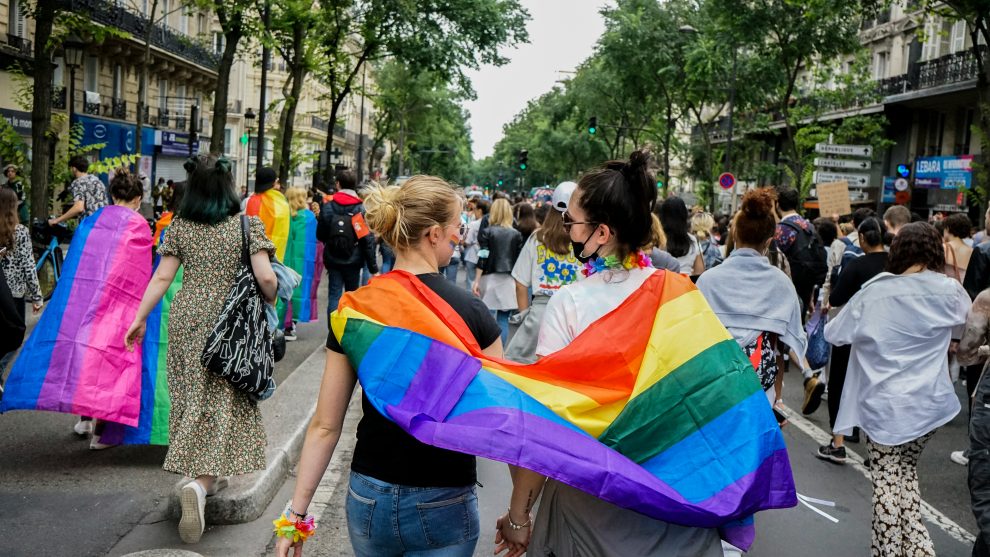
Image: Unsplash/Norbu Gyachung