The word sabotage—from the French saboter, “to bungle, wreck, or willfully disrupt”—originally referred to a 19th-century labor tactic. French textile workers wearing wooden shoes (sabots) slowed or halted production by any means necessary. Across the Channel, their English counterparts were known as Luddites. Both groups targeted the automated machinery that threatened to replace their skilled labor. Today, though, saboteur conjures a shadowy figure bent on destruction, while Luddite suggests a technophobe stuck in the past.
But the real Luddites were not finicky old people resistant to change, and their true story has important implications for contemporary Catholic reflections on technology and labor. We might keep these in mind as we heed Pope Leo’s recent warning about the harms of technocratic capitalism, echoing both his 19th-century namesake and his immediate papal predecessor.
Who were the Luddites?
The Luddites get their name from their mythical leader, King Ned Ludd (also known as Captain or General Ned Ludd). An actual Ned Ludd (or possibly an Edward Ludlam) may have been involved in an 18th-century textile labor protest, but he was certainly not the author of the dozens of letters written in his name.
Ludd was a folk hero, an industrial Robin Hood. Luddite art portrayed him as a giant leading the people in battle, while letters written under his name spoke with a commanding authority undiminished by their poor grammar or spelling. This apocryphal figure’s followers were the disgruntled, downtrodden poor, people who regarded the men profiting from mechanized labor as threats to their families’ financial security.
Consider this line from the letter that opens Writings of the Luddites (Johns Hopkins University Press): “Every frame Breaking act you Make an amendment to only serves to shorten your Days Theirfore you may Prepaire to go to the Divel to Bee Secraterry for Mr Perceval theire.”
The “Mr Perceval” referenced here is Prime Minister Spencer Perceval, who was assassinated by John Bellingham. While not connected to the Luddites, some people saw Perceval’s death as divine or poetic justice. His death occurred amid public anger at harsh labor laws, especially Parliament’s Frame Breaking Act of 1812, which punished labor agitators for sabotaging the new automated looms.
The Industrial Revolution was marked not only by new inventions. It was also a time of new conflicts between a growing urban working class and the rich and powerful who profited from them. In Britain, this shift began in textile manufacturing in Manchester with the invention of mechanized looms and frames, including the power loom and gig mill. As productivity increased, mill owners drove wages down—and aggrieved workers took action, sending warning letters written under Ned Ludd’s name to mill owners who had installed powered looms. If the frames were not taken down by a certain deadline, the letters warned, workers would break in at night and destroy the machines.
Today, because of such acts, the Luddites are characterized as anti-technology. But in reality, they were simply anti-exploitation. This early conflict between rich capitalists and impoverished laborers set the tone for many other class conflicts that followed. Understanding Luddism’s roots is therefore deeply relevant for contemporary Catholic social thought on labor justice.
The Luddites’ legacy
While liberation theologians often speak of the “voiceless” poor, political philosopher Frantz Fanon had a more controversial opinion: that violence can be a legitimate speech-act of the oppressed. What may have looked like senseless destruction and aggression was actually the workers’ cry against the dehumanizing forces of early industrial capitalism.
In this case, as has so often happened in human history, the voice of the oppressed initially went unheard. Aggrieved mill owners turned to the House of Commons, and the Frame Breaking Act made Luddism punishable by exile or death.
Violence escalated with the murder of William Horsfall, a prominent anti-Luddite provocateur who protected his mill with a cannon. In response, the government rallied some 12,000 troops against the Luddites. Luddites unfortunate enough to be caught were publicly executed or sent to Australia.
By the beginning of 1813, Luddism had been nearly crushed, and by 1817, the movement was dead. Textile workers’ wages continued to decrease between 1809 and 1817. Today, the movement lives on in public consciousness merely as a caricature.
However, the Luddites’ direct action inspired subsequent struggles for economic justice. When the poet Lord Byron gave his maiden speech in 1812 to Parliament’s House of Lords, he spoke out against the mill owners’ brutal response to their workers. A year later, Robert Owen, sometimes called the father of British socialism, began advocating for a more egalitarian society; he was among the first industrialists to put restrictions on child labor in his factories and publicly advocate for broader reform. Workers’ unions and socialist movements proliferated throughout the 19th century, worker protection acts gained ground, and by the turn of the century, the Labour Party was formed.
Amid this growing tension between urban working classes and business owners, Pope Leo XIII inaugurated magisterial Catholic social teaching in 1891 with Rerum Novarum (On Capital and Labor).
Luddism for contemporary Catholics
Dorothy Day once remarked that Catholic bishops oppose pacifism except when it comes to class warfare. But the Luddites’ story offers us what theologian Marcella Althaus-Reid calls “theological traffic,” the “raw subject of liberation theologies.” Catholics today should follow Belgian cardinal and social activist Joseph Cardijn’s “see-judge-act” prescription for Catholic social ethics and meditate upon what the Luddite experience teaches us about how to view technology’s role in today’s economy.
In the contemporary digital capitalist system, gig workers are exploited by loopholes in labor law. Data taggers in Kenya experience PTSD from labeling horrific content used to train ChatGPT to recognize harmful materials. Amazon warehouse workers die on the job. The so-called Fourth Industrial Revolution has ushered in a new need for reskilling rather than once and for all eliminating drudgery.
We have no excuse for blithely accepting the conditions our forebears would have rioted over. An antihuman future has been thrust upon us by today’s captains of industry—and most of us have capitulated to technofatalism.
As technology’s hucksters push the newest device or development, they are at the same time furthering global wealth disparities. The parallels between today’s issues and those of the 19th century are clear. Mill owners petitioned Parliament to protect their exploitation, and today’s tech leaders employ marketing and lobbying to secure popular and political support for their technologies. In a world where techno-capitalism continues to accelerate climate collapse, the Luddites are more relevant than ever. And meanwhile, as capitalism pursues ever cheaper markets to exploit, technology’s advance forces everyone to reskill for the inevitable AI future.
Recent responses to AI from the World Council of Churches, Christian Conference of Asia, and various offices of the Holy See highlight Marx’s insight that religion is the “heart of a heartless world.” Our Catholic tradition has more than enough resources to articulate a position of contemporary Luddism, from early industrial social Catholicism to magisterial social teaching, from Latin American liberation theology to the radical Catholicism of Daniel Berrigan or Dorothy Day. We have the theological grounding; perhaps all we lack is a central mythic figure, our own St. Ned Ludd.
This article also appears in the March 2026 issue of U.S. Catholic (Vol. 91, No. 3, pages 21-22). Click here to subscribe to the magazine.
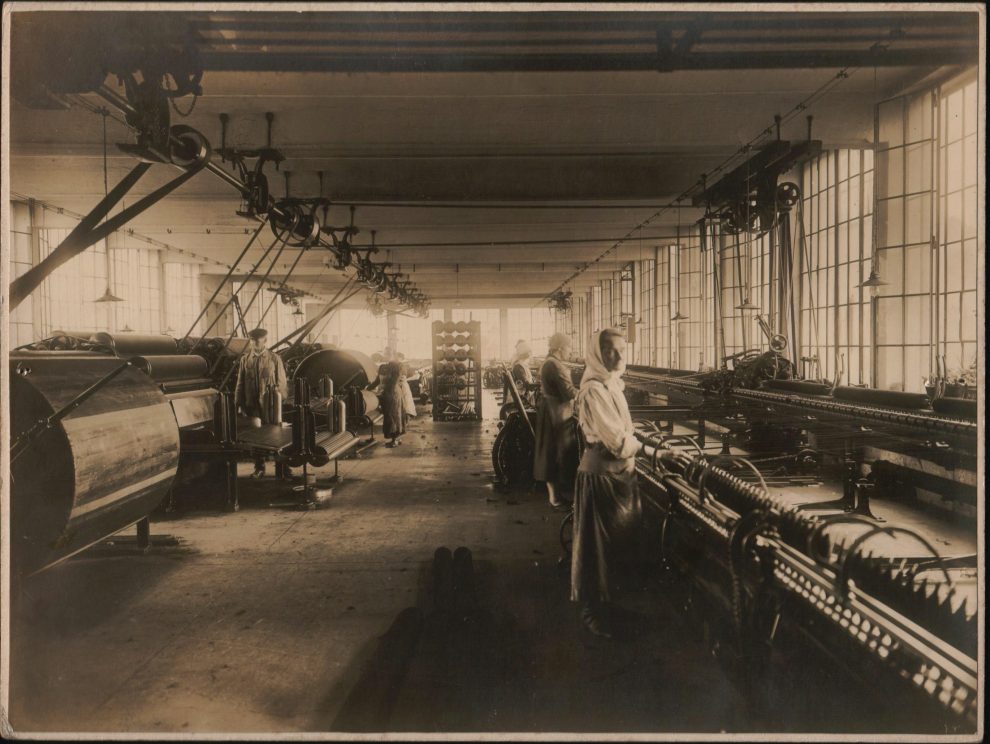
Image: Vonwiller & Co. spinning house, 1915, Wikimedia Commons