Martin Scorsese’s first feature film, Who’s That Knocking at My Door? (1967), was panned because Harvey Keitel’s gangster character exhibited what one critic called “medieval” morality; he wouldn’t marry his girlfriend (Zina Bethune) because she wasn’t a virgin. (She was raped.) Twenty-one years later, Scorsese’s adaptation of Nikos Kazantzakis’ novel The Last Temptation of Christ was met with boycotts and picket lines because of a dream sequence in which Jesus is tempted to abandon his divine mission and settle down with Mary Magdalene. Across his 26 films and counting, Scorsese persistently wrestles with complicated questions of sin and redemption, often framed in terms of his Catholic upbringing.
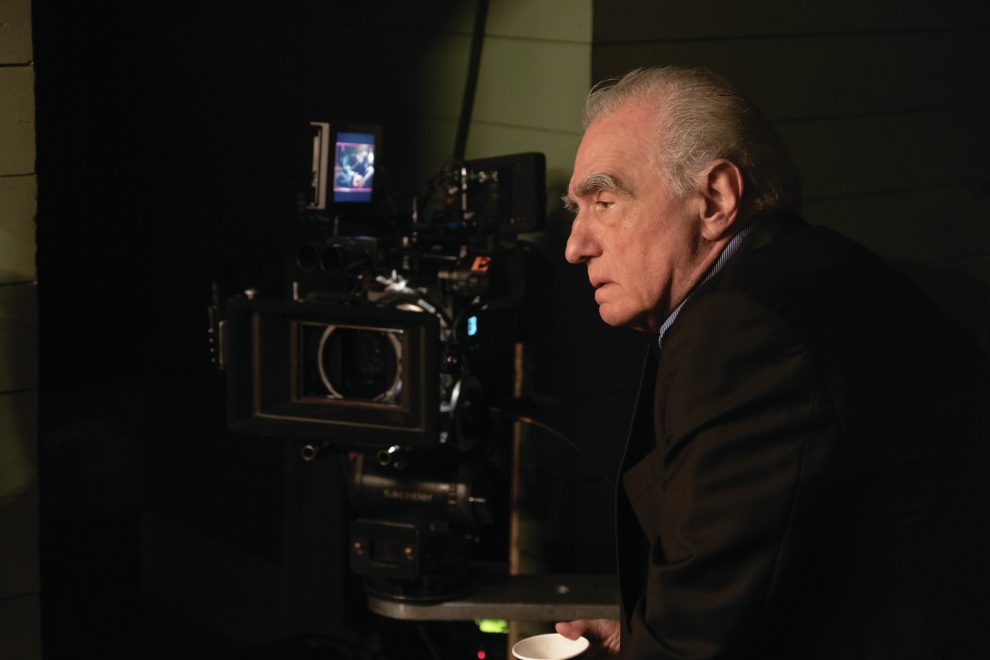
His own life has been morally murky from a Catholic perspective, including multiple failed marriages, drug abuse, and violent outbursts. Despite all this, the octogenarian filmmaker says, “The Catholic Church has never left me, and I have never left it.” In a new, five-episode documentary series, Mr. Scorsese (2025)—directed by Rebecca Miller and streaming on Apple TV—Scorsese also says the biggest influence on his life was Father Francis Principe, pastor of his home parish, St. Patrick’s in Little Italy in New York City. And Scorsese says Principe was the one who opened his eyes to the worlds of literature, cinema, and art.
Mr. Scorsese takes viewers through the filmmaker’s 56-year body of dramatic features, plus his student shorts, several documentaries, and side projects. His work ranges from an early feminist statement (Alice Doesn’t Live Here Anymore, 1974) and a children’s movie (Hugo, 2011) to a nearly X-rated thriller (Taxi Driver, 1976) and a depiction of what Scorsese calls “a modern-day Caligula” (The Wolf of Wall Street, 2013).
For those who didn’t come to his work until this century, Mr. Scorsese’s trip through such a large and varied body of work may be bewildering. The docuseries suggests that one handy way to sort Scorsese’s work is to separate his personal artistic statements from other films (such as The Color of Money, 1986) that he did mainly to establish or reestablish his credibility with Hollywood’s corporate number-crunchers.
Viewers of the docuseries learn that The Last Temptation of Christ (1988) and Gangs of New York (2002) were on Scorsese’s to-do list since the 1970s. Other products of the Scorsese vision include his collaborations with actor Robert De Niro, whom Scorsese has known since they were teenagers, and with screenwriter Paul Schrader, the product of a strict Calvinist background who shares Scorsese’s obsession with questions of faith and morality. These films include Taxi Driver, Raging Bull (1980), and an often-overlooked gem, Bringing Out the Dead (1999, about emergency medical technicians who cruise the midnight streets of New York healing the sick and sometimes reviving the dead).
In all these films, central characters are engaged in different ways in what Scorsese calls a “struggle with evil.” For Jesus in The Last Temptation of Christ, the evil is an external force (the devil), while his other protagonists fight—and generally lose—battles with evil urges from within, manifested as bloody violence. In what the documentary affirms as Scorsese’s greatest gangster films, Goodfellas (1990) and The Departed (2006), the main characters live with the consequences of their violence, which is a sort of spiritual death. Both movies’ leading men betray their criminal colleagues and disappear into the limbo of the witness protection program.
People often note that the Catholic vision of Scorsese’s films includes a lot of Good Friday but not much Easter. In Raging Bull, the boxer Jake LaMotta mortifies his own flesh by banging his head against the concrete wall of his prison cell. Taxi Driver notoriously ends in a torrent of blood and a pile of dead bodies. However, Father Principe claims Easter always glimmers in his old altar boy’s work. He points out that even in Taxi Driver, Jodie Foster’s character (a victim of child sex trafficking) is saved and returned to her family.
In recent years, all Scorsese’s films have been personal projects; the spiritual concerns have become more overt, and the Easter faith has been a little easier to find. In Silence (2016), a Jesuit missionary in Japan surrenders everything, including his faith, apparently, to save the lives of his fellow Christians. And the mob hitman played by De Niro in The Irishman (2019) makes a confession (of sorts) to a priest in his nursing home. The last scene in Mr. Scorsese shows preproduction work on Killers of the Flower Moon (2023).
That film, about the early 20th-century conspiracy to steal the Osage Nation’s oil wealth, is another grim Good Friday depiction of violence and betrayal. However, it ends with an Easter scene of rebirth in which today’s Osage people perform a ceremonial dance to “Wahzhazhe” (A Song for My People), a song written for the film that calls the Osage people to “stand up.” That film would have made a neat capstone for the Scorsese corpus—but he’s already at work on a ghost story called What Happens at Night. It will be his 27th dramatic feature.
Toward the end of Mr. Scorsese, the director asks him, “Are you a Christian?” He replies, “Yes, I think I am. I believe I am.” That perspective has allowed Scorsese to see both the fallenness and the essential goodness of characters the world might deem worthless—a vigilante killer, a crooked and washedup boxer, an apostate priest, and others. As critic and screenwriter Jay Cocks says in the docuseries, at its core, Scorsese’s work is about “loving the least of these.” No exceptions, no matter what.
This article also appears in the February 2026 issue of U.S. Catholic (Vol. 91, No. 2, pages 36-37). Click here to subscribe to the magazine.
Image: AppleTV+/Melinda Sue Gordon