For our Sounding Board column, U.S. Catholic asks authors to argue one side of a many-sided issue of importance to Catholics around the country. We also invite readers to submit their responses to these opinion essays—whether agreement or disagreement—in the survey that follows. A selection of the survey results appear below, as well as in the November 2025 issue of U.S. Catholic. You can participate in our current survey here.
For this edition of Sounding Board we asked Ed Simon, author of Writing During the Apocalypse (Bloomsbury), to weigh in on how the contemporary American view of apocalypse first took root and developed into the kinds of pop culture portrayals we see today. He traces the story of a distinctly evangelical reading of Revelation that seems to reinvent itself in the face of each new global catastrophe. Although our current views of the apocalypse are relatively modern, their influence is profound.
Film director Richard Donner’s 1976 horror classic The Omen, which, though it may lack critical accolades, has secured its status in pop culture, has its share of shocking scenes. There is a nanny who hangs herself at a 5-year-old’s birthday party, that same child riding his tricycle through his family’s mansion and knocking his mother off of a balcony so that she’ll miscarry, and even the discovery half-way through the movie that the woman who actually delivered him was apparently a jackal, a narrative which is ostensibly supposed to be inspired by the biblical book of Revelation.
The Omen is very much a product of its social and political context. Donner’s film is a time capsule of American preoccupations and paranoia in the bicentennial year, a movie made at the height of national malaise and in the radioactive afterglow of the Manson Family and Altamont, Watergate and the fall of Saigon. More than that, The Omen is part of the pop culture explosion that prefigured the “Satanic Panic” and that included (better) movies such as Roman Polanski’s 1968 Rosemary’s Baby and William Friedkin’s 1973 The Exorcist.
The Satanic Panic itself, which fully erupted by the 1980s and saw a hysteria around supposed devilish influence in everything from heavy metal rock music to the role-playing game Dungeons & Dragons, was one element in The Omen’s popularity. Most importantly, however—and related to both the general social, cultural, and political context as well as the specific nature of the Satanic Panic—The Omen was influenced by a particularly evangelical Protestant understanding of the apocalypse.
The survey says . . .
When I hear the word apocalypse, I think of . . .
- The Bible – 51%
- Movies or television – 14%
- Climate change or global politics – 11%
- Personal morality – 5%
- Other – 19%
I believe that one day the world will literally end.
- Agree – 72%
- Disagree – 28%
The Book of Revelation is best understood as . . .
- A symbolic spiritual text – 56%
- We don’t know, it’s a mystery – 17%
- A literal prophecy about the future – 6%
- A literal prophecy about events that are now in the past – 3%
- Other – 18%
Where The Exorcist, despite the controversy surrounding it within some elements of the church, was a consummately Catholic film in its depiction of the psychologically tortured Father Karras sacrificing himself to save the life of a single child, The Omen hewed to a specifically evangelical conception of eschatology that (in part because of the movie) has made such perspectives a mainstay of American culture, religious or secular.
Both the director and the screenwriter of The Omen were secular Jews, and yet the evangelical Protestant belief in “premillennial dispensationalism”—that is, the understanding that a figure called the Antichrist will reign during a period of worldwide tribulation until the return of Christ and the inauguration of the millennium—is replete throughout the movie. Indeed, screenwriter David Seltzer took inspiration from evangelist Hal Lindsey’s 1970 bestseller The Late Great Planet Earth and his claim to offer a “direct account of the most thrilling, optimistic view of what the future could hold for any individual.” Lindsey reads any number of contemporary events, from NATO to the formation of Israel, through an eschatological gloss that in his estimation proves the coming of the Antichrist (but thus also the coming of Christ).
Like many American evangelicals, Lindsey inherited a particular narrative of what the end of the world will look like, and much of the apocalyptic accoutrement associated with Armageddon—the rapture or the tribulation, for example—owes its interpretations to a variety of Protestantism that is basically a novelty of the 19th-century American series of revivals known as the Second Great Awakening. The rapture, wherein it’s believed that all of those who are saved in Christ will be spared the horrors of the tribulation and so bodily ascend into heaven, is mentioned nowhere in Revelation (nor is the Antichrist, for that matter).
Nonetheless, this variety of eschatology is common throughout American pop culture. Even for those who’ve never read Revelation, or know what premillennial dispensationalism is, that’s become the primary understanding of what the word apocalypse means in a religious context.
The original definition of the word apocalypse was “uncovering, revealing something not previously known.” The Oxford English Dictionary didn’t associate the term with the end of the world until the 1980s. However, since then, the previous meaning has quickly become subsumed by popular culture.
According to Box Magazine, during the 1976 commencement address of the California Graduate School of Theology, a nondenominational evangelical institution now known as Haven University, a speaker praised The Omen for “daringly taking a step into a new type of dramatization of a biblical doctrine,” while the trade publication Daily Variety reported that same year that Roman Catholic Church officials condemned Donner’s movie precisely for its biblical inaccuracy (including invented verses of Revelation).
This difference of theological opinion is crucial, for while believers and non-believers alike might assume that belief in things like the rapture and tribulation have a long history within Christianity, such premillennial dispensationalism is historically recent and a minority opinion. While there were often quite fervent apocalyptic currents within the church during the Middle Ages, the church itself has largely hewed to a position of “amillennialism,” which reads Revelation as largely a spiritual and historical allegory, a position that admittedly lends itself to less dramatic horror movies.
Readers weigh in:
Popular culture—e.g. Hal Lindsey, Chuck Smith, etc. of the late 1970s and ‘80s—drove me into a deep dive into the end times. Patristics informed me more than popular culture, but, in my study, I recognize that many people have been lured into a millennialism that has come out of the past few
hundred years.
Dana Callan-Farley
Milwaukee, Wis.
I think the prophecies of the Book of Revelation are multi-level, and can be placed in various times because I think it’s ultimately about the cycle of humans vying for power. Now, having said that, yes, it’s possible it’s prophetic about Israel at some future moment and about a literal return of Christ and a new heaven and earth. The thing is, we really don’t know. But one thing we can learn is that entering into a relationship with Jesus Christ out of love rather than out of fear or duty is more sustainable and desirable. If our hearts say, “Come Lord Jesus,” if we open the door of our heart to the one who stands outside knocking, not forcing his way in, then we don’t need to fear the fires or the desolation of hell, because we’re already home in Jesus.
Ritagail Burleson
Bartlesville, Okla.
Since childhood the apocalypse has always been on my mind as something deeply interesting. I imagine it a lot out of habit of mind, or, rather, it comes to my mind consistently, especially since my conversion. This has forced me to reconcile with it, try to see it in a right way, the way of Christ and in accordance with the unrelenting mercy of an all-powerful, all-knowing, all-seeing, loving creator and Christ, God’s wonderful, beloved, only-begotten son, fully human and fully divine.
Renia Saddler
Alpena, Mich.
But, for the bulk of Americans, the depiction of apocalypse in films such as The Omen simply is the apocalypse. According to a 2022 Pew Research Center study, 39 percent of Americans believe that “we are living in the end times.” That number jumps to 63 precent for evangelical Protestants, but is still 27 percent for Catholics. A Pew Research Center poll from 12 years earlier reported that 41 percent of Americans expect Jesus Christ to return to Earth by 2050.
In When Time Shall be No More: Prophecy Belief in Modern American Culture (Belknap Press), historian Paul Boyer theorizes how there are “those superficially secular individuals who exhibit little overt prophecy interest, but whose worldview is nevertheless shaped to some degree by residual or latent concepts of . . . last things.” Pop culture is replete with apocalyptic and post-apocalyptic books and films where there is nary anything theological, from Cormac McCarthy’s The Road to Emily St. John Mandel’s Station Eleven, the zombie horror of The Walking Dead and Danny Boyle’s 28 Days Later franchise, and of course the entire cinematic oeuvre of director Roland Emmerich.
None of these works are explicitly evangelical, much less even “religious,” but they do reflect that American preoccupation with sudden and dramatic revelations, with the violence of a rapidly approaching final day. They also reflect their times, much as The Omen did.
When people are asked about their belief in the apocalypse, their answers must be read amidst the current political, economic, cultural, social, and ecological situation which can seem, well, apocalyptic. Growing inequity, increasing authoritarianism, widespread social alienation, and the overwhelming specter of climate change understandably feel like harbingers of the end of the world (with some irony, most polls show that believers in a literal apocalypse are the same people who minimize the worst effects of global warming).
When the 91 climate scientists who coauthored 2018’s United Nations Intergovernmental Report on Climate Change concluded that our unfolding environmental catastrophe has “no documented historical precedent” and that we only have until 2030 to stave off the worst effects of global warming, many of us can’t help but feel like there are reasons to believe in apocalypse beyond the merely prophetic.
Perhaps that’s the same as it ever was, even if we are living in a historically unprecedented age. After all, Christ says in the Gospel of Matthew that before his return, “nation will rise against nation and kingdom against kingdom, and there will be famines and earthquakes in various places,” but when is that ever not the case? For we’re always living before the return.
Survey results are based on responses from 64 uscatholic.org visitors.
This article also appears in the November 2025 issue of U.S. Catholic (Vol. 90, No. 11, pages 31-35). Click here to subscribe to the magazine.
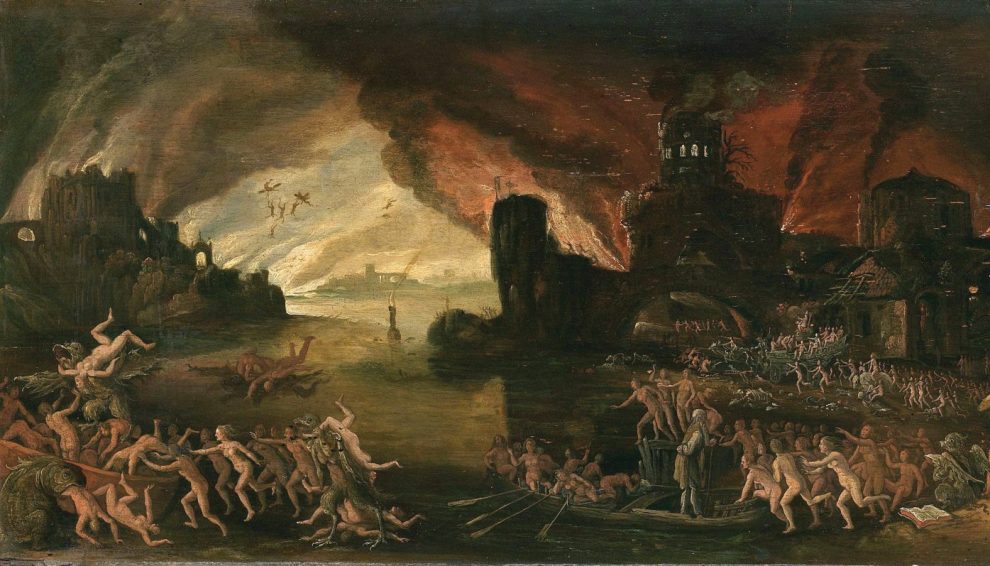
Image: Jacob van Swanenburgh, The Last Judgment and the Seven Deadly Sins, 1600–1638, oil on panel, 28 cm x 88 cm, Rijksmuseum, Amsterdam