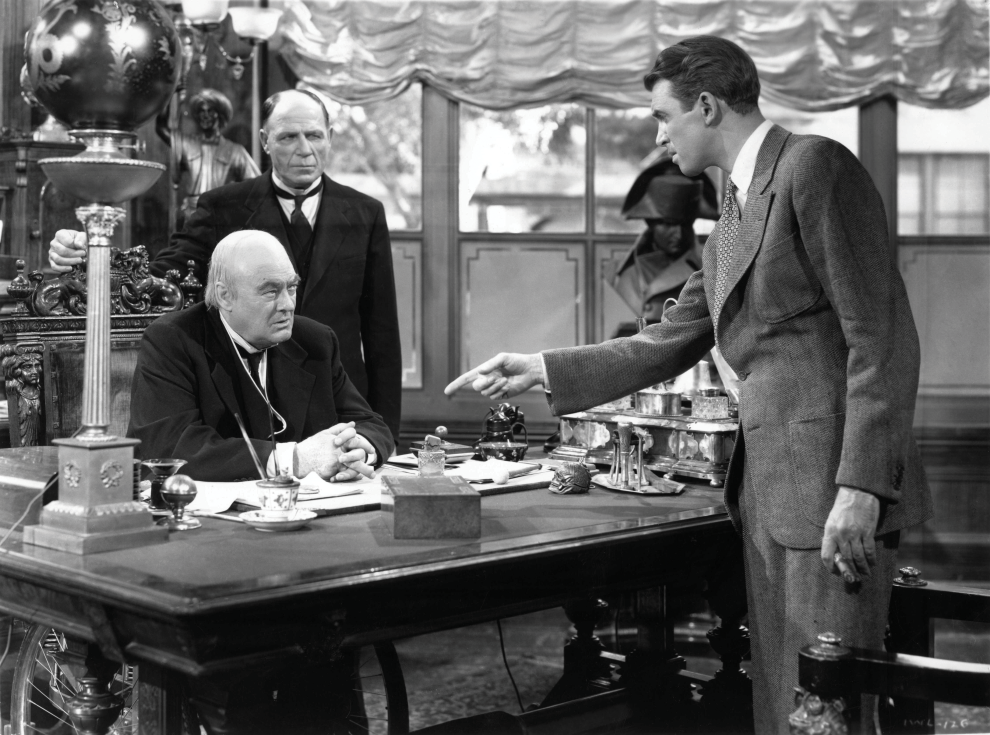
Maybe you haven’t noticed him. Essentially a means to someone else’s ends, Mr. Potter’s anonymous manservant in Frank Capra’s It’s a Wonderful Life has a simple job: getting the wheelchair-bound Potter from here to there. Captive to the tyrant in the beloved Christmas movie, he might be a patron saint of Advent.
Throughout my many viewings of the film, I’ve come to feel sorry for him. If George Bailey’s life and dreams are constrained by a strong sense of obligation, surely this man’s constricted life seems to have echoes of that experience. The movie is about George, so we know his self-denying sense of duty drives him to forgo his dreams. We don’t know why Potter’s servant also seems trapped (he’s there for the film’s entire nearly 30-year timeframe). It is unrealistic to assume he has an uncritical devotion to the man. His boss may have something on him—a debt or knowledge of a criminal history—but it’s not explored. A potential alter ego for George, the silent, emotionless man is an enigma.
Reading the screenplay made me more sympathetic. The film’s credits refer to him as Potter’s bodyguard. The script for this heartwarming, redemptive film calls him a “goon”—a fool or hired thug.
Subject to another’s orders and whims, the Goon mostly stands by his man. He rarely pushes the wheelchair more than a few feet, and, given Potter’s nature, there’s surprisingly little need to protect him. Rather, the Goon awaits commands. Only in his last scene in the film does he act in his own interest or, at least, from curiosity.
Captivity is a theme of Advent—“Ransom captive Israel” goes the common Advent hymn. A regular Mass reading speaks of a “people in darkness.” The servitude is historical, the ancient Jews confined in Egypt or Babylon or under Roman occupation. It’s also contemporary. We can be subject to sin or forces beyond our control—emotional disorder, abuse, violence, poverty, or other personal or social ills. In any epoch, the people await a great light.
John the Baptist prepares the way for that light. Decades earlier, however, his devout parents, Zechariah and Elizabeth, were captive to an infertility that seemed an undeserved, demeaning, but tolerated curse. Then, when an angel tells Zechariah they will be parents in old age, the doubting old man is muted. But he will speak again. Conversely, one might imagine the Goon feeling lucky getting a job with the richest man in town, then, recognizing the reality, being unable to protest.
Potter and the Goon first appear when adolescent George seeks his father Peter’s counsel after his druggist boss accidentally substitutes poison in a prescription. The youngster interrupts a meeting that introduces Potter’s desire to destroy the Bailey Brothers Building & Loan Association, because he despises its generous business practices. When Potter insults Peter, the scene also reveals George’s John the Baptist-like tendency to speak truth to power. “You’re bigger than him!” he says and shoves Potter. At this, the Goon gently (for a goon) but firmly deflects George’s hands.
After he barely appears in the ensuing summary of George’s life, we see the Goon a few times on Christmas Eve 1945, George’s “crucial” day, according to the film’s heavenly narrators. As he and Potter enter the bank, George’s Uncle Billy accosts them with a newspaper trumpeting George’s war hero brother. The Goon wheels his irritated boss away, but not before Billy triumphantly shoves the paper into Potter’s lap after unwittingly folding the Building & Loan’s $8,000 bank deposit into it.
In his office, Potter discovers the money, then orders the Goon to take him back to the door, not to return the money but to watch Billy search for it, then settles at his desk to consider his options. The Goon observes, maybe showing disappointment—or repentance for the part he has played?—but so little of either as to possibly be only in the eyes of this sympathetic beholder.
After a fruitless day searching, George begs Potter for an $8,000 loan, explaining he somehow misplaced the deposit. Surprised by this selfless absolution of Uncle Billy, Potter glances at the Goon behind him. In this odd recognition of the witness to his crime, one might wonder if the Goon is Potter’s conscience, though a happily mute one. George escapes, and Potter calls the sheriff to report the crime he, in fact, committed.
After the intervention of the angel Clarence, George recognizes his wonderful life and runs through town shouting gleeful Christmas greetings, even stopping to bang on Potter’s office window with a deliriously joyful “Merry Christmas, Mr. Potter!” As he rushes home to discover the townspeople’s generous financial rescue, Potter responds, “Happy New Year to you—in jail!”
The Goon’s reaction is different. He walks to the window and cranes his neck to follow the departing George. It’s the Goon’s most spontaneous, independent, personal, and—for him—dramatic action. He does not rush as if responding to a threat; his steps are more deliberate, curious. I imagine him envisioning his own freedom as he witnesses someone escape Potter’s dominance over the community.
This intuited, vicarious sense of freedom the Goon might experience could echo Zechariah’s joyful canticle after his voice is released by naming his son in accordance with the angel’s command. It’s a breathless benediction of a newborn by a father who sincerely believes in what God wants for creation and the role this father’s son might play in that new world. Maybe, like Zechariah anticipating the future departure of his son on his mission, the Goon watches George continuing to free people and bring mercy and light to those in darkness, including perhaps the Goon?
What are the Goon’s prospects, however? Advent is also about waiting—for freedom and light, for the Messiah. The readings we hear in Advent never change, mostly situated before the Word is heard. The people wait. The Goon likewise waits forever. His story in the movie never changes. No matter how many times we watch, he is forever captive, except perhaps in how we view his potentiality.
There have been parodies of It’s a Wonderful Life. On Saturday Night Live, while George’s friends sing “Hark! The Herald Angels Sing,” Potter’s theft is discovered. They confront him, learn that he’d faked his handicap and can walk, and beat him. Left out of the skit as though he never existed, the Goon can’t protect him. Such satisfying and vengeful alternative endings are hard to resist.
But this violates Capra’s code: While good guys win and bad guys lose, the latter are rarely punished. Besides, as he silently witnesses and essentially abets Potter’s evil, the Goon is no saint, perhaps inevitably—but not necessarily permanently—tainted by his boss’ coldhearted avarice. Like all of us, he’s a candidate for repentance and mercy.
My sister wishes the Goon would show up at George’s house, give money, and sing along, though that might show too much initiative, especially for a minor character. My proposal might conform more to the Capra-verse and keep the star in the lead. In the light of the Baptist and his cousin, George pays forward his Christmas Eve windfall, which he merits, and ransoms the Goon from apparent indentured servitude, which he may not deserve but needs. Rescuing this man might be an Advent miracle—and a wonderful sequel.
This article also appears in the December2025 issue of U.S. Catholic (Vol. 90, No. 12, page 15-16). Click here to subscribe to the magazine.