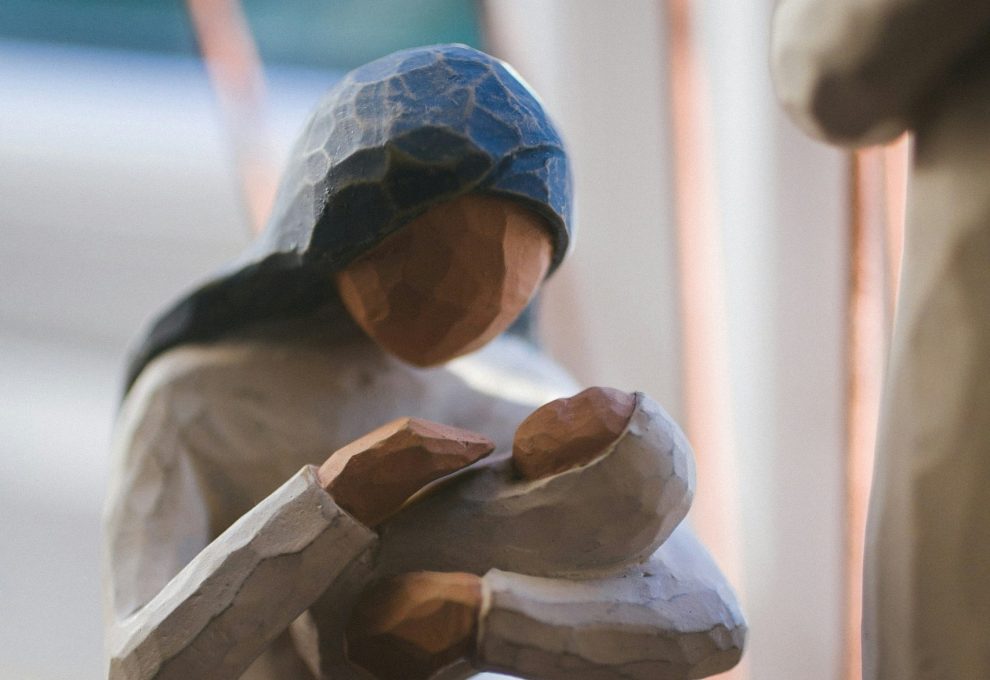

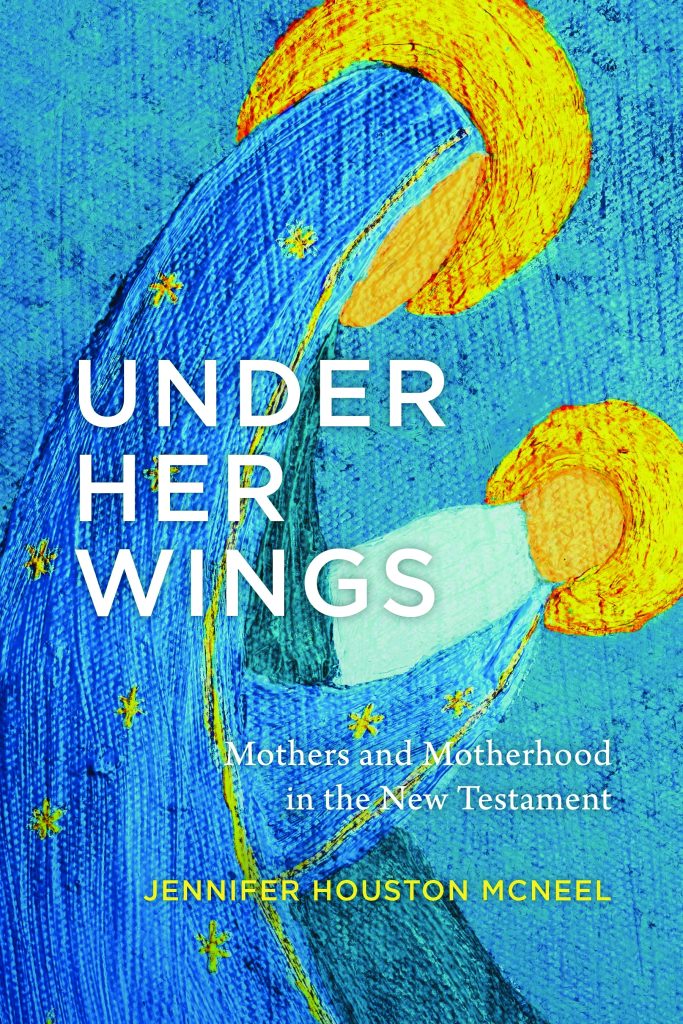
For many of us, when we think of mothers in the Bible, specifically the New Testament, Mary is the woman who immediately comes to mind. Maybe this is followed by Elizabeth, or possibly some of the mothers that Jesus interacts with during his ministry. But, says Jennifer Houston McNeel, author of a new book, Under Her Wings (Eerdmans Press), mothers—both real and metaphorical—are actually far more commonplace in scripture than many of us realize.
“As a student at a Lutheran seminary, it just so happened that one of the first biblical studies papers I ever wrote was about 1 Thessalonians 2:7, a passage where Paul describes himself as a nursing mother,” McNeel says. “It really struck me as very significant that a man in the first century would choose to use maternal language at that time. And if people aren’t familiar with that passage, what else might they be unaware of?”
McNeel started wondering what other mothers she might be missing in the New Testament. She eventually found mention of mothers in 21 out of the 27 books in the New Testament. In Under Her Wings, she invites readers to notice these overlooked mothers and to consider what they reveal about God, family life, and discipleship in the ancient and modern worlds.
What do we know about women’s lives in the first century in regards to childbirth and child-rearing?
One thing I talk about in Under Her Wings is the danger that was involved in having and raising children. Women had to face the prospect of death when they were pregnant and giving birth. And even if they successfully delivered a child, it was very likely that child would die in infancy or childhood.
Of course, tragically, those things still happen. But maternal mortality rates were much higher in the ancient world, as were child mortality rates. So those associations would have been more top of mind for ancient readers and writers than they are today. We need to keep that in mind when reading both mothers and maternal metaphors in scripture.
Another thing to know is ancient patriarchal cultures placed a high value on motherhood; the greatest thing a woman could do was provide legitimate offspring to her husband. We see this in the Bible in women’s desperation to have children and in how scripture treats the issue of barrenness.
And the third thing to know is the importance of relationships between mothers and their children. That’s a point of connection between the modern and ancient worlds; mothers have a strong connection to their children that continues even after the children aren’t children anymore.
Do we know anything about what parenting looked like as children moved toward adulthood?
A little bit. It’s difficult because ancient sources don’t tend to describe everyday life. We hear about moments of crisis and important people, but we don’t get a lot of description about what people are doing on a daily basis. What do they do when they get up in the morning? Or before they go to bed?
So there’s a lot we can’t say. But we can say family was important in ancient cultures, and that transcends the ages of the children. That bond continues.
We also know that almost everybody homeschooled; schools were typically reserved only for boys from elite families. So parents played an important role in educating their children and preparing them to enter the world of adulthood.
In the Book of Matthew, there’s a genealogy of Jesus that is mostly patrilineal, but it includes a few women. Why do you think the author decided to include women, and these women specifically?
Hebrew Bible genealogies, and even New Testament ones in some cases, are typically father-son genealogies. Women are only mentioned in special circumstances—like when the writer needs to indicate that a man had children by more than one woman. So for the author of Matthew to mention any woman is unusual. And then the women he mentioned were Tamar, Rahab, Ruth, and Bathsheba.
These four women all had unconventional paths to motherhood, at least from the perspective of ancient patriarchal culture. And this, in some way, prepares the reader for the story of Mary and Joseph and their unconventional paths to parenthood.
Tamar marries one of Judah’s sons. He dies before they have children, so, as the practice of levirate marriage demands, she is given to the next brother. He also dies without producing children. Tamar has the right to expect that someone from Judah’s family would provide her with children and a home. But Judah tries to get out of this responsibility.
Tamar feels that she is within her rights to continue pressing the matter. She disguises herself as a prostitute and gets pregnant by Judah himself, although he doesn’t realize who he’s sleeping with.
Judah is angry when he finds out Tamar is pregnant, because he doesn’t realize the baby is his. Once he realizes it’s his child, we might think he would be even angrier. But what he says is, basically, “She’s more righteous than I am, because I didn’t act toward her the way I was supposed to.”
This story has interesting parallels to Matthew’s account of Mary and Joseph. In Tamar’s story, we’re told the neighbors are gossiping about her when she becomes pregnant. We’re not explicitly told this about Mary, but it’s not a big leap to think if Mary’s not married and she’s pregnant, then people are probably viewing her in a similar way. Joseph initially wants to divorce her, but eventually he changes his mind about the pregnancy, just as Judah does.
For me, the message is that God works through unusual circumstances. God is not bound by our notions of how society should work. The story of salvation is something that God accomplishes in unexpected ways. These four women are illustrations of that and prepare us to hear the unusual birth story of Jesus that follows.
In Tamar’s story—and in stories throughout your book—the woman who theoretically has the least power is the one who takes God’s plan for the world into her own hands. It’s similar to what Mary sings in the Magnificat.
That’s true. And sometimes the woman has to use tricks and deception to accomplish God’s will. That’s one of the things people object to about the story of Tamar; they think that Judah should still be upset at the end of the story.
But I think about a similar story in the Hebrew Bible, this one about Rebekah. She also engages in deception, tricking Isaac into thinking he is talking to his other son to ensure that God’s promise continues through Jacob rather than Esau. Modern readers criticize her for that behavior, but God told her Jacob was the one who was chosen. She was taking action to make God’s plan happen.
These stories can make us uncomfortable, but the trickery speaks to the fact that women have less power. If men want to get something done, they can just do it. But these female characters have to find other means to ensure the situation moves forward in the way they believe God is calling it to.
You point out that modern readers tend to miss things about Mary’s experience. What are some of these things that we often get wrong?
People are often surprised how many details of our traditional Christmas story are actually not in the biblical text. There is no innkeeper in Luke, there’s no star, and there’s not even a stable. The only thing that is mentioned is the manger, a feedbox for animals.
Modern readers assume if an animal feedbox is there, we must be talking about some kind of a barn. But when you look at archaeological evidence of how people lived in Israel thousands of years ago, a typical house arrangement for the peasant class was to have a courtyard that included a place for animals to be kept within the first floor of a house. Luke’s gospel makes more sense if we picture that kind of a house as the place where Mary gives birth.
Another assumption is that Mary is having labor pains as they arrive in Bethlehem on a donkey. (Of course, there’s no donkey mentioned in the text.) But the gospel says while they were there, the time came for her to give birth. This implies they’ve been there for some time before she goes into labor.
We know Mary and Joseph have come to town because that’s where Joseph’s ancestors are from, so it’s natural to assume he would be staying with extended family. If the census is happening as described in the text, there may be a lot of other people coming into town looking for places to stay. So we imagine this crowded space where there’s no room for everyone, but it exists within a family household; Mary and Joseph aren’t out by themselves in a barn.
There’s more evidence for this idea in the scene where the shepherds come. They tell the story about the angels coming to them and telling them about Jesus’ birth, and the Bible says that everyone was amazed at the story they told. In other words, Mary wasn’t alone. I find it comforting to think of Mary as being surrounded by people while she’s giving birth.
This makes both Mary and Jesus figures who are more like us. These are human beings who lived real lives in a real community. They become more accessible. That’s a positive thing. We can experience some of the same things they did and hopefully emulate their faithfulness to the extent that we’re able.
Who are some of the other mothers in the New Testament we should pay attention to?
One of my favorites is the Syrophoenician woman—that’s what she’s called in Mark. She’s called the Canaanite woman in Matthew. She is a bold mother seeking help for her demon-possessed daughter, and she won’t take no for an answer.
The disciples try to push her away, especially in Matthew’s version, but she keeps trailing after them. Interpreters have different opinions about Jesus’ actions, but at first it seems like he’s trying to push her away. He says, “I was sent only to the lost sheep of the house of Israel.” And she’s a Gentile, which seems to imply that he thinks it’s not the right time to help her; no one knows what’s going on inside his mind.
She persists. Her boldness isn’t on behalf of herself; she’s there for her daughter. It’s her job as the mother to get what her daughter needs, and she’s not going to stop until she gets it. She’s an inspiring mother in that way. And, at the end of the story, Jesus feels she’s an inspiring mother as well. He praises her faith and grants her request to heal her daughter.
In your book, you mention there is evidence she changed Jesus’ mind about ministry to the Gentiles.
Right. This is one of the more controversial aspects of the story; not everyone is comfortable saying anybody changed Jesus’ mind about anything, much less a woman. But there are indications in the gospel narratives of a shift in Jesus’ focus after he has this encounter with her.
Now, of course there’s this bigger Christological question about whether Jesus could learn or change his mind. But if we look at the way the story speaks to us, I find it inspiring to take Jesus as an example. Jesus was a human being, and we humans tend to create barriers between groups. He’s grown up on the Jewish side of the divide, and he has this encounter with a Gentile. What a great example it is for us to say we can learn something from and be open to people who are on the other side of a dividing line in a way that changes us.
We tend to think about biblical mothers as good mothers—paradigms in some way. Are there any not-so-good mothers in scripture?
There are several examples of mothers that are ambiguous, like the mother of James and John. In the Gospel of Matthew, she goes to Jesus and says, “I want my sons to have places of honor at your right and left hands when you come into your kingdom.” And then Jesus calls all the disciples together in response and gives a speech about how this kind of request is not what we’re all about here; we’re about servanthood.
Jesus’ response obviously indicates the actions this mother took were not in line with his teachings. But it doesn’t make her a bad mother. It might make her a bad disciple. In the synoptic gospels there’s this idea that while family is important, it has the potential to interfere with your discipleship. And this mother maybe had her maternal desire for her sons to have the best of everything interfere with her ability to hear and absorb what Jesus was saying about discipleship. But she’s there; she herself is a follower of Jesus. She’s traveling with him on the road. She just doesn’t quite understand the heart of what he is teaching.
What about bad mothers?
Herodias is the only mother in the Bible I’d call a bad mother. She outwardly works against anything we would think of as God’s will or God’s plan.
In the story, John the Baptist has been arrested, but Herod is undecided about what to do with him. He doesn’t like John, but he finds him interesting. He thinks John is dangerous, but he’s also worried about the consequences of killing him. Into this situation comes the child of Herodius, Herod’s wife. The text is ambiguous, but most likely this is her daughter from a previous marriage, and she’s not Herod’s daughter. This girl is often called Salome, although the text never mentions her by name.
She performs a dance at Herod’s birthday party that pleases him to the extent that he promises to give her whatever she wants. She goes to her mother for advice, and Herodias tells her to ask for the head of John the Baptist on a platter.
Now, this story is familiar to many people, and universally readers think that she is a bad person here. But as I was reading this story thinking specifically about motherhood, I realized Herodias is also a bad mother. We know what happened to John, but what happened to Herodias’ daughter?
The text describes her as a “girl,” meaning she was probably younger than we imagine her to be in some depictions of the story, probably 11 or 12 years old. Imagine having a freshly severed human head that you have to carry on a platter and present to someone. That is not good parenting on Herodias’ part.
You mentioned that the gospels are ambivalent about the relationship between an adult, their family, and their discipleship. How is this portrayed in the relationship between Jesus and Mary?
Different gospels paint different pictures. Luke and Matthew portray a positive role for Jesus’ parents early on in the story, especially in Luke’s portrayal of Mary as not just a wonderful mother, but also a disciple, someone who follows God. I would even characterize her as a prophet, especially because of the Magnificat. But then they drop out of view; we don’t see a lot about his relationship with his parents once he’s grown and begins his ministry.
In John we get a little more, because we have the story of Mary at the wedding at Cana, where she’s the catalyst for Jesus to begin his ministry. And she’s present at the cross as well. And yet, even in John there’s an ambiguous portrayal of her. Jesus seems to be a little standoffish toward her at the wedding, and then at the cross he establishes this new church-based family relationship when he gives his mother to the beloved disciple and vice versa. Even though she’s there, which is important, he establishes spiritual or church relationships as more important than blood relationships.
In the synoptic gospels, there’s a story about Jesus teaching in a house when his mother and brothers come to see him. In Mark, it indicates they’re coming to restrain him, because people are saying he’s gone out of his mind. And when people tell Jesus they are here, he says, “Who are my mother and brothers? They are those who do the will of God.” Again, that seems to create distance between himself and his parents.
My conclusion from all this is just that it’s complex. We can’t say Jesus had a positive relationship with his parents or a negative one.
This isn’t surprising. How many families would be on board with one of their members going outside of the expected norms of the way his life was supposed to go? We should expect some tensions within that family.
However, there’s evidence this tension was resolved after Jesus’ death and resurrection. We know Mary was present at the beginning of the Book of Acts, and it implies she’s present at Pentecost; the book says Mary was among the believers, and it says all the believers were gathered in one place when the Pentecost event happens. And later on, we have someone who’s identified as James the brother of Jesus who leads the church at Jerusalem. There’s no evidence James was a disciple of Jesus during his lifetime, yet he ends up the leader of this church.
It reminds me how a lot of adults have complicated relationships with their families today.
Family was complicated in the ancient world; family is still complicated today. Even if a family isn’t dysfunctional, it’s still hard for parents and children to renegotiate their relationship when a child becomes an adult. You have to begin to have a different relationship with that person than you had before. And that can be challenging.
I’m not sure the New Testament gives us any therapeutic advice about how to proceed in that situation. I think the challenge of the New Testament is that it calls us to always have our deepest loyalty be to God and to discipleship. In many cases, our families help us along that journey and we can celebrate that. But there will always be cases where someone’s family doesn’t help them along their discipleship journey.
The Bible might not give us advice about how to fix that situation, but it gives us assurance that God is with us even if our own families don’t support us.
There’s this story in Luke where a woman calls out to Jesus, “Blessed is the womb that bore you and the breasts that nurse you.” Jesus replies, “Blessed rather are those who do the will of God.” That plays into this dynamic we’ve been talking about, because it seems to create distance between Jesus and Mary. This woman is saying, “Mary is blessed for having you as her son,” and he’s saying, “No, it’s not that that makes her blessed, it’s doing the will of God.” And of course, we can read that and say, well, according to Luke’s gospel, Mary qualifies as blessed because she does the will of God.
So it’s saying she’s blessed for reasons outside her identity as a mother?
Exactly. She’s blessed, according to Jesus, because she is one who does the will of God. That’s the synoptic gospels’ view of family and the role of family.
Did writing this book change your perspective on scripture or motherhood?
I wouldn’t have set out to write this book if I didn’t think motherhood had an important place in the New Testament. But I was surprised at just how often motherhood shows up in scripture. I believe I reference mothers or motherhood-related images in 21 out of the 27 books of the New Testament. This says something about just how important motherhood was as a concept to the New Testament writers. It was one of the ways they expressed not just peripheral ideas but the heart of Jesus’ message.
Header image: Unsplash/Phil Hearing
This article also appears in the December 2025 issue of U.S. Catholic (Vol. 90, No. 12, page 20-25). Click here to subscribe to the magazine.