

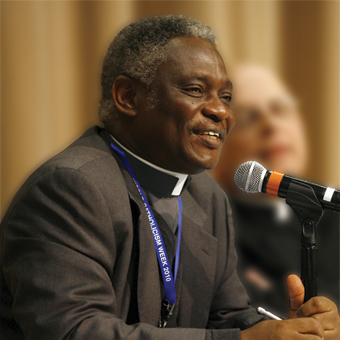
In its 75 years U.S. Catholic has also covered the global church. Cardinal Peter Turkson of Ghana shares with us how we are all connected.
When Cardinal Peter Turkson flies from Ghana to Italy, all the passengers are escorted by police to a small entry point at the airport in Rome, where their documents are checked even before they get to immigration.
“Why all this scrutiny?” Turkson asks. “It is because of where the plane is coming from: Africa.”
While his diplomatic passport from the Vatican helps him avoid much hassle, Turkson says that this reality illustrates the current relationship between the global North and South. Africa may be the future of the church, but it is global relationships—through immigration, industry, the environment, and faith—that concern Turkson.
After serving as relator (secretary) for the Synod of Bishops for Africa last fall, Turkson was appointed as president of the Pontifical Council for Justice and Peace. At 61 Turkson is the youngest African cardinal—and now the highest-ranked African in Rome.


National Catholic Reporter’s John Allen Jr. says that “he’s destined to be an ecclesiastical star” and perhaps even the first black pope, though Turkson says he wouldn’t want the job.
“The truth is that our world is still too color sensitive,” he told Justice Magazine earlier this year. “All that would make the work (of a black pope) more difficult.”
At last year’s Synod for Africa you talked about the “lust of some multinational corporations” who are pillaging the natural resources of Africa. What effect has this had?
First off, this is not just an issue in Africa. We recently had a bishop from Brazil visiting us in Rome who was explaining that a new dam is going to be built in the Amazon that will displace many indigenous communities.
As archbishop in Ghana, I was involved in mining issues. We were trying to respond to what the pope highlighted in his Peace Day message this year: solidarity with future generations and with all people who depend on the land for their livelihood.
It’s easier and cheaper for mining companies in Ghana to do surface mining. As a result, villages are being wiped out, and the companies build a few shacks for the displaced people and leave it at that. But it’s not just about people’s homes. When you move people off the land that they have been farming, you are also taking away their jobs and livelihoods. People think mining companies bring jobs, but when we visited those areas we found that far more jobs were lost than new ones created.
The other part is that, after the surface mining, the forest cover and the top soil are gone. What’s left behind is a deep, gaping crater. Mining companies claim it is not cost-effective to refill those craters. When I challenged them about that, they told me they were going to put in a fish pond. Actually there’s cyanide in these holes, so this is not a viable option.
It’s not only multinational companies that are to blame but our governments, too. We need to talk to the government officials who sign these contracts to make sure that they won’t sign away the future and the destiny of our environment.
How can American Catholics respond to this situation?
The first thing is for American Catholics to become knowledgeable about it. The second thing is that these days nobody can pretend that when there is an ecological disaster in one place, it only affects that locale. We are all interdependent.
Take the hurricanes in the United States: The winds start out over the Sahara, and the deforestation that happens through surface mining in Ghana is accelerating the expansion of the Sahara. That might contribute to the increase in hurricanes in the Caribbean and the United States.
We all need to recognize this ecological interdependence. And Americans and Europeans also need to know that the worsening of living conditions in Africa and elsewhere will have direct repercussions through increased migration.
You already have all kinds of laws in place to keep people out of your countries. But the worse it gets in countries of the global South, the more people are going to show up in the North. You can’t stop them. So paying attention to global economic issues is directly in your interest.
You are currently the highest-ranking African cardinal in the Roman Curia. How would you describe the state of racial justice within the church?
I’m reluctant to equate lack of knowledge and familiarity between Europeans and Africans with racism. Often it’s not racism; it’s just that people don’t know much about each other.
Europeans and Americans sometimes act like they think people in Africa are still living in trees. Maybe that’s from what they’ve seen in movies. People tell me that they don’t know much about Ghana or Africa.
Everyone is a product of their own culture. Many of the people I work with in the Vatican are sons and daughters of European and other cultures and they may not have been exposed much to Africa.
I know that many people’s ideas about Africa and Africans are generally negative. The competence and abilities of Africans are often doubted. This is challenging, and I need to prove myself capable of creditably leading and administering this vital office of the Vatican: the Pontifical Council of Justice and Peace.
This does not make me angry. I view it as a kind of ministry to help them overcome certain blind spots they have due to a lack of exposure. But, again, I would not call this racism.
Aren’t you being generous here? Isn’t there a fine line between unfamiliarity and willful ignorance or racism?
No, racism is a pursued policy, a program or line of action. It puts people in boxes and categories so you no longer see reality but only what you want to see. It’s more intentional.
In general I hesitate to describe manifestations of this unfamiliarity as intentional. I’ll give people the benefit of the doubt, but if this attitude persists, then maybe I’ll need to respond to your question differently.
Still, just as some may doubt my competence, many others believe I will make a positive contribution in Rome.
What about women in Rome? One of the documents at the Synod for Africa talked about actively promoting the participation of women “at appropriate levels.” What does this mean?
Apart from the question of ordination, I don’t see why we should exclude women from positions of responsibility in the church. For example, in the Council for Justice and Peace, we have a woman as the undersecretary.
In the church in Ghana we now have many women catechists, which is a very important position. Many communities do not have a priest to lead them in worship every Sunday, so it is this woman catechist who leads the worship.
We also have a number of women in significant government positions in Ghana, including our chief justice and speaker of parliament. At the same time, if you go to a village, you’ll see a woman carrying a load on her head, a baby on her back, and another child by the hand, while her husband is following her, maybe with a machete under his arm and smoking a pipe. You would probably consider women’s roles as almost servile.
This is part of the traditional life, but it is changing. More women are going to school, and they are encouraged to go into the sciences, which used to be open to men only.
In the church, too, the study of theology, canon law, and other ecclesiastical disciplines has become open to women of late, allowing them to be eligible for higher appointments. I expect that as more women enroll in such studies, we will begin to see more women take up leadership positions in the church and the Roman Curia.
How much damage has the abuse scandal done to the church’s moral authority and its ability to speak out on social issues?
No doubt it has been damaged, and the pope is the first to admit this.
But we also have to admit that we are a bunch of sinners in pursuit of salvation. And when we experience salvation, we’re also able to lead others to it. I’m not saying that everybody needs to be a public sinner before we can preach about God’s grace, but if anybody should stumble and fall, that should not be the last word. Stumbling and falling is an invitation for us to hold on more firmly to the hand of God.
What do you see as the most important task for the church with HIV/AIDS in Africa and elsewhere?
What we’ve always been doing: taking care of those infected. But the medical care and attention is one side of it. The other part is about how to stop its spread.
That’s a tougher one because you’re dealing with people’s lifestyles, and you’re not always able to legislate that. Some say that we can control the disease through the use of condoms, but that’s where the church has difficulty. Some claim that that can still be studied, but to date, I think the position of the church on condoms is pretty clear.
In Ghana people will say that kids in junior high school are sexually active anyway so we should allow them to use condoms. Are we promoting sexual promiscuity? What happened to self-control? Over and above what the church teaches officially, some of what goes on locally really worries me. At the end of the day, the question we find ourselves asking is: What is the condom really for?
African church leaders have recently been criticizing what they see as an imposition of Western values, especially in sexual ethics, on their continent. Do you agree with that criticism?
Just as I hesitate to speak globally about Africa, as if it were one and the same, we also need to be careful about generalizing about Western values. In Africa just as in the rest of the world, culture is changing, lifestyles are changing.
Traditionally, it’s of utmost importance for African societies to ensure growth for survival. Therefore, when people say that traditional African societies consider homosexuality taboo, for instance, it’s because any lifestyle that does not lead to the growth of the community is seen as dysfunctional.
A lot of traditional families will have that view. And sometimes that’s exaggerated to the point that when women are infertile, they are ostracized and mistreated.
Of course, as cultures are changing, this view will be challenged. But in a traditional African society, people wouldn’t even tolerate or listen to talk about homosexuality.
Do you see that kind of conflict intensifying in the near future?
It’s bound to become stronger. As the world is becoming increasingly global and the news from around the world is reaching every corner, traditional families are going to find out that what they consider to be taboo is not considered so elsewhere. They will read that other countries now have a legal structure that allows two men to get married. Invariably tension will be created, and people will be forced to ask themselves how to handle these issues.
What do you think Catholics in the United States can learn from Catholics in Africa?
I would first think about worship. We tend to make more room in our lives for God and worship. That is something that people in America may have difficulty with.
For African priests serving in parishes in the United States, it is difficult to understand the stringent impositions on worship. Sermons can’t be longer than five minutes, or the whole Mass has to be done in 25 minutes. They will do what they are asked to do, but deep down they think, how can this be?
The second thing I would mention is the enthusiasm, the way that we like to live out our faith, the expression that we like to give to what is within us.
In Europe, which used to send us its missionaries, many churches are now closing. In younger churches we need to ask ourselves why this is happening. Will this happen to us as well?
Part of the problem is that Christianity has become too notional, too much in our heads. It is something that we learn about but not really something that we live. A catechism is not a bad thing, but it’s a bit unbiblical to limit our entry into the church and the faith to catechetical knowledge.
Traditionally and biblically, people enter into the church and begin their faith journey with a life of conversion, not because they learned something that they could repeat by heart. A catechism should deepen the faith we have. If it becomes the only indicator that we have faith, then it’s taking the place of something—really Someone—we need to love and give our lives to.
Sometimes we Africans make fun of how Europeans and Americans are such enthusiastic sports fans. They can yell and shout and sing their hearts out at a soccer or football game, but in church even to sing a hymn seems to be such a penitential exercise.
Pope John Paul II often said that the church has only one program, the person of Jesus Christ, and when you become a Christian, you come to meet a person, not a set of ideas. Our faith is a personal relationship, and that should also be reflected in its expression.
Everybody says that Africa is the future of the church. But this will not happen automatically. We need to learn our lessons from Europe and try to avoid making the same mistakes. Only then can we reasonably become the future of the church.
This article appeared in the August 2010 issue of U.S. Catholic (Vol. 75, No. 8, pages 34-38).



Add comment