For our Sounding Board column, U.S. Catholic asks authors to argue one side of a many-sided issue of importance to Catholics around the country. We also invite readers to submit their responses to these opinion essays—whether agreement or disagreement—in the survey that follows. A selection of the survey results appear below, as well as in the August 2026 issue of U.S. Catholic. You can participate in our current survey here.
The survey says . . .
I think about traveling as a moral act.
Agree – 69%
Disagree – 31%
It is not possible for most people to travel in an ethical way.
Agree – 29%
Disagree – 71%
I think about the ethical dimension of traveling every time I travel.
Agree – 53%
Disagree – 46%
When I think about ethical travel, ____ seems most pressing to me.
Environmental impact – 9%
Economic impact – 10%
Respect for foreign cultures – 4%
All of the above – 70%
Unsure or other – 7%
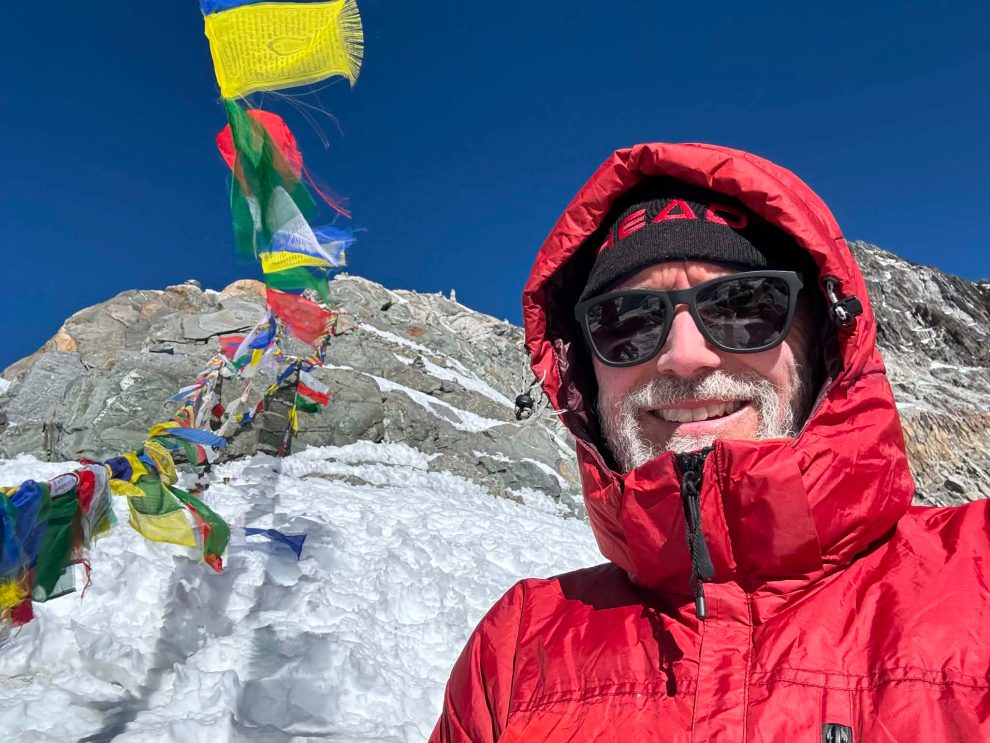
If you’ll excuse me, I’m writing this on my phone from my tent on an 18-degree night in the high desert of New Mexico, so I may not be at my most eloquent. I have been fortunate over the past year to take a sabbatical from my job teaching theology at a Catholic high school in Colorado, and I am spending the heart of the year on the Continental Divide Trail (CDT), a national scenic trail that travels 3,100 miles across the country from Mexico to Canada. I backpacked from Colorado to Alberta last summer and fall to avoid the desert heat and am currently hiking from the Chihuahuan desert back to Colorado. From October to March, I traveled in the Himalaya, South Asia, and South and East Africa.
Journeys, like life itself, must be firmly grounded somewhere to make sense. Everything new that we experience is ultimately understood in relation to the known. In that way, life and travel are always grounded in a sense of home. This year has been a whirlwind of logistics, full of challenges—physical and mental—and nonetheless has been an experience of absolute wonder and awe. There has been only one constant: From mission churches in rural Montana and northern India to cathedrals in Johannesburg and Helena, and from vibrant liturgies in Victoria Falls and Mumbai to the open arms of small faith communities in Silver City, New Mexico, and Lusaka, Zambia, the church, in all its glorious diversity, has consistently brought me back home.
My faith provides the ethical framework to go deeper and contemplate the value of my life and travels, as well as the cost. How should one who wishes to travel ethically think about economics, sustainability, and culture? Is it even ethical to travel in the first place?
While ethics are the moral principles and codes that we apply to our lives, ethos is the spirit of those laws; it is the character or belief that underlies and enlivens the ethics that guide us in our discernment. My decisions on what to do, how to act, and who to help are dictated by my own understanding of ethical conduct rooted deeply in this ethos.
An ethos of travel
It is only when we become acquainted with an ethos of travel that we can begin to consider travel’s ethical implications. During Holy Week this year, I was in Silver City, New Mexico, resupplying for my backpacking trip. I attended a Mass celebrated by Father Patrick Bergin, a conservationist serving in Tanzania. In his homily, Bergin reflected on what contemplative theologian Beatrice Bruteau calls the Holy Thursday revolution. He talked about how Jesus’ washing of feet and institution of the Eucharist have turned the world’s default culture of domination on its head. He asked us to consider the three pillars of this revolution: Jesus’ unconditional positive regard for every person, Jesus’ expansive redefinition of family as all God’s children, and Jesus’ breaking of social boundaries.
Humans have accepted a culture of domination as reality. Jesus’ reality alters our vision of a world defined by dichotomies of strong and weak, essential and worthless, rich and poor. When we see others in a positive light, expand our sense of family, and break social boundaries, we upend these preconceived dichotomies. In fact, we don’t just reverse them (the weak don’t become the new strong or the worthless the new essential); we replace the entire worldview of division, hierarchy, and power with Jesus’ vision of oneness and equity.
The key to this Holy Thursday revolution is our decision whether to participate. Jesus tells Peter he must consent to be washed and tells his disciples they must consent to eat his flesh. Will we choose to participate in Jesus’ revolution?
This seems to me the perfect framework for understanding the ethos of travel.
Travel must begin with a spirit of commitment to Jesus’ message that God’s love is present always and everywhere in all things. With this ethos, we cannot help but encounter every person we meet with unconditional positive regard—the gaze of love.
Travel must focus our attention on Jesus’ message that every person is part of God’s family. In fact, family can be seen as so expansive as to include the very ecosystems in which we live and travel. This ethos means encountering people and places by listening first and developing relationships from which we can identify others as true siblings and both be with them and perhaps ascertain an appropriate response to their needs.
Travel, moving out toward politics, must invite us to become breakers of social boundaries. We see all people and the whole world as priceless, intimate family. Any efforts to separate us, divide us, and create hierarchies of domination must be opposed at all costs.
Travel ethics
From this ethos, we derive ethical codes and parameters from which to operate. Consider some examples from my travels this year.
First, the ethical dilemma of whether to give, from my relatively deep Western pockets, to the multitude of people who seek help, many of whom see me only as a potential source of money.
In Kathmandu, Nepal, I was preparing for a Himalayan trek and went to the only Catholic church for Mass. I met a Catholic family who had escaped persecution in Pakistan and were living as refugees. The father had sold his barbershop to pay for his son’s kidney treatment. We visited the boy in the hospital, and I spent some time with the family. They took me into their home, and we shared meals and stories.
The father asked me to help him get back his business so he could support his family. In my travels, I cannot tell you how often I’ve been approached by people asking for money, and my dilemma is always whether to give or not. In this case, I became the proud co-owner of a Kathmandu barber shop. The decision was easy: I had seen and been seen with unconditional positive regard. This was the right thing to do.
Readers weigh in:
Mostly, I travel to learn, and sometimes in the right situation to teach as well. I like seeing new sites and new gardens and farms and learning how different people do things. I like experiencing different religious rituals (Catholic, Protestant, Muslim, Hindu, Buddhist, etc.). I like having conversations with Buddhist monks and Jewish rabbis. I remember having a great time with a Maryknoll priest from the United States and some sisters from Sumatra at a Maryknoll mission in the sticks on Bali fifty-some years ago. My wife and I travel for encounters like that.
David Mandel, Corvallis, Ore.
I traveled to Kazakhstan for mission work with my family at age 13. I had always heard that people everywhere are essentially the same. This was supposedly an inclusive message about diversity. But in Kazakstan, I really saw how different people were: humor, culture, personal expression, etc. were very different! This made me skeptical of the message that we’re all the same. Travel taught me to respect the very real diversity in the world and to embrace difference with curiosity.
Ariell Simon, Sedalia, Mo.
No matter how hard I try to reduce my carbon footprint, to be open and humble with those I encounter on my travels, I am still conflicted. How privileged I am to be able to go on vacation, even if it’s only within my own state? Do I adequately thank and appreciate the people working at places I visit? Do I adequately offset my carbon emissions? Probably not.
Betsy Reifsnider, Sacramento, Calif.
Travel has changed over the years. Service used to be humane; now it’s all about corporate profits and draconian regulations. And as Christians, we must not lose sight of the fact that millions of people these days are forced to travel against their will, because they are fleeing for their lives. Refugees from horrifying ecological disasters or from dangerously corrupt political situations come to mind, or workers who can’t feed their families and who must emigrate to find jobs. And we know how these people are received in whatever country they flee to.
Joseph Pecroella, Tuckahoe, N.Y.
Second, I have traveled literally thousands of miles both in the United States and abroad. My environmental impact can be monstrous. I am continually faced with the dilemma of whether or not to shape my behavior in light of its ecological impact.
On Mount Kilimanjaro, many people travel the trails with no consideration of their impact. Plastic bottles and trash are ubiquitous. It is difficult to cover the mileage without loosening your own wilderness ethics, and it is almost impossible to reach your destination while collecting all the garbage you see. But, when the entire world is experienced as family, it is easy to make the choice to leave no trace. On these 3,100 miles of the CDT, when I am tempted to ignore the ecosystems and simply conquer the trail, a healthy ethos of travel makes it easy to choose to tread lightly.
Third, as a traveler from the first world raised on rampant consumerism, an ongoing ethical dilemma I face is how to counter my sense of entitlement with an awareness of my economic impact on others. Is it possible to break free of materialism and, in so doing, break the social boundaries that divide us?
In the Himalaya, I struggled with how to spend money conscientiously. For example, should I hire a porter? There is an ethical argument for employing somebody in this capacity. But, for me, the deeper ethos wins out. I chose to carry my things myself and, in the process, try to break social boundaries: not served and server, but partners despite any economic assumptions. I carried my own bags but hired friends and people I had come to know to join me as guides when a trek so required.
In my experience, there is no way—or at least it is prohibitively time consuming—to establish an ethics of travel for every circumstance. But an ethos of travel that puts Jesus’ revolutionary message first guides me through my dilemmas and quandaries as I travel the world and walk the trail.
Come to think of it, as I lie here in my tent preparing for tomorrow’s 20 miles, no matter how hard I plan the day or any interaction, I am left with an unfolding mystery that can only be approached with a spirit of awe, openness, connection, and love.
This article also appears in the August 2026 issue of U.S. Catholic (Vol. 91, No. 8, pages 29-33). Click here to subscribe to the magazine.
Image: Courtesy of Michael Lantagne