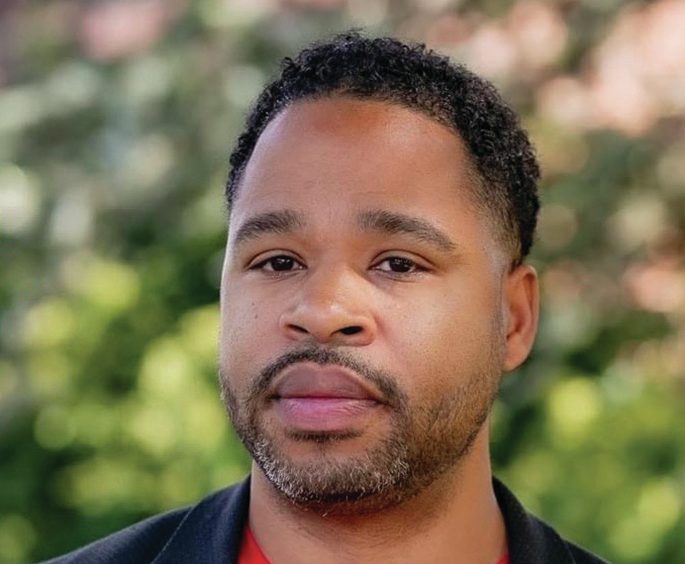
During the rise of the Black Lives Matter movement in the 2010s, David F. Evans, a historian and associate dean of Eastern Mennonite Seminary in Harrisonburg, Virginia, was looking for resources to help his students “in a predominantly white institution combat injustice,” he says. “All the models I have for that are from Black freedom movements: My heroes are the Ella Bakers, Claudia Joneses, Malcolm Xs, Martin Luther Kings, James Baldwins.”
Beverly Tatum, an educator, argues that “white people need positive role models in these areas of multicultural activism and justice,” Evans says. “So I asked my colleagues, who do you read? Who should my students read? It was crickets. I thought: I need to write that book.”
While reading other books about white allies, Evans noticed that the white people being profiled were working for racial justice and had relationships with Black folks, “but at some point in the narrative, there would be a break, a disconnect between the white ally and the Black freedom fighter. [The authors] would just have a few lines about that and go on. I got really curious about what happened in the space between the breakup and the end of the story.”
Damned Whiteness: How White Christian Allies Failed the Black Freedom Movement (The University of North Carolina Press) takes a critical look at those stories. Evans focuses on three white Christian progressives from the 20th century: Dorothy Day, Clarence Jordan, and Ralph Templin, looking at the years 1930 to 1969.
Ralph Templin was a Methodist pastor who was transformed by his missionary experience in India. He became a follower of Gandhi and started a Christian ashram. When he learned about the Black Power movement, he started preaching Black Power in white churches.
While looking through Templin’s writings, Evans saw letters from Dorothy Day, the founder of the Catholic Worker movement, inviting him to speak at events. Templin also knew Clarence Jordan, a Southern Baptist and New Testament scholar who started Koinonia Farm in Americus, Georgia in 1942. Koinonia was an interracial farm that practiced a sharing economy. Being in the south during Jim Crow, they were often violently targeted by their white neighbors.
Evans chose to write about Templin, Jordan, and Day because “these people are willing to risk their lives,” he says. “They’re confronting the KKK. They’re willing to lose friendships. What became curious for me is that despite the seriousness of what they were doing, there was something missing, and it was Black people: Black organizations, Black philosophies, Black methods. So my big question became, how is this possible? Why don’t you all have closer relationships with Black organizations, Black folks? Why are there fractures?”
In the 1960s, Stokely Carmichael introduced the phrase Black Power, of which “self-determination and Black pride” were essential parts, Evans writes in the book. Because of continued anti-Black violence and oppression, Carmichael believed, “Black people should be ready to take by force that which white society was slow to give to them by choice.” Templin, Evans writes, told audiences that Black Power meant “change by and for blacks.”
Black activists in the Black freedom movement “see themselves as standing in a tradition that goes all the way back to enslavement,” Evans says. “Black folks have been trying to get free in this country from the very first moments that we were taken into the colonies.”
Damned Whiteness proclaims that “Black freedom is a position that frees everybody,” Evans says, offering lessons for Christians in what radical solidarity in the movement for freedom can look like.
You write about patterns of “parallel organizing” between white progressive movements and Black freedom movements in the 20th century. What did that mean and look like?
It was very physical or geographical. Philosophically, allies were interested in fellowship and friendship, what Catholics called interracialism. Like, let’s get everybody together; can’t we all just get along? But if we start there, we miss that there is a physical or geographic component to this. White ally groups were literally moving to spaces that put them out of close proximity to Black organizing, to Black people.
In 1957, the first Black civil rights movement demonstration on Washington happens. That year, Washington, D.C. becomes a majority-Black city. That same year, Dorothy Day visits Koinonia Farm, and she’s shot at while sitting watch over the farm. This farm is in a very white space.
Catholic Workers also buy farm property. Ralph Templin becomes the leader of a homesteading community. There’s this back-to-the-land movement happening. White folks are protesting capitalism. They want to engage in what Peter Maurin calls an agronomic university. They move out to these rural spaces at the same time that Black folks’ presence is growing in urban spaces.
Black and white Americans literally have a geographic and physical distance from each other, while each having an interest in addressing the greatest problem of American history, which is the racial divide. We have groups that sound very similar—they appear to be moving against the structures and systems of white supremacy in the same direction, but what’s happening is they are moving in parallel—not together but distant from each other. And they have different visions of where they’re supposed to be going.
Can you talk about Arthur Falls’ vision for a Chicago Catholic Worker and how that differed from Dorothy Day’s vision?
Arthur Falls is a really interesting person, because he represents a long tradition of Black Catholics. My grandparents are Black Catholics from Detroit. I grew up in the Catholic Church, and my grandparents were the only Black people in their church.
I was fascinated by Arthur Falls, who was a well-educated physician. He had his own impulse toward fighting against injustice for his community. When the Catholic Worker newspaper comes out on May 1, 1933, he sees it as this amazing moment where he can bring together his concerns about the economic exploitation of Black people in Chicago and his Catholic faith. But he notices right off the bat that the masthead has two white men on it. So he writes to Day and says, you should make one of the editors Black and the other white, and then the masthead will represent the interracial thing that it seems like your paper wants to promote.
On the cover page of the first issue of the Catholic Worker is a story about what’s happening to Black workers in the Mississippi Delta. If you dig deeper, there are stories about the Scottsboro Boys. To see a Catholic newspaper doing this in 1933 is new to him.
When he tells Day to change the masthead, she enthusiastically agrees. That’s how serious she is about this. They become what seems like pretty close colleagues. She gives him a column in the Catholic Worker, and she goes to visit him. That’s when things start to kind of fall apart.
Falls has a vision for the Catholic Worker that parallels what Day wants the houses of hospitality to be. Day has soup kitchens that also educate people. There are scholars coming through, people having conversations. The part that Falls thinks is most promising for his community is the education part. He wants to see economic uplift. There are all these poor people in his community that don’t understand how finances work, and they’re not networked to anything. He wants to help them with mutual aid funds or credit unions. He brings white University of Chicago students and Black people together for these intense conversations about what they can do in their Chicago neighborhoods. He wants students to see that their freedom is wrapped up in the freedom of Black people on the south side of Chicago.
When Dorothy Day sees this, she doesn’t seem to let on to him that she’s disappointed, but she does tell some other people that this is not really what she had in mind. Falls finds out after she leaves that she has given permission to someone else to open another house. She wants that house to be more like charity than this vision of solidarity that Falls seems to be building.
Dorothy Day is saying we all need to commit to voluntary poverty. In the book, I quote James Farmer, who says something like, I didn’t volunteer to be poor the first time. It’s different when you are already poor to be asked to commit to poverty. These folks are trying to build something different that will allow for a better quality of life for people in the neighborhood.
I want to be careful, because charity is so vitally important to care for people, to give to people who don’t have what they need, especially in emergencies and crises. But when those power imbalances remain indefinitely unless the structure changes, charity allows for those systems of power to continue. Falls felt that people needed economic uplift. Dorothy Day and Peter Maurin and the Catholic Worker movement saw that the way to engage in positive Christian practice as we have done for centuries is to live into charity.
Maybe there’s another way to think about charity that allows for the smashing and transforming of systems. In some places, people say things like, we need the poor so that we can practice charity. Falls doesn’t agree with that.
Day doesn’t demonstrate much awareness about her own networks and her ability to take a vow of poverty while also having access to people with enough money to purchase land. She has connections to networks that most Black people in America don’t have.
Falls believes we need people to stand with us in the midst of these oppressive forces. If one group can work to deal with what’s going on in Chicago right in their own community, then we will potentially have a recipe for helping everybody get free. That’s solidarity.
Can you say more about Catholic interracial efforts at the time?
The Federated Colored Catholics was a group of people who loved being Catholic. But—and it wasn’t just Black folks, there were immigrants in the earlier part of the 20th century—they were discriminated against in Catholic parishes. They wanted to help the church become what the church is supposed to be, where we are all kinfolk in Christ. They asked questions like: Why are we not admitted to our Catholic universities? Why don’t we have more Black clergy?
The FCC pushed American Catholics to change. Thomas Wyatt Turner, the Black layman who founded it, did not pull any punches. He said some hard things for people to hear. And two white Jesuits, Father John LaFarge and Father William Markoe, were concerned about the demands that Thomas Wyatt Turner and the FCC made upon Catholics.
When LaFarge heard what the FCC was doing, he seemed threatened. He quickly moved to change the leadership so that it was just him and Markoe. At first, many in the Black Catholic community thought this could be a good thing: No one’s been listening to us; maybe if we have the power of the priests, this could signal something good.
But what they didn’t realize is that LaFarge had a completely different philosophy. One, he believed the organization should be interracial. The philosophy of interracialism is that any action needs to be practiced with Black and white people together. He also thought that this kind of movement should not be led by a layperson. There’s a problem with this, of course: If you say only clergy can lead, you don’t have a bunch of Black clergy running around, so who’s going to lead it? It becomes Markoe and LaFarge. What started out as a Black freedom movement within the Catholic Church becomes not about freedom, but about friendship. Interracialism is about fellowship.
Markoe and LaFarge are symbolic of a number of white people who see the problem of Jim Crow’s segregation as one of division. Black folks don’t see the problem of segregation as fundamentally division. They see the problem as, we’re not free. We need to be free. Anti-segregation is not the same as freedom.
When LaFarge and Markoe took over, it changed the whole tone of what was happening. They changed the name to the Catholic Interracial Council. Then Markoe and LaFarge moved on, and Turner tried to get the organization going again, but it never had the same impact.
How did Clarence Jordan’s vision for Koinonia Farm fall flat for many Black sharecroppers?
Jordan sees that segregation is a problem. So he and his friend decide they’re going to start what they call a “demonstration plot for the kingdom of God.” They want to set up this space where they practice the things they think are going to happen in the end times: We’re going to all live together in harmony and share things in common.
There are some fascinating things that happen at Koinonia Farm. One of my favorites is the cow library, where, say, you want some milk: You can go to the farm and check out a cow and bring it home. You can milk that cow until it’s dry, then take it back and get a new one. They’re anti-capitalists; they believe in a sharing economy.
They pay everyone who works on the farm the same amount. They hire out Black day laborers. Jordan wants Black folks to eat at the same table and share in fellowship with white folks. But the Black folks are like, hmm. We know where we live. We are in an open space in Georgia in the 1940s and ’50s. Y’all want us to eat at the same table as you, when it is against the law to do so. Jordan never got these Black laborers to move to the farm, because they were concerned about the violence that would come down upon them if they crossed over those Jim Crow laws.
Jordan started the farm for two reasons. One, to teach Black people about farming, and two, to teach Black people about religion. If you know anything about the southern United States, Black people have been farming that land for a long time. Not freely, but for a long time. When it comes to religion, there’s around a dozen Black churches in Americus before Jordan shows up. What is it you’re going to teach these people about religion that they don’t already know?
In the book, I start the chapter about Koinonia Farm with Rosa Lee Ingram, a sharecropper in a nearby county who gets into trouble with her white neighbor who comes by, and she and her boys kill him. They are defending themselves. There is a communal effort to rally behind the Ingrams. The NAACP is involved, and it becomes a nationwide story. But Jordan and Koinonia Farm are nowhere to be found in this story. So here we see the parallel organizing, but it’s so close. They’re in the same region, working with the same people, and working at different efforts.
Jordan is a nonviolent nonresister. That’s a distinction from nonviolent resistance, which is what Martin Luther King was advocating. One of my former mentors, Vincent Harding, who died a few years ago, was friends with both Jordan and King. Jordan asked for a meeting with King and told him that marching is not Christian, that public demonstrations are not the ways Christians should be acting. We just need to practice being the church. King, according to Harding, respectfully disagreed with him. Here’s one of those fractures: They don’t speak to each other again.
Where did the title of your book, Damned Whiteness, come from?
The title comes from a Ralph Templin poem. After World War I, Templin goes to India as a missionary. He starts to notice that though he doesn’t know anything, he gets put in charge of everything. He starts to call this “white prerogative.” He suspects that there’s something in the white person’s psyche that makes them believe that they should be in charge of everything everywhere all the time. W. E. B. Du Bois writes something similar in the 1920s: “Whiteness is the ownership of the earth forever and ever, Amen!”
For Templin, this is very concerning. The Indians are saying to him, why are you trying to Christianize us? Why don’t you go make your own country Christian? We know what you’re doing to Black people there. And he’s stunned.
He sees whiteness as a disease that has seized upon him and white people all over the world. He writes a poem where he calls it “damned whiteness.” When I read that, that seemed like the right title, because this book is somewhat of a lament for me.
I got emotional at different points in writing this book, because I wanted Dorothy Day, Clarence Jordan, and Ralph Templin to be these people that white students could look to and say, yes, that is the person I want to learn from. But they are products of a system and structure that they can’t escape from.
I don’t know who has better intentions than Day, Jordan, or Templin did. These are good, righteous people. These are the salt-of-the-earth people. One of the questions my book asks people to grapple with is: What do we do with their failures? They’re the best of the white progressives. Why couldn’t they get this right?
A mentor of mine when I was in seminary taught me to define holiness as giving all that you know of yourself to all that you know of God. These are holy people. So “damned whiteness” explains what they were trapped or mired in. The imperial tentacles that spread capitalism and racism all over the world is a system that forms people’s identities and what they think is possible.
Jordan, Day, and Templin are responding to their environment that is coded very white because of segregation and their inability to acknowledge the wisdom and skill of Black organizers, Black communities, and Black people. It leaves them impoverished in and trapped in a white world that cannot imagine freedom for everyone.
Templin feels the weight of that. He’s dying; that’s why he calls it a disease. When the Black Power movement starts, he says, this is it. This is the answer to white supremacy, to whiteness: Black Power.
Templin ultimately chose solidarity over allyship. Why is that an important distinction?
Allyship looks like agreeing in principle that racism, segregation, anti-Black animosity, and racial prejudice are wrong. It allows for temporary alignments. It allows for tokenism. In allyship, there are resources and time and money being spent. But it also allows for allies to opt out when things get too hard.
Radical solidarity repositions us in relation to empire. I put myself in a position so that what happens directly to that person directly happens to me too. Templin immerses himself in Black experiences in the Black world. He becomes the first white pastor to be ordained in an all-Black conference of the Methodist church. He gets invited to the third Black Power conference.
He starts preaching Black Power in white churches. His relationship now to empire is no longer one of white prerogative. He leaves behind a lot of the leadership positions he had in white pacifist spaces and white churches where he would gain all kinds of accolades. Instead, he fades into history, and no one really hears from him again. There are no books on Templin; this is probably the most that anyone has written on him. I think a lot of that is because he does not take the limelight or center himself anymore.
But he also doesn’t shrink himself. When you’re in solidarity, you are not a bystander. You were with us when police showed up and raided our building. You were present with us when we couldn’t pay rent. You’re not an ally; you’re one of us. You’re not fighting for us, you’re fighting with us. And that’s what Templin represents.
The Combahee River Collective, Claudia Jones, and Kimberlé Crenshaw are undergirding my work. As queer Black women, they are facing capitalism, homophobia, racism, and patriarchy. If we figure out a way to get us free, that means that these systems will have been dealt with in such a way that not only are we free, everybody else is free.
One of the lessons here could be: Join a local community organization. Solidarity connotes a kind of indebtedness. When you start to invest in a place, you are indebted to it.
There are more brown and Black people around the world than there are white people. We need the world’s majority to have the power to change this. The more that white nations hold on to power, the less capability they have to change the problems they’ve created.
Listen to Black folks, support Black people and Black organizations. Get involved. We don’t all have to agree with one another. But these are our problems together. Allies don’t have that knowledge; they’re standing outside looking in. You’ll know you’re in solidarity when the other people in your community say, you’re one of us.
This article also appears in the June 2026 issue of U.S. Catholic (Vol. 91, No. 6, pages 20-24). Click here to subscribe to the magazine.
Image: Unsplash