

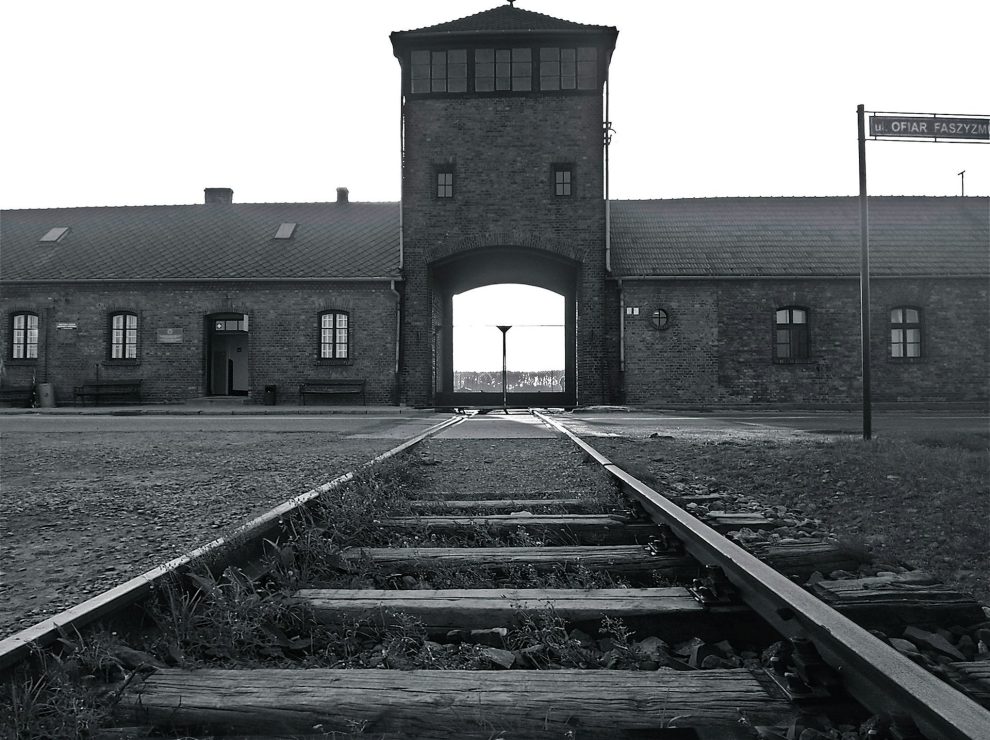
On April 13 to 14, Yom HaShoah—Holocaust Remembrance Day—we remember both the immense human loss and the fragile, defiant humanity that persisted despite it. For Barbara Shaiman, founder of the nonprofit Champions of Caring and the daughter of Holocaust survivors, this remembrance is not abstract. Its legacy is handed down not only through stories of suffering but also through her family’s stubborn commitment to kindness.
As Catholics, Yom HaShoah is also a call to examine our own history and responsibility: to reject antisemitism in all its current forms and to stand in solidarity with the Jewish community. It can also be an invitation to learn from the individuals who carried the weight of this history and who, even then, bravely chose a path of hope and compassion.
The Holocaust—known in Hebrew as the Shoah, meaning “catastrophe” or “utter destruction”—was the systematic murder of 6 million Jews, two-thirds of Europe’s Jewish population. Millions of others were also killed: Roma and Sinti people, disabled individuals, political and religious dissidents, LGBTQ+ people, Slavic civilians, prisoners of war, and countless others who were deemed a threat to the regime and “unworthy of life.”
In total, at least 13 million people were murdered in this vast campaign of dehumanization and annihilation. Numbers like these are almost impossible to comprehend.

For the people who lived through it, the Shoah raised many questions: Where was God when these atrocities were committed? In the face of racist hatred so virulent, how could they have faith in anything? How could they ever again trust humanity?
Barbara’s family answered these questions with a determination that created meaning even amid the Holocaust’s madness. The unspeakable horrors revealed how broken humans can become, but true humanity, they insisted, is expressed in kindness and courage. Those of her family who survived the concentration camps emerged with a fierce determination to create a kinder world. This was the moral mandate they passed on to Barbara.
Until she was 19, Barbara shared a bedroom with her paternal grandmother and grew up listening to her stories. An intrepid and intelligent businesswoman before the Holocaust, her grandmother refused to let the Nazis steal her identity.
She was in her 50s when she stood in line under Josef Mengele’s watchful eye at Auschwitz. Realizing she’d been placed among those deemed too weak to work—and therefore marked for death—she made a split-second decision. She stepped out of line and joined a group of younger, stronger prisoners. If Mengele and his minions had noticed, they would have shot her instantly. But she got away with it. She survived.

Inside the camp, small kindnesses became another form of rebellion, a way Barbara’s grandmother could hold on to a morsel of the control she’d been accustomed to. She found berries growing in the barracks and used them each morning to rouge the cheeks of the sick, making them look a bit healthier. This meant they would pass the guards’ inspection and live one more day.
Barbara’s mother, Carola, also practiced kindness as a form of rebellion. When she was 15, as antisemitism grew more virulent, her parents and older brother went out to search for a hiding place. They never came back, and the next day, Nazi soldiers sent Carola to Łódź Ghetto. There, children separated from their parents roamed the streets, aimless and afraid. Carola gathered them together, comforting them with songs and stories.
Four years later, Carola and her good friend Sarah were sent to Auschwitz, where their friendship grew even stronger. One day, Sarah found a raw potato. Starving, she might easily have eaten it all herself. Instead, she shared it with her friend. Years later, Carola told her daughter, “That act was the kindest thing anyone could ever do.” Carola’s friendship with Sarah endured to the end of their lives.
Barbara’s father, Henek, had his own stories to share. As a young man in his early 20s, he too faced the Nazis’ cruelty. Then, as Allied forces approached, Henek and his cousin Henry were among the weak and starving prisoners forced to walk hundreds of miles without food or winter clothing. If they stumbled, they would be shot or beaten and left to die in the snow—and so, as Henry grew more and more ill with typhus, Henek carried him mile after mile on his shoulders. That act of dogged compassion saved Henry’s life. He lived to be 101, and every year, on his birthday, he called Henek to thank him.
Before liberation came, Henek was sent to the Theresienstadt camp, where he met Carola, who had also been moved there. Surrounded by suffering and devastation, they fell in love.
At last, in May of 1945, the Russians arrived, and they were free to leave. They traveled together back to Łódź, where Carola had lived, and then to Henek’s old home in Krakow, Poland, searching for lost family. To her sorrow, Carola discovered she was the sole survivor out of a family of 65, but in Krakow, Henek was reunited with his mother, one of his brothers (the Nazis had killed his other brother), and his cousin.
From this barren ground, they built a life together in Regensburg, Germany, and had a child—Barbara. Later, the Hebrew Immigrant Aid Society brought them to America. Barbara grew up in a Jewish neighborhood in New York City, where nearly every adult she knew was a survivor of the camps.
Their stories formed the backdrop of her childhood. So pervasive was this shared history, little Barbara assumed everyone in the world had lived through the Holocaust. That history helped mold her into the person she is today. “The more horror they saw,” Barbara says, referring to the adults who shaped her childhood, “the more they insisted that to be human is to be kind. The cruelty they witnessed propelled them to be even kinder.”
That didn’t mean they were saints, Barbara says. They were angry. They grieved bitterly. But they refused to allow anger to lead them. They refused to let bitterness become their legacy.
Even as her mother lay dying years later, her mind drifting back to the ghetto, she worried aloud: “But if I die, who will take care of the children?”
“I will,” Barbara promised.
And she did. In 1995, Barbara founded Champions of Caring, a nonprofit that has since mentored more than 10,000 young people in the greater Philadelphia area, empowering them to become agents of kindness and social change. Together, these young people contributed a million hours of service locally, nationally, and globally. Decades later, those young “Champions”—now adults—continue to live and teach the values of kindness, caring, and empathy throughout the world. A soon-to-be-released documentary titled The Coral Ring Legacy tells their stories.
As I listen to Barbara, I can’t help but marvel at the power of such simple things—red berries, a raw potato, and people determined to be kind in countless other tiny ways. These things created change that continues to spread. Today, Champions of Caring focuses on bringing generations together to do the work of kindness. As Barbara says, “We need old people and young people. We need everyone.”
Now in her late 70s, she continues the work. “People ask me how I keep going at my age,” she says. “And I say, ‘This work is manna for the soul. . . . I am the daughter and granddaughter of people who went through horrendous things. I am proud to be living my family’s legacy.’ ”
At first glance, we might think Barbara’s family history is merely a collection of touching anecdotes. It is not. Her family’s steadfast and defiant kindness still has power to transform our world. Her stories reveal something essential for us to hear today: Even in a world engineered to erase humanity, people can still choose to be human.
And yet, as Yom HaShoah returns each year, it continues to raise urgent questions: How do we remember? How does memory change the way we live today? What does it mean to be human in a world still capable of cruelty?
Barbara returns, again and again, to something her mother told her: “The sun will always come out. If it came out for me after Auschwitz, it will come out for you.”
This is a hard-won truth that empowers us all. We don’t merely wait passively for the sunlight to return; we do our part to make it happen.
“Indifference and apathy are choices,” Barbara says. “If you don’t like something, do something. We still have a voice in this country—so use it! We still have privileges—so exercise them! Ask yourself: ‘What kind of world do I want our children to inherit? What will my legacy be?’ ”
The task can seem overwhelming. But it does not begin with grand gestures or heroism. “It starts,” Barbara says, “with one person asking: What can I do today? It starts with little things. But it can escalate into bigger projects, the way it did for me. You never know.”
On this Yom HaShoah, we remember the millions who were lost. And we remember, too, the quiet, innovative acts of kindness that refused to be extinguished. “How,” I ask Barbara, “can we best honor these memories?”
“Stay hopeful,” she says. “Look around you and see where there’s a problem. Gather together like-minded people. Then make a plan. Do something, even if it’s small. Speak out. Never give up.”
Image: Unsplash/Colin C. Murphy




Add comment