

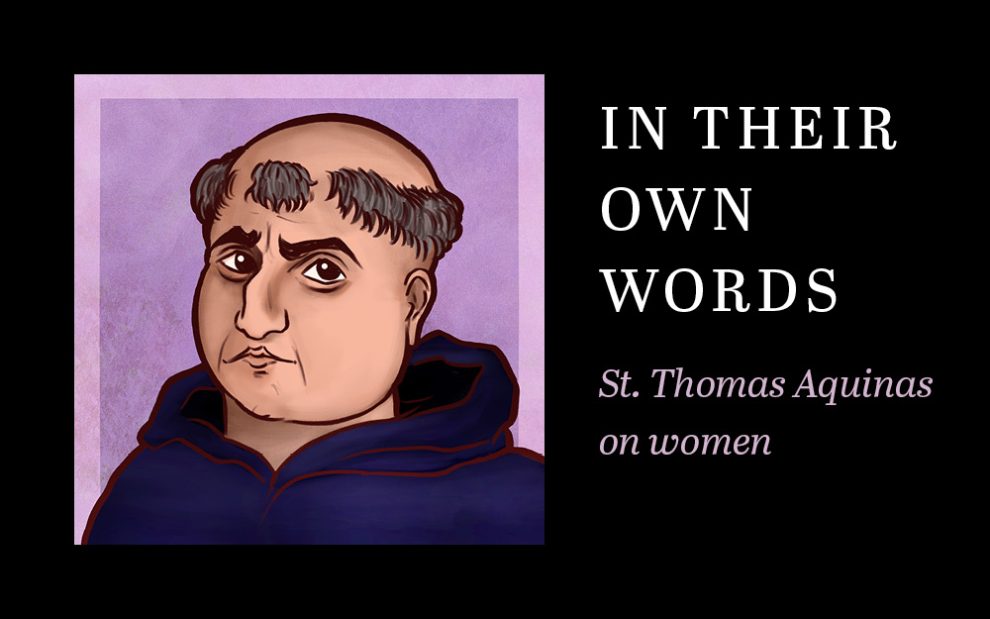
In Their Own Words is a new web column from U.S. Catholic. In these essays, academics and other experts provide short, evidence-based explanations of prominent Catholic figures’ views on an array of topics of interest to the church and offer resources for finding further accurate information.
I once told a colleague that I was giving a lecture on Aquinas’ feminist tendencies. “That is going to be a short lecture,” he replied. Unfortunately, my colleague had a point. It is difficult to see Aquinas as a feminist thinker. At the same time, his views on women are not as negative as we often assume. Like all of us, Aquinas was a person of his time. He was shaped by a complex cultural and intellectual tradition regarding men, women, and the relations between them. Aquinas’ remarks on women in his Summa Theologiae represent the most mature statement of his overall views.
Within the Summa Theologiae, the key passages for understanding Aquinas’ views on women include his questions on the creation of humanity in paradise. He devotes a whole question, comprising four articles, to considering queries that were commonly raised about the creation of woman—that is, Eve—in paradise. In the first article, he asks whether woman should have been made in the first production of things, then concludes that she was indeed a necessary part of the first creation, because she was created to be a “helpmeet” to man in the process of generation.
This line of argument has troubled many readers, since Aquinas seems to be saying that women, as individuals, exist for the sake of reproduction. But this would be an odd view for Aquinas to defend, given the long, celebrated tradition of vowed celibacy among women as well as men. The existence of vowed celibate nuns and religious sisters, whose way of life is celebrated by the church and society, does not fit well with the idea that women exist for the purpose of reproduction.
When we look more closely at what Aquinas says, we see that he justifies his position through an extended analysis of the processes of reproduction in plants and animals, and finally, in humans. He is not interested, at this point, in the purpose or vocation of individual women; he wants to defend God, and the idea that God ordained the division of the sexes as the basis for the sexual propagation of humanity.
This may strike us as an odd line to take, but Aquinas is reacting to those theologians who denied the goodness of the body and claimed that sexual reproduction is degrading, or even sinful. Yet there are still some views in this section that are regrettable, such as Aquinas’ claim that even in paradise, women would naturally be subject to their husbands, because in men, he believed, the discretion of reason is naturally more abundant than it is in women.
In the next question, Aquinas considers the purpose for which human persons are created, in light of the widely held view that we are made in the image and likeness of God. He asks whether this is true for women as well as men and concludes that women and men are equal with respect to the possession of the image, understood in its primary sense as a capacity for reasoned self-governance. He repeats, with approval, Augustine’s remark that with respect to the mind, “there is no distinction of sex.” This is an especially significant point. Aquinas is claiming that there is no essential difference between women and men. Unlike Aristotle, also an important authority at this time, Aquinas does not believe that women are incapable of virtue or suited only to a lesser kind of virtue. He believes that the differences between men and women, with respect to wisdom and discretion, are differences of degree, not kind.
Aquinas goes on to defend the practice of women exercising the charism of prophecy, teaching, or acting as counselors, on the condition that they do so privately, without claiming any kind of official status. Yet he also defends the exclusion of women from public offices within the church. Since women are subordinate to their husbands in marriage, he argues, the social status of women carries a connotation of subordination. For this reason, he argues, a woman cannot represent Christ, who holds authority within the church.

However, this, in his view, does not mean that women cannot serve in public offices in civil society, and in his commentary on Peter Lombard’s Sentences, he holds that this practice is entirely legitimate. One of Aquinas’ treatises, De regimine judaeorum, is addressed to a woman ruler—traditionally identified as Marguerite, Countess of Flanders—who had written to him asking for advice on matters arising in her rule. In his response, he takes the legitimacy of her rule entirely for granted.
Although Aquinas’ comments on women are problematic in many respects, he does affirm the essential equality of men and women, and the capacities that women possess for prophecy, teaching, counsel, and leadership in civil society. Many contemporary readers will doubtless wish that he had gone further with this line of thinking. Nonetheless, his views are understandable, given his intellectual and social context, and he provides starting points for developing what he says, in such a way as to contribute to our own conversations about the place of women in church and society.
Art: Dani Jimenez





Add comment