

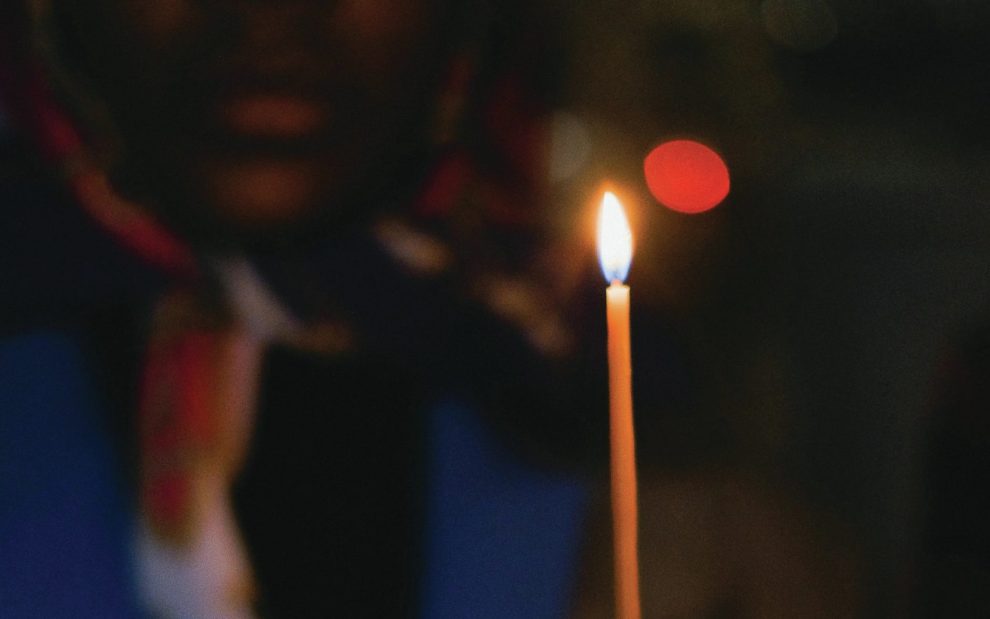
God bless you and keep you,
God smile on you and gift you,
God look you full in the face and make you prosper.
—Numbers 6:24-26 (The Message)
The priest blessed my mother with oil as she lay dying in the hospital room. I wept in grief for her deteriorating body, but I also wept with consolation; the ancient act of blessing the sick wove me into a wider community, a community that has known illness and loss, grief and sorrow. In those moments, under the glare of fluorescent lights, I met blessing in a new way and saw it as an act of embodied love, pouring forth what the divine wishes for us—to be held safe in all our moments of confusion and loss, while also celebrating our joys.
During this season of Lent, as we are called to deepen our prayer life, we expand our connection with God in our daily lives. Blessing is one of the most powerful tools we have to achieve that intimacy.
The tradition of offering blessing
The Christian concept of blessing originates in the beginning of the Hebrew scriptures, when God blesses all creation. Later in the Book of Genesis, God declares that all Abraham’s descendants will be blessings to the world. Then, in the Christian scriptures, Jesus offers blessings many times, including to the children and at the Last Supper. These ancient affirmations of divine favor call each of us to share our blessings with others and become a blessing to our communities.
The Catholic Church continues this act of blessing. Bishops, priests, and deacons administer formal blessings, such as at the end of Mass. Meanwhile, however, anyone can offer informal blessings. Big and small moments—a new home, for instance, or a family meal, a friend’s hospital bed, or a birthday celebration—can all be occasions for blessings.
Blessings connect us to our spiritual lineage of saints and ancestors who gave and received blessings themselves. Throughout Catholic history, blessings have been a part of weddings and baptisms; they have been prayed over journeys, ships, and new ventures. The church blesses altars, vestments, rosaries, and chalices. We even bless our animals, especially on the Feast Day of St. Francis.
What does it mean to bless?
To bless means to make holy, but in reality, a blessing honors the holiness already present. The word comes from the Latin, benedicere, which means “to speak well of.” Blessings affirm the love and beauty of the Holy One in our lives and remind us to take nothing for granted. When we bless something or someone, we call upon the grace of the divine presence to be fully with us in this situation. We participate in the abundance of grace at work in the world.

We tend to think of prayer as a time to ask God for the things we need, but blessings remind us that prayer is transformative rather than transactional. We pray not just to ask for things. Blessings offer hope and encouragement, steep us in gratitude, and nurture our courage. They make us present to the grace of each moment. They act as maps to navigate our human experience, orienting us to gratefulness and praise.
Blessing brings reverence to all our experiences, from the most ordinary of tasks to the great thresholds of our lives. It invites us to breathe more deeply, enlarge our vision, and honor our experiences. When we bless, we touch eternity here and now. We immerse ourselves in the holy rhythms of the sacred. All the mundane activities of the day became opportunities to witness grace at work.
A blessing is also an acknowledgment of the gifts already present. When I start treating my calendar and to-do lists like holy grails, speaking a blessing is a way to put things back into perspective. When my heart aches and grieves over loss, a blessing is a sanctuary space within which God meets me and holds me. Blessing opens my heart to gratitude for the multitude of gifts I experience moment by moment. It empowers me to name all the ways God is at work already within and around me.
When we bless our actions, we lift up our partnership with the Divine; we take our place as embodied messengers of healing, love, joy, hope, and more. Meanwhile, receiving a blessing is an act of being seen, witnessed, and loved. It weaves us into a community of care and concern.
Blessing is an act of solidarity that says: I am praying for you, I am celebrating you, I am grieving with you, and I know the Holy One is praying, celebrating, and grieving with us. To both offer and receive a blessing demands vulnerability so we can be met where we are.
Blessing is not about a privileged status over others but about recognizing the blessing we receive with the gift of life itself. In all places and in all moments, we are already blessed. We need only shift our perspective.
The practice of writing a blessing
I first started to write blessings several years ago for the ecumenical community I lead, Abbey of the Arts, a virtual monastery rooted in the desert, Celtic, and Benedictine traditions. I sometimes write blessings for retreats I lead as well. I write the blessings out of a great love for my community and a desire for God to meet them in the midst of the daily challenges of their lives. When I write a blessing, I put words to whatever concerns me, whether that be the unfolding rhythms of the day, the food I eat, or a friend I know who is struggling.
To begin, I center myself, dropping my awareness into the sanctuary of my heart, resting for a few moments in the presence of the Beloved. I connect to this infinite source of blessing, allowing myself to be held in this energy.
Next, I call to mind and heart a person or a situation that is tugging on my heart. This could be for myself, another, or a larger situation in the world or in nature. I draw from the infinite well of blessing that pulses within me, as the Holy One dwells in my heart. I imagine life and light showered on the person or situation I am holding in my heart.
Now, I am ready to write. I ask God for the words to support this individual or circumstance. I begin by scattering words on the page like seeds, words that reflect my longings and desire for this person or situation. As the seeds fall and grow, the blessing slowly takes shape. Finally, when I am done, I read it out loud to imagine the words doing their sacred work.
In this practice, I find a sanctuary space where I open myself to an encounter with God. It has helped to deepen my prayer life as I feel more intimately connected with those whom I am blessing. Writing a blessing never fails to expand my heart as I connect with God’s desires for the world. This year, during Lent, may the practice of blessing transform all our lives. As we bless others, may we too be blessed, becoming more openhearted, generous, and joyful as we participate in God’s ongoing work of love.
This article also appears in the March 2026 issue of U.S. Catholic (Vol. 91, No. 3, page 45-46). Click here to subscribe to the magazine.





Add comment