

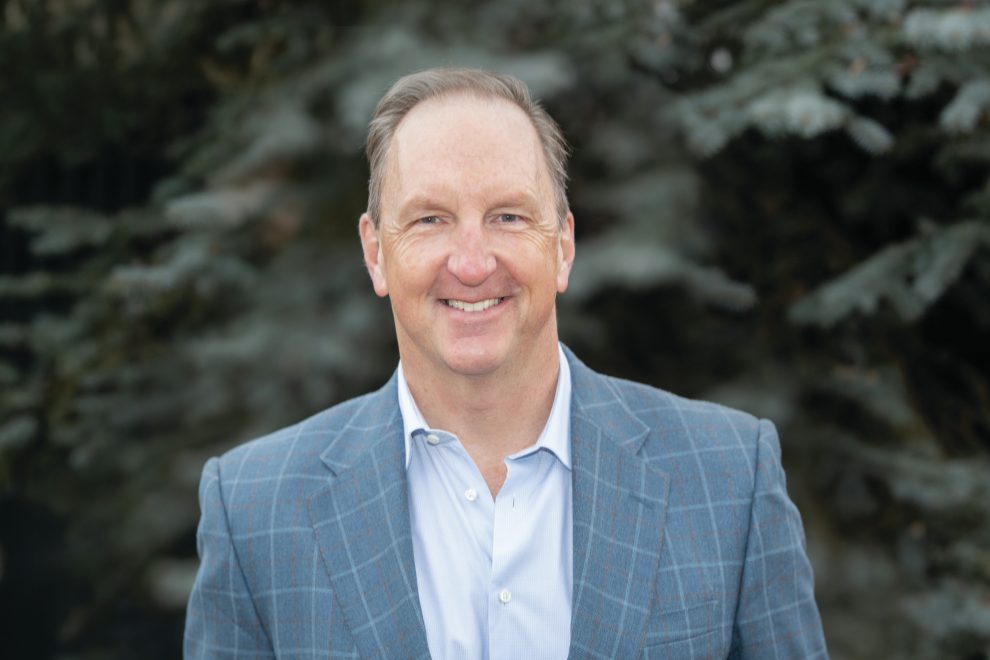
The solar industry faces headwinds this year, due to the policy changes from President Donald Trump. But Page Gravely, whose team developed Catholic Energies alongside Catholic Climate Covenant, is certain he’s bet on the right dog in the fight. Clean energy will continue to grow for economic reasons. “The solar train has left the station a long time ago; there’s no turning back. It may slow a bit,” he says. But the storm will pass.
Gravely is the rare, moderate Republican who believes that climate change is happening. He also knows business and believes that market competition will lead to solar’s appeal as a less expensive energy source—incentivizing certain regions of the country regardless of policy.
However, he’s dismayed that politics stands in the way of an even playing field. “A true competitive market is one where we let the users decide,” he says. “As a Republican, it’s pretty shameful how this administration has targeted this clean energy market.”
Gravely, an Episcopalian, went back to school for his master’s in environmental management when he was 50 years old, inspired primarily by his brother-in-law, Bill Ross—the former secretary of the Department of Environmental Quality in North Carolina. “I didn’t come out of there with solar in mind, but I’d been in commercial building and real estate,” he says. “So, the transition to solar—I just fell into it.”

Before Catholic Energies, Gravely and his business partner, Dan Last, worked together helping building owners seek LEED (Leadership in Energy and Environmental Design) certification. An acquaintance, Dan Misleh, the founder of Catholic Climate Covenant, asked for their insight on how to support Catholic organizations following Pope Francis’ call to action in Laudato Si’ (On Care for Our Common Home). They landed on exploring how to facilitate a solar transition. Gravely and Last consulted pro bono, wanting to develop new professional pathways for themselves as well.
The test run was a five-acre property in Washington, D.C., owned by Catholic Charities. Developers had come knocking with offers to buy the convent on the land and build condos. But the sisters wanted something more missional. Could they find institutional money—avoiding using Catholic Charities’ own money—to build solar under current regulations?
The financial model chosen: a local solar company—using incentives from the District of Columbia and Pepco, the local electric utility—agreed to fund the construction. With the amount of power it generated for the grid, Gravely negotiated an agreement for Catholic Charities to receive credit for nearly all the energy needs of the organization’s remaining 12 properties.
When completed in 2019, the ground solar array—5,000 solar panels—was the largest the nation’s capital had seen and generated a year’s worth of power for 260 homes.
“That’s a lot of money they could take and now they could put that to serve their mission,” he says.
While the project was underway, the Washington Post published a front-page article. “I was at my sister’s vacation house, and my phone blew up,” Gravely says. “I must have fielded over 100 calls over two weeks. Dan and I realized we’d tapped into an interest. We didn’t even have the name of a company. Catholic Energies was the name Dan Misleh created for this one project.”
From there, Mission Energy was formed, and Catholic Energies became a partnership project of Catholic Climate Covenant. Almost all the initial projects at Mission Energy were generated by the media coverage. The demand has remained consistent ever since.
Early on, they decided to put mission in their name—broadening their clientele to provide solar development for nonprofits across the country. Catholic organizations, however, make up about 85 percent of its business. “Catholics own a lot of real estate, and solar can absolutely benefit that real estate,” Gravely says. Many of the company’s other clients embrace a strong mission that goes beyond financial motivation—this also inspires Gravely to press on, fueled by the faith of his clientele.
Sometimes that mission guides organizations to go solar because it is economic—more dollars can be spent on programming. But for others, it is about meeting the moment placed before them by Laudato Si’.
Currently, Mission Energy has more projects under development than they’ve ever had because of the political climate. “We’re having to push clients to make decisions,” Gravely says. “A lot of our clients that were on the fence are [saying], ‘Now let’s move forward and get this thing built,’ ” he says. “We are just working very long hours because there’s a sense of urgency.”
Last summer’s “One, Big, Beautiful Bill” included a plan to phase out financial incentives for solar, which, coupled with the impending promise of higher tariffs, rewrites many project timelines. While interpretation of the bill is still unfolding, the direct pay tax rebates offered in the Inflation Reduction Act (IRA) of 2022 should still be fulfilled if projects break ground before Dec. 31. Following a White House order, Gravely is concerned that projects with components from certain foreign countries—many solar components are made in China—will be disqualified from receiving the funds.
“It’s like going up and hitting a beehive with a broom,” Gravely says. “It’s created a tremendous amount of churn.”
Gravely may be set back, but he isn’t deterred. After all, Mission Energy began before the IRA of 2022 offered generous incentives. The federal program would help, he says, but his clients aren’t purely financially motivated, and they’ve found other ways to go solar in the past.
Quick takes from Page Graveley
What makes Catholic organizations unique?
Churches are very unique. We’re very proud and feel like we got the name of our company right. They truly make mission-based decisions.
For the sister organizations, the paybacks are quite long, but they don’t care. To so many sister organizations, they know the age and volume of new nuns is being outpaced by the expected rate of decline. A lot of them are looking at solar as a legacy investment. It is truly an answer to God’s calling to leave this Earth better than you arrived. Solar is going to last 30, 35, 40 years. The panels only degrade 0.5 percent a year. It’s not like a car that’s going to start breaking down. The sun is very predictable. They look at this as a long-term viable, multigenerational investment that is for the long term for the better good.
What kind of limitations are organizations facing when exploring solar?
We do an up-front pro bono analysis so they can see what numbers look like. What are your goals? What are you trying to achieve? If it’s purely financial, then we can tell them in five minutes whether the chances of achieving their goals are pretty good. We don’t want to waste their time.
We want to understand what incentives are based on utility bills. There are a lot of variables. Every project is like a snowflake. We know what states have much better [incentives] than others. We’ve done projects in 16 states plus Puerto Rico. In some states, organizations must own the solar array. In others, like if they’re in Alabama, there are no incentives—they don’t allow [solar buy-back agreements]—but solar is still inexpensive.
We help get them to that understanding very quickly, so they can make a go/no-go decision.
Image: Courtesy of Page Gravely







Add comment