

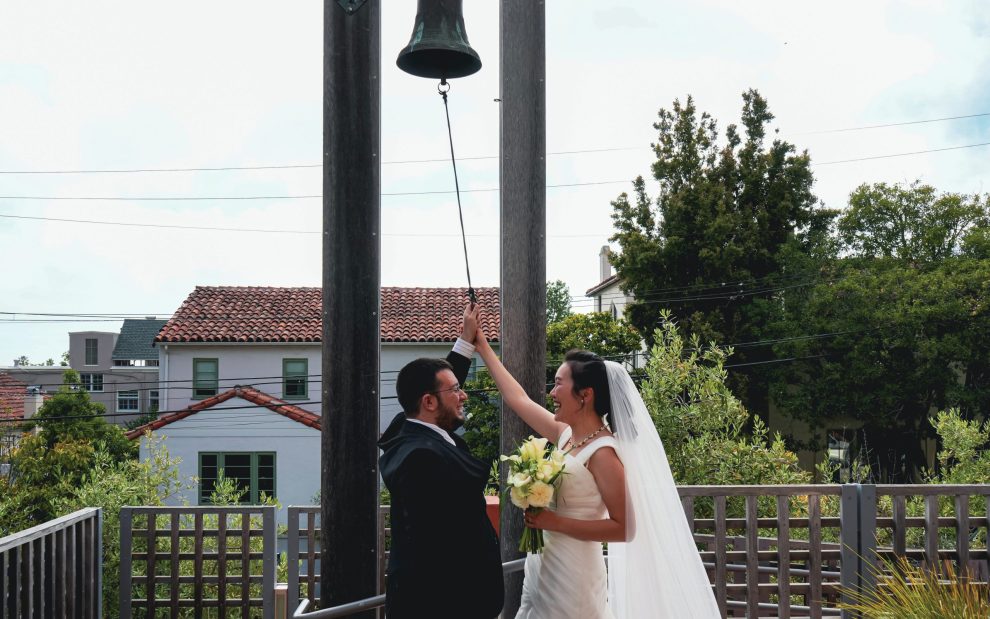
How do you prepare a Catholic wedding between a born-and-raised Salvadoran Catholic and the only nondenominational convert in a nonreligious Chinese family?
This may sound like a far-fetched joke, but in our case, it was a reality we had to navigate over a short period of time while preparing for our marriage.
Fabio was born in El Salvador. El Salvador is a deeply Catholic country, and his life was no exception. Fabio was baptized as a months-old baby, had his first communion at 11, and was confirmed by 15. His family is deeply Catholic, with several close family members attending Catholic schools. He even attended seminary for one year, where he discovered that he liked studying theology more than living the priestly life. That fact is what eventually lead him to Berkeley, where he enrolled in a master’s in theology program at the Jesuit School of Theology (JST).
Selah, meanwhile, was born in China and came to faith during her undergraduate years at China University of Political Science and Law. She is the only Christian in her family, which might be described as “socially religious”; they participate in the big Chinese holidays but don’t believe in organized religion. In fact, they believe that religion is for ignorant people. In China, she studied the Bible and worshiped at a small house church. (Chinese Christians are a minority and religious affiliation is discouraged—sometimes to the point of persecution— by the government.) The more she read scripture, the more she wanted to learn; this thirst for knowledge is what eventually led Selah to JST.
And this is where we met: We started at JST in the fall of 2022 and separately applied to live in a lay intentional community. We ended up living together with four other students— some American and some international. It was in this community that we fell in love and started dating but not without some difficulty at the start.
Early on, we discovered that our cultures and upbringings tinted our expectations and perceptions of dating (and all other aspects of life as well). This led to several confusing or annoying moments before we figured out a simple solution:
Don’t assume we understand things the same. What you think is obvious might not be obvious to the other one.
We applied Hanlon’s razor: “Never attribute to malice that which is adequately explained by ignorance.” We both agreed that we need open and sincere conversations and that it is better to talk things out than to just assume we are both on the same page. This open communication would prove useful when preparing for our Catholic wedding.
Fabio proposed to Selah during a winter break while visiting his family in El Salvador: We were in their backyard, and he had his grandmother’s ring. Selah said yes: We had already talked about marriage, so the surprise was in the timing, not the question. The next question was the more difficult one: Would we receive the Catholic sacrament of marriage, or would we get married outside of the Catholic Church?

We decided that yes, we wanted to be sacramentally married, but now the question became how to prepare for a Catholic wedding between a Catholic and a non-Catholic Christian. We knew we had to ask someone with more experience than we did. Luckily (or providentially), we knew the perfect person: Jesuit Father Eduardo Fernández.
Eddie was Fabio’s advisor, and Fabio worked as his teaching assistant as well. He had seen our relationship grow and flourish and was more than willing to lend us a hand in this new step. His advice was the same as he has given many couples throughout the years: to read Together for Life by Joseph M. Champlin and Peter A. Jarret (Ave Maria Press). The book, first published in 1970, is a practical guide to the sacrament of marriage. It contains a step-by-step guide to all the parts of the ceremony, pointing out each part of the sacrament where a couple has options—and what those options are. The couple goes through the book, choosing readings, vows, intersessions, etc. Appendices cover topics such as “marriage between a Catholic and a Non-Catholic” (just what we needed) and “honoring ethnic and cultural traditions” (something we realized we also needed).
JST prides itself (and with good reason) on teaching culturally contextualized theology. But while we had learned about what this meant in class, we were about to really experience what it meant in practice. Part of acknowledging both our heritages was asking the question: What is really part of the sacrament and what are parts that have come about as a result of tradition?
According to the Code of Canon Law and the Catechism of the Catholic Church, a marriage must meet several conditions to be both lawful according to canon law (which is highly encouraged but not necessary) and a valid sacrament (which is necessary).
For a marriage to be lawful, it must meet these four requirements: The couple must take part in premarital preparation, there must be a prenuptial investigation, it must be celebrated in a proper place, and the liturgical forms must be observed. All of this happens before the sacrament itself.
For the sacrament to be valid it must meet four requirements: The couple must express publicly, freely, and in a well-informed manner their consent to marry. They must understand that a sacramental marriage is exclusive, indissoluble, open to children, and without any natural or ecclesiastical impediment. There must be no impediments without the proper dispensation regarding age, prior marital bond, sacred orders, public perpetual vow of chastity, consanguinity, or others.
Finally, at least one member of the couple must be Catholic, and the sacrament must be witnessed by a qualified priest or deacon and at least two witnesses (with very rare exceptions). (If you are a theology geek like us, go read paragraphs 1055–1165 in the catechism and 1601–1666 in the Code of Canon Law, but a priest or sacramental director can guide you in all this legalese.)
One example of how we parsed this all out in our own Catholic wedding ceremony was figuring out how the bride would enter the church. The Order of Celebrating Matrimony says: “The procession to the altar then takes place: the servers go first, the Priest follows, and then the couple who, according to local custom, may be accompanied as a sign of honor by at least their parents and the two witnesses, to the place prepared for them.”
Note the caveat regarding local customs. In Salvadoran Catholic weddings, the father of the bride “hands her off” to the groom;
this practice is taken for granted as an established part of the ceremony. But it was something that we as a couple had to discuss. Selah’s parents were not able to be present at our wedding, and we also worried this tradition might enforce a patriarchal view where men hand women to other men.
So we got creative—but creative with a purpose. We invited current and past members of the lay intentional community of which we were a part to be our entrance party. While Selah entered through the front door with the women, Fabio entered through the side door with the men. We met at the center of the chapel, where the community proceeded to bless us before we walked to take our places.
The Order allows this type of leeway, and we took every chance we could to make the wedding our wedding. Another
example was the first reading, taken from the Song of Songs. In Chinese churches, a dating couple will often be assigned an older couple as their mentors. We loved this idea, and that is how we met Randy and Chris. They met with us regularly and even invited us to their Thanksgiving dinner. Providentially, they celebrated their 50th wedding anniversary two days before our wedding. We had them do the first reading together, alternating parts, as they read a passage about the love between two people.
We also had to choose a gospel reading, and decided on the story of the wedding at Cana. This reading resonated with us, because we felt our community come together for this moment— everyone bringing their water and God making it into wine.
We also chose to be creative in regard to the ministers of the cup. We are both studying theology not to make money but as a service to those around us. Thus, we were eucharistic ministers during communion as a symbol of service, a way to give back a little of what our community has given us.
It was illuminating for us to discover the ways in which we could make the sacrament of marriage our sacrament of marriage. We could have done more. We could have made different choices. At the end of the day, the solution to finding what works for both you and your future spouse is what we found at the beginning of our relationship: talk. Talk openly and sincerely with your partner; figure out what is essential and what is tradition. Figure out if the tradition handed down to you is something you want to keep, or if you need to be creative and start new traditions.
Jesus blessed the wedding at Cana with wine, and he blessed our wedding by giving us a community where we felt at home, a community where we could be ourselves and stand witness to the love we have—love for each other, love for the community, and love for God and the church.
This article also appears in the February 2026 issue of U.S. Catholic (Vol. 91, No. 2, page 23-25). Click here to subscribe to the magazine.




Add comment