

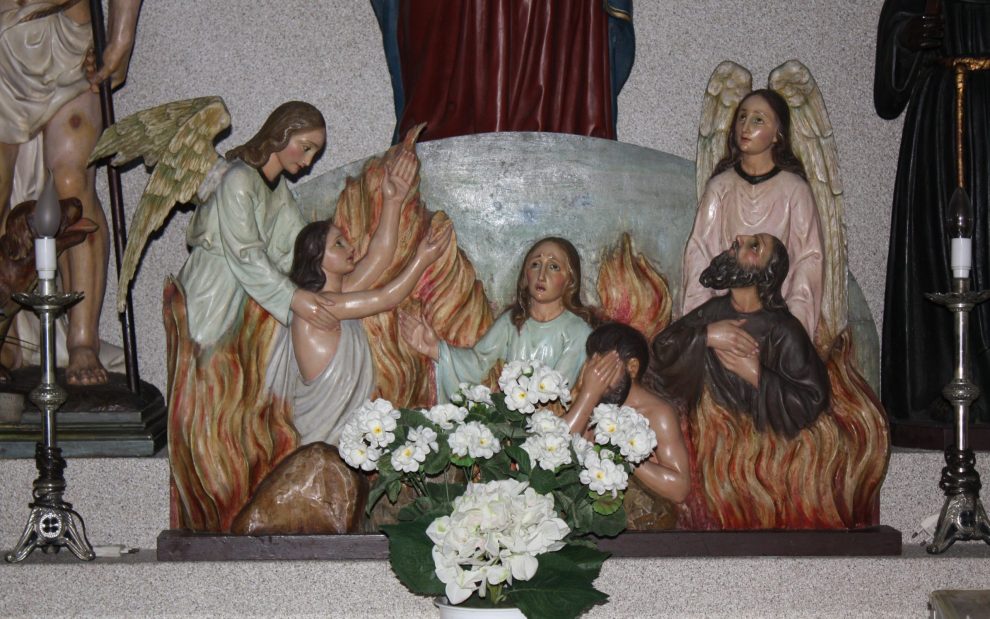
The rich young man who approaches Jesus in Matthew’s gospel already keeps the commandments. He wants to know if he should do more to have eternal life. “If you wish to be perfect,” Jesus says, “go, sell your possessions, and give the money to the poor.” Hearing this, the young man goes away sad. Perfection does seem to be an unreasonable expectation. But this is where the doctrine of purgatory comes in.
The church’s understanding of purgatory has been formulated over centuries, affirmed at councils such as Nicaea II, Florence, and Trent, and reiterated at the Second Vatican Council. In a nutshell, purgatory is a process of purification immediately following death, during which souls are “made perfect” for heavenly glory. In Lumen Gentium (On the Church), the council fathers wrote that “those who have faithfully followed Christ . . . in keeping with the state in life and condition proper to each of us . . . will be able to arrive at perfect union with Christ, that is, perfect holiness.”
We don’t know who first used the term “purgatory,” but the idea that we must be purified from attachment to sin goes back to the earliest writings of the Christian tradition, with roots in Hebrew scripture. We see hints of it in the stories of the Maccabees, who sought to make atonement for the sins of the dead, and in the New Testament, with Paul’s allusions to cleansing fire (1 Cor. 3:11–15). The belief grew throughout the age of martyrs, with injunctions to pray for the dead inscribed on the walls of the catacombs, and in the writings of the Christian fathers.
Purgatory isn’t found in every Christian faith tradition. Orthodox Christians believe in an intermediary state between heaven and hell and in prayer for the dead but reject purgatory as a Roman Catholic concoction. During the Reformation, Protestants challenged Catholic belief in purgatory. Today, many (though not all) Protestants do not believe in it.
The sacraments of baptism, confession, Eucharist, and the anointing of the sick cleanse us of sin. But the effects of sin can remain even after culpability for sin is removed.
Let’s look at baptism. The church believes the first humans committed a sin, the effects of which are passed down to humankind. Baptism removes original sin, infuses the soul with sanctifying grace, and is the occasion of rebirth in Christ. If a person dies immediately after baptism, Catholics believe they go straight to heaven. But life on Earth means facing multiple temptations and likely succumbing to some. Someone who hasn’t been cleansed of sin and attachment to sin in life can be after death. This is why the church urges Christians to pray for the dead.
The church does not describe what exactly purgatory entails but does teach that a soul who enters purgatory is on their way to heaven. Purgatory is not limbo, nor is it a testing ground, and any suffering undergone there is entirely different from hell’s punishments.
Like the rich young man, we may be intimidated by the expectation of perfection, but purgatory means we can fulfil Jesus’ mandate to “be perfect, therefore, as your heavenly Father is perfect” (Matt. 5:48).

This article also appears in the January 2026 issue of U.S. Catholic (Vol. 91, No. 1, page 49). Click here to subscribe to the magazine.
Image: Wikimedia Commons/Lameiro





Add comment