

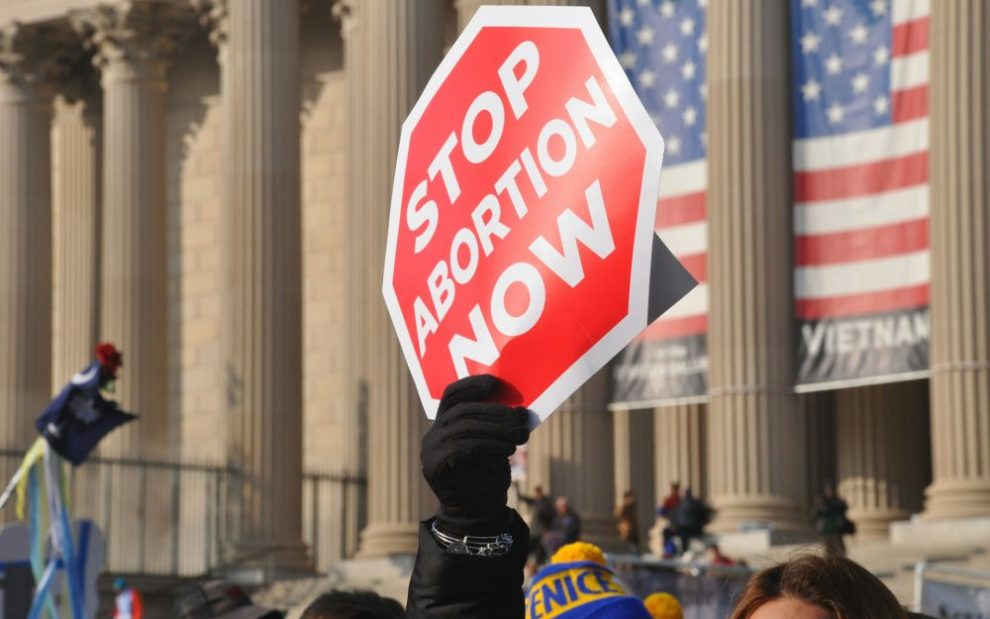
Pope Francis said, “My friends, we cannot tolerate or turn a blind eye to racism and exclusion in any form and yet claim to defend the sacredness of every human life.” I am disheartened that so many Catholics seem to reject this truth, viewing abortion and sexual politics as an integral part of their faith while tolerating overt racism, misogyny, and state-sanctioned violence. Indeed, higher levels of church attendance correlate with support for such worldviews, according to the Public Religion Research Institute. Perhaps the insidious misogyny that often distorts our faith offers an explanation.
Cynthia Miller-Idriss, founding director of the Polarization and Extremism Research & Innovation Lab (PERIL) at American University, identifies misogyny as an “inextricable root of, and an underacknowledged pathway to, violent extremism” and demonstrates its connection to racism and other dehumanizing ideologies. “In the present context, in which hostile sexism and misogyny are frequently mainstreamed and incubated on social media, taking a closer look at where those beliefs come from and how ubiquitous they are can help shed light on the pathways to violence, including when and how society might best be able to interrupt them,” she says. Catholics must commit to rooting out those pathways that the church itself has implemented.
Throughout scripture and our theological tradition, women are blamed for the fall of humanity. Paul, for example, says, “For Adam was formed first, then Eve, and Adam was not deceived, but the woman was deceived and became a transgressor” (1 Tim. 2:13–14). Later, Augustine asserts that Adam only ate the fruit because Eve seduced him, and the serpent only approached her first due to her inferior intellectual capacity. Women are weak and do not understand what is good for them, he suggests, so men are responsible for resisting their wiles and standing strong in truth.
While there have been attempts to rescue the agency of both Adam and Eve from this misogynistic interpretation, the focus on anti-abortion legislation today echoes the same line of thought Paul and Augustine express. When female agency is held ultimately responsible for the preeminent issue of concern in our “culture of death,” the subjugation of so-called sensuous women to so-called intellectual men repeats itself.

Disregarding the fact that bodily integrity is considered an intrinsic good and fundamental human right in Catholic tradition (see Pacem in Terris, On Establishing Universal Peace)—and despite empirical data and women’s stories that show that legal prohibitions on abortion are at best ineffective and at worst mortally dangerous and that there are more effective ways to reduce the occurrence of abortion—Catholics have spent an inordinate amount of resources to empower people who will impose anti-abortion legislation, regardless of their positions on other matters or their imposition of violence toward others.
Seeking to control women’s bodies by overriding their right to bodily integrity for the sake of their fetuses perpetuates the idea that women need to be kept in line and that their bodies are the cause of sin. Here, women appear as scapegoats for the general decline of society (nevermind other harms perpetrated against humanity). In fact, when women have more agency—including recognition of bodily integrity as well as access to necessary services—abortion rates go down.
By asserting the preeminence of the abortion issue and leaning into anti-abortion ideology that refuses to allow for nuance or dialogue, the church has ensured that many of its members would become one-issue voters, neglecting or perpetuating other harms against the poor and vulnerable. I am not saying that the moral stance against abortion is problematic; indeed, all life is precious. However, by focusing on one type of harm while acquiescing to other grave harms, the church has given the impression that those other harms are permissible.
While Catholics who oppose legal prohibitions against abortion are censured, Catholics perpetuating violence, misogyny, and racism are given a pass. Compare the bishops’ treatment of former President Joe Biden and Speaker Emeritus Nancy Pelosi over their positions on abortion’s legality to their relative silence concerning Vice President JD Vance’s proselytizing on behalf of the administration’s violence.
In fact, lauded as a pro-life exemplar by many in the movement, Vance is scheduled to be one of this year’s speakers at the March for Life. This is unconscionable to me, given that this administration is implicated in violence, dehumanization, and disregard for the needs of the poorest and most vulnerable among us. Think of an ICE agent fatally shooting Renee Good, the unacceptable killing of Venezuelans at sea, or the assaults against people presumed to be immigrants based on racial profiling, including children and elderly people. Recall the language of “animals” and “monsters” regularly wielded against immigrants and the objectification of women through the glorification of or dismissiveness toward rape, as in the Young Republican group chat leaked last fall and the cover-up of the Epstein files. Consider the failure of Congress to extend subsidies for health care and their decision to gut SNAP benefits while increasing funding to Immigration and Customs Enforcement. These events are not tangential actions or mere policy differences; they are fundamentally anti-life.
I am grateful for the bishops and clergy who have been vocal advocates for a more consistent ethic of life. Still, I worry decades of a “preeminent” focus on abortion and the sexuality and gender culture wars render recent efforts insufficient.
I am urging Catholics who plan to attend the 2026 March for Life to do so with the intent to bear public witness to the sanctity of all life. Bring signs that express your outrage at the extrajudicial killings and racially motivated assaults against immigrants. Start chants that call on the U.S. government to protect all life, including people who are poor, by reinstating health-care subsidies and SNAP benefits. Churches should consider fact sheets, bulletin inserts, or homilies that reject the superficial understanding of what it means to be pro-life and the harms that understanding has done over the past year.
We cannot continue to allow politicians to use anti-abortion positions to whip up support from the pro-life movement while engaging in acts of cruelty and violence. Being pro-life should mean that we deeply desire every living being to have what they need to thrive and that we try to live in ways that facilitate that outcome. Until the church challenges—emphatically, unequivocally, and unanimously—the misogynistic ideology that is fueling extremism and violence, we will not be able to vivify the culture of life that our world so desperately needs.
Image: Unsplash/Maria Oswalt







Add comment