

Many years ago, I visited the beautiful Belgian city of Bruges.
Wandering along the canals, I came to what is called a beguinage, where women called Beguines once lived and which is now inhabited by Benedictine sisters. It is a collection of quiet buildings around a grassy field, which in the springtime bursts forth with daffodils and stands as a witness to another time.
In Benedictine sister Laura Swan’s wonderful book The Wisdom of the Beguines (BlueBridge), she describes the Beguines as a medieval movement of women from every social class—poor, merchants, artisans, and aristocrats alike—who ranged from women in their teens to those in their elder years. These women were either single or widowed, lived a chaste life in community together, and sought a vibrant spiritual life independent of marriage or the cloister.
I imagined what it must have been like centuries ago, where women gathered who wanted to live in a different way than the two main paths society offered to them. They forged a life in community, lived in simplicity, and immersed themselves in prayer. These women became a witness to a way of being in the world that was vibrant and creative, using their material and spiritual resources on behalf of those who were ill and dying.

There were thousands of Beguines across medieval Europe, and many lived in beguinages, self-sufficient collections of homes or apartments around a central courtyard area and a chapel for prayer. The women developed common rules of life based on restraint: living in a simple way, avoiding displays of wealth, and sharing with others anything that wasn’t essential to their lives. Their ministry was to serve the sick and poor. They pooled resources to buy medicine and trained as healers. They sat in vigil with the dying.
I became enamored with these women, who forged their own path in service to the most vulnerable. I began exploring the names of some of the most significant Beguines through the texts they left behind. One of these women is Mechthild of Magdeburg.
Mechthild lived in the 13th century, and specific biographical information for her is scarce. The only details we know about her come from hints in her work.
Born to a noble family, Mechthild had her first vision of the Holy Spirit at 12 years old. Those visions continued for many years. In 1230, when she was around the age of 23, her society’s growing poverty inspired Mechthild to become a Beguine and go to Magdeburg’s poor neighborhood to take care of society’s outcasts and abandoned. She lived there for almost 40 years. She seems to have been in a position of authority within a Beguine community, serving as magistra or leader.
While in Magdeburg, Mechthild became acquainted with the Dominicans, reading many Dominican writers, and becoming a Dominican tertiary or third-order member. It was her Dominican confessor, Henry of Halle, who encouraged and helped Mechthild to compose the seven books of The Flowing Light of Divinity, which she wrote between the years 1250 and 1280.
Her work contains beautiful poetry, prose, monologue, and dialogue—visions, letters, parables, reflections, allegories, prayers, criticism, and advice—and refers to her understanding of the divine presence that is always in movement toward loving relationship with human beings.
She trusted that the “great flood of divine love never ceases. . . . It flows on and on effortlessly and sweetly and without failing until, finally, our tiny vessel becomes full and spills over.” The flow of divine love never falters or recedes. When we are ready to receive, our own vessel overflows. There is never a lack.
It is this image especially that helped me to fall in love with Mechthild’s spirituality. She offers me a poetic vision like a love letter across 800 years, encouraging me to trust in this abundant, divine flow even when life feels dry or challenging. I often pray with these images and let my heart be refreshed by them.
The Beguines lived and served in the physical realm while the spiritual realm energized them and gave them purpose. Swan writes, “Beguines were believed to straddle the border between life and death in a powerful way and so could help the dying in their final days, easing their path to heaven. Attending to the dying and the dead was a ministry rooted in the Beguines’ compassion and love for others.”
Along with Mechthild, the Beguines were threshold dwellers who offered a powerful ministry of presence. Their ministry was motivated and nourished by their spiritual commitment and practice. Their profound experience of the divine presence within compelled them to serve those on the margins around them. I often imagine how Mechthild’s experiences alongside those who were dying helped her to see the abundance of divine love at work. Seeking to embody this love, she became the hands and heart of Christ at work and calls me to do the same.
Mechthild is also known for her effusive and evocative poetry. She experienced God in the sensual delights of the world and nature and helps me to celebrate my senses as vessels for coming to know the divine presence more intimately.
Her writing didn’t just address the easeful, pleasant experiences of life, however. As she experienced much physical suffering, she also wrote about “Lady Pain.” Mechthild helps me to hold the joy and beauty of this world alongside my own ongoing struggles with chronic autoimmune illness.
Mechthild reminds us that Lady Pain will be our companion throughout this life; she is part of our human inheritance. Even God entered that pain with us and promises to carry us through it. Conscious suffering can be generative. It can cultivate in us a profound compassion for those on life’s edges. It calls us to listen for the whispers of the holy in all we do and bring what we hear to birth.
As Mechthild got older, she became blind, and in 1272, around the age of 65, she joined the Cistercian nunnery at Helfta, which offered her protection from persecution and support in the final years of her life. It was here where she finished writing down the many divine revelations she experienced. It is unclear whether she formally joined the Cistercian community or whether she simply lived there, participating in prayer services without taking monastic vows.
Through her witness, Mechthild shows us how to allow the flow of the divine to move freely through us and all we do, even in the midst of pain and suffering. And her Beguine community offers a model of how love of God can deepen our commitment to the vulnerable, and how humble service can be a healing gift to a suffering world.
This article also appears in the January 2026 issue of U.S. Catholic (Vol. 91, No. 1, pages 45-46). Click here to subscribe to the magazine.
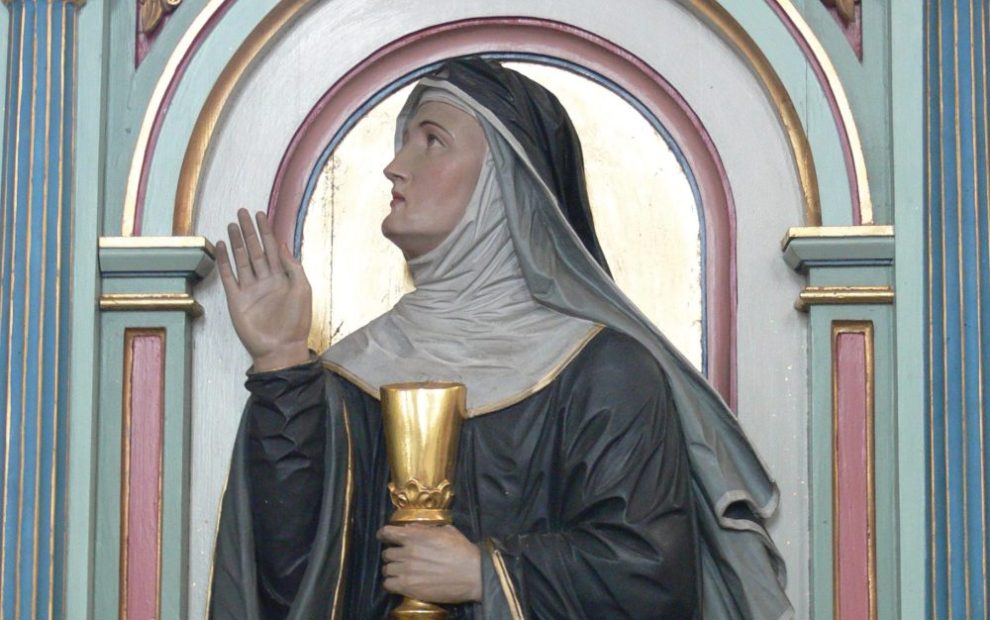
Image: Peter Paul Metz, Mechthild of Magdeburg, 1896, St. Gordian und Epimachus church, Leutkirch im Allgäu, Germany, Photo by Andreas Praefcke/CC-BY-SA-3.0






Add comment