

He said to them, “Come away to a deserted place all by yourselves and rest a while.”
Mark 6:31
I’d heard the phrase “silence is golden” all my life. But I can’t say I really understood it until one stressful day when my daughters were young. Money was tight, my husband was working long hours, and I was neck-deep in the care of young children.
As I remember it, the girls and I were out running errands, and we found ourselves in the church parking lot. I hadn’t planned to go there; it’s just where we ended up. I unbuckled the girls from their car seats and grabbed something to keep them busy—probably a few notepads and a handful of crayons. I was relieved to find the church unlocked. We went inside.
It wasn’t the most beautiful church you ever saw. It was dark and plain and, on that day, cold. But those things didn’t matter. It was the quiet I was looking for. I’m not sure I even realized that until I got inside—got the girls settled, pulled down a kneeler and experienced something I’m not sure I’ve ever experienced before or since: pure silence.

It only lasted for a few moments before a toddler sneezed. But those few moments of silence were gold. Something restorative washed over me—like a sunset that sinks deep into your soul, sunlight shimmering through trees, or the loving gaze of a friend. I was surprised by the power silence had to heal me.
As a prolific healer, there’s no doubt Jesus of Nazareth knew this healing power of silence very well. And yet it isn’t easy to find silence in the pages of the gospels. In fact, the fast-paced, jam-packed daily gospel readings leading up to Lent attest to the fact that, by all accounts, Jesus’ day-to-day ministry was quite noisy.
While I may have found toddler chatter a challenge, Jesus’ days were filled with the sounds of entire crowds of people. Crowds gathered around Jesus while he taught and healed (Mark 2:13). They followed him from place to place (5:24). They were waiting for him when he set foot or moored a boat in a new region (5:21). Sometimes numbers tell the story best—the word crowd appears in Mark’s relatively short gospel a whopping 36 times.
The gospels include astonishing summary statements indicating that Jesus willingly immersed himself in these noisy, jostling throngs, healing entire crowds of people in one sitting or in a single evening (Matt. 15:30; Luke 4:40). His healing ministry simply pulsed with sound and activity. And yet it is in the heart of these gospel stories that we find silence—if we really listen.

In some accounts we see Jesus actively seeking silence as an intentional part of the healing process. Whether he simply desired silence or actually needed it to heal, we can’t be sure. But we know he was deliberate about creating it.
In several of these stories, Jesus creates silence by physically removing someone from crowds and noise. When a crowd brings Jesus a man who is deaf and has difficulty speaking, Mark writes that Jesus “took him aside in private, away from the crowd” (7:33). Immediately after the healing, Jesus asks for more silence (“Jesus ordered them to tell no one”), but the crowd does not comply (“the more he ordered them, the more zealously they proclaimed it”).
The irony of this disobedience only reinforces why Jesus sometimes leaves the crowds behind: Because they talk too much. Later, when a man who is blind is brought to Jesus, Mark tells us that Jesus “took the blind man by the hand and led him out of the village” (8:23).
Both of these quiet, secluded healings require extra effort from Jesus. When Jesus heals the man who is deaf, he touches, spits, prays, and sighs. When he heals the man who is blind, it takes two tries. Perhaps Jesus instinctively knew that in these particularly difficult cases, silence was needed.
As we read these stories, we can think of Jesus the healer as a master craftsman selecting just the right tools for the job at hand. Sometimes he used words or the touch of his hand. Sometimes he mixed spit with dirt to create a healing poultice. And sometimes he used silence. Such is the case in another healing story—the colorful (and noisy) account of Jesus raising Jairus’ daughter from the dead. A synagogue official named Jairus approaches Jesus, who is, as usual, surrounded by a great crowd (Mark 5:21). Jairus tells Jesus that his daughter is about to die and begs Jesus to come and heal her. As is Jesus’ way, he readily agrees to go.
Jesus and Jairus are soon intercepted by messengers. “Your daughter is dead,” they tell Jairus. Jesus will hear none of this noise, and they continue on their way. When they arrive at Jairus’ home, they encounter more noise: a “commotion, people weeping and wailing loudly.” Matthew’s version of the story even includes flute players. When Jesus declares that the girl is “not dead but sleeping,” he is met with another jarring sound: laughter.
What is Jesus’ response to all this noise? Like a parent with a house full of noisy kids, he sends them all outside. He then takes only the girl’s parents and his own inner circle and enters the girl’s room. This is the moment to take a sacred pause and listen. In a world full of noise, Jesus has created silence. On one hand, this silence is heartbreaking, for there is no sound from this child who should be talking and laughing—or at least breathing. But on the other hand, it is profound and holy. It will bear the fruit of healing and new life, for after breathing in this long, golden silence, Jesus takes the girl’s hand and restores her to her parents alive.
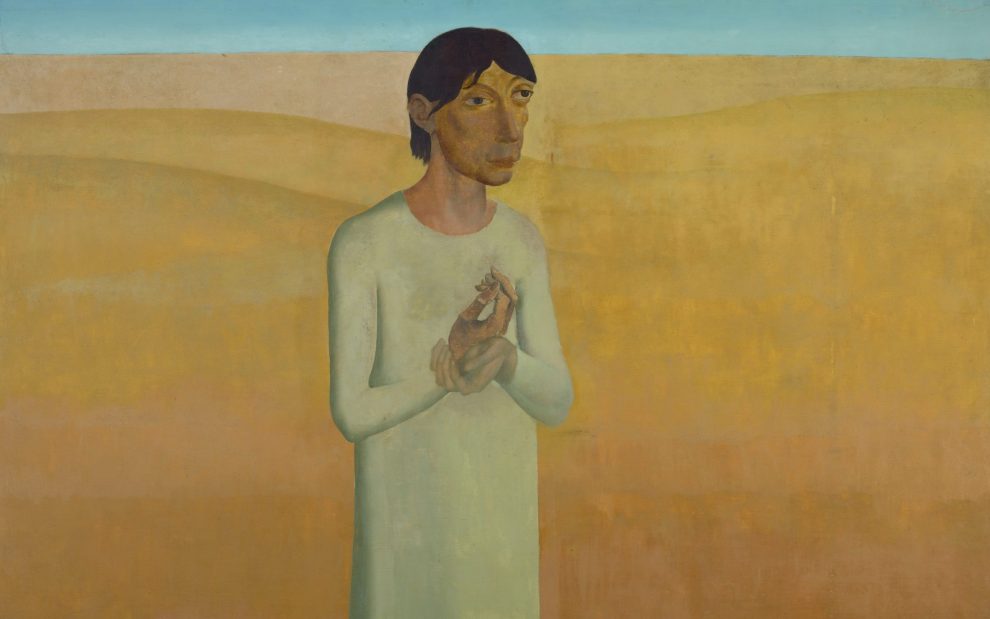
While we have to read and listen carefully for these pools of silence in Jesus’ public ministry, the gospels are a bit more explicit about silence in Jesus’ personal life. Given his radical availability to individuals and crowds, it’s no surprise that sometimes Jesus needed to get away from it all for the sake of his own healing and restoration. Early in Mark’s gospel we’re told of times when Jesus retreated to deserted places and countrysides (1:35, 45). Later, when his ministry was in full swing and his disciples had also experienced the demands of mission, he invited them to “come away to a deserted place” by themselves to “rest a while” (6:31).
Imagining these quiet scenes is a worthwhile prayer exercise for us, especially if we are new to the practice of silence. First, imagine the reality of Jesus’ daily ministry—saturated with crowds, activity, needs, and noise. We can relate to these busy, noisy days. Then imagine Jesus in a deserted place or out in the country, surrounded only by the sounds of night and day—the wind in the trees, a crackling fire, rainfall, birdcall. Imagine Jesus sitting quietly—resting, thinking, and just being. Imagine the restoration of his mind, body, and heart in these quiet times, immersed only in the gentle sounds of the natural world.
Jesus knew why silence—even in small pools or fleeting moments—is golden. Silence calms us. It lowers our blood pressure and increases our focus. It allows us to hear the voice within rather than the sounds without. The mind and heart are activated and refreshed. In a world full of needs and noise, silence heals.
This article also appears in the February 2026 issue of U.S. Catholic (Vol. 91, No. 2, pages 47-49). Click here to subscribe to the magazine.
Image: Gustave Van de Woestyne, Christ in the Desert, 1939, oil on hardboard, 48 in X 66.5 in, Museum of Fine Arts Ghent







Add comment